
When Resistance Means Death: Sofie Scholl 1921–1943
Resisting Nazi Germany
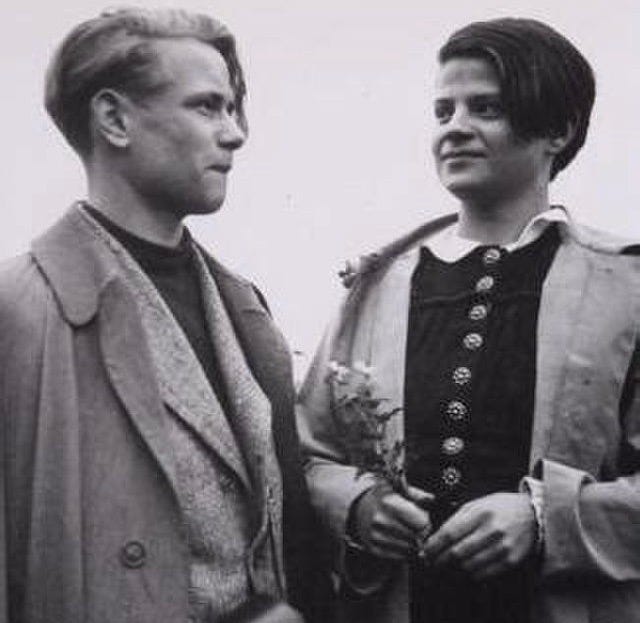
Her bust now stands in Valhalla, the hall of Great Germans, one of the very few women selected for this honor.
Another bust lives in the White Rose Atrium at the University of Munich, where she and her brother Hans were arrested in 1943.
“Learn from us,” it pleads. “Don’t allow the same thing to happen in your nation, neighborhood, city and state.” The leaflets preserved in bronze on the ground in front: “Wake up. Resist. Sabotage!”
Sofie Scholl’s words ring out still, a grim reminder of what can happen in times of totalitarianism and fascism when one is brave enough to speak out.
But also a reminder of what one or a few voices speaking out could do and what more could have done, had they joined in.
Sofie and the group of college students at University of Munich who called themselves “The White Rose” urge us to stand up and resist racism, sexism, fascism, anti-Semitism, warn of what could happen if we do not.
Resisting Nazi Germany
A young woman in Nazi Germany ripped apart within by the horrors her government and nation were perpetrating onto other humans, Sofie Scholl took the most dangerous risk of speaking her mind and having her voice when she knew it would mean her life if caught.
She chose to join the group of young college students called “The White Rose” in Munich in the heart of Nazi Germany at the peak of WWII; an attempt to wake up her peers and change the tide of events, so horrendous and annihilating, being carried out in their name.
“Rip off the cloak of indifference you have placed on your hearts. Decide — before it is too late!” Leaflet 5
Born in 1921, Sofie grew up in the city of Ulm, Germany. Her father was outspoken against the Nazi regime from the beginning. In spite of this, his children chose to participate in the Nazi youth movements — creating tension in the family. It took them a while, but, slowly they all came to agree with their father. Sofie and her brother Hans grew more and more radicalized as the war continued.
Hans was already at University of Munich when Sofie arrived to attend. He had already begun the movement to take action against the Nazis rather than just hold in his anger and disgust quietly.
The White Rose had made the initial plans for their work, which included releasing leaflets protesting the war and asking the general population to wake up and resist.
The Leaflets of the White Rose
“The ‘LEAFLETS OF THE WHITE ROSE’ began to appear in Munich in mid-June 1942. Four of them came out, one after another, like a staccato burst of fire — filled with rage, brimstone, and literary citations. And as quickly as they came, they were gone.
The city had seen nothing like it in years; perhaps only in the early months after Hitler’s takeover had such lengthy and passionate anti-Nazi tracts been circulated. The leaflets were typed single-spaced on both sides of a sheet of paper, duplicated, folded into envelopes with neatly typed names and addresses, and mailed as printed matter to people all over the city”(Dumbach 56).
When Sofie arrived the first leaflet was already released. She found out her brother had written it after discovering a book in his apartment with the same passages highlighted that were in the leaflet.
She joined the group immediately.
“Isn’t it mysterious — and frightening, too, when one doesn’t know the reason — that everything should be so beautiful in spite of the terrible things that are happening? My sheer delight in all things beautiful has been invaded by a great unknown, an inkling of the creator whom his creatures glorify with their beauty — That’s why man alone can be ugly, because he has the free will to disassociate himself from this song of praise”(HWR 276). Sofie Scholl in a letter 1942
They typed the leaflets up secretly at night trying not to make a lot of noise. They acquired printing machines and copied them by hand on these machines one at a time, staying up all night. They put the leaflets into suitcases and got on trains with the loaded suitcases, transporting them to other cities all over Germany in order to have them postmarked from various locations.
They risked checkpoints and identity checks to do this, in order to speak to all Germans, “this is not who we are. Wake up! Resist! Sabotage! Do anything to stop this terrible regime.”
They ended each leaflet asking the recipient to make copies of it and distribute it further. The White Rose distributed 5 leaflets. The 6th was never distributed. They were caught while it was being written.
They began to paint graffiti, “Down with Hitler,” and white swastikas crossed out with red on campus buildings and walls. The student body became disruptive and agitated.
They felt they were being heard, making a difference.
Capture and Death
They were being sought after, hunted down. Threats to their lives were publicly made by the regime who asked for their peers to turn them in. Yet they persisted.
Until . . .
On February 18, 1943, Sofie and her brother Hans were arrested while scattering leaflets from a balcony in a University building with high vaulted ceilings onto the gallery below.
They were, tried, found guilty and beheaded in one day.
Later, many of the others of The White Rose were caught, tried and murdered. When word of their murders got out to the larger world, the allies reprinted tens of thousands of their leaflets and dropped them from allied planes over Germany.
In honor of. In tribute to. A brave attempt to resist.
“Once upon a time — I’m reminded of this by your reference to the innocent suffering of the trees — I occasionally use to wish I was just a tree, or better still, just a fragment of bark from a tree. I entertained such whims very early on, but nowadays I take care to stifle them and resist the kind of fatigue that seeks fulfillment in nonexistence. It isn’t because I’ve conquered the feeling, far from it, but I’m often, almost constantly, overwhelmed by a feeling of melancholy of which I am becoming almost fond. Do you know what I mean? It’s dangerous and even sinful to cherish one’s own agony of mind”(HWR 301). Sofie Scholl in a letter to her sister, February 2, 1943
Thank you, Sofie Scholl.
©Theresa C. Dintino
Works Cited
Dumbach, Annette and Jud Newborn, Sophie Scholl and the White Rose. One World Publications: Oxford, 1986.
Jens, Inge, ed. At the Heart of the White Rose: Letters and Diaries of Hans and Sophie Scholl. Plough Publishing House: New York, 2017.