avatarTheresa C. Dintino

Free AI web copilot to create summaries, insights and extended knowledge, download it at here

3811

Abstract

esa-c-dintino/">Paula Modersohn-Becker’s</a> painting and her impact on Modern Art. I knew that Worpswede was outside of Bremen, and yet did not know until I was actually in Bremen a few years ago that there was a whole museum dedicated to Modersohn-Becker.</p><p id="2e4c">“The first European Museum dedicated solely to the art of a woman.” In fact the museum brochure goes so far as to state: “The <a href="https://www.museen-boettcherstrasse.de/english/">Paula Modersohn-Becker Museum </a>was the first museum in the world to be dedicated to the work of a female painter.”</p><p id="1709">There, I was able to stand before her paintings and feel their power for myself. Then it was that her world opened up to me and I began to learn more about this singular woman and all that she was able to accomplish and change for women for all time.</p><blockquote id="b20f"><p>“Modersohn-Becker had a ten-year painting career, during which she executed more than seven hundred paintings, pushed limits, experimented with technique, and revolutionized female body imagery. She also produced hundreds of drawings and a dozen etchings”(Radycki 94).</p></blockquote><h2 id="f3a6">Paula Modersohn-Becker’s Ambition</h2><p id="047a"><a href="https://www.nastywomenwriters.com/ich-bin-ich-i-am-me-paula-modersohn-becker-the-self-portraits/">Paula Modersohn-Becker</a> set out to do what she did. And she succeeded. We should know that and understand that and we should know her name and her art.</p><p id="82ef">I want to know about the woman who wrote this:</p><blockquote id="1c28"><p><a href="https://www.azquotes.com/author/28584-Paula_Modersohn_Becker">“I love color. It must submit to me. And I love art. I kneel before it, and it must become mine. Everything around me glows with passion. Every day reveals a new red flower, glowing, scarlet red. Everyone around me carries them. Some wear them quietly hidden in their hearts. And they are like poppies just opening, of which one can see only here and there a hint of red petal peeking out from the green bud.”</a></p></blockquote><p id="bfe3">She studied in Berlin, at The School of the Association of Women Artists, (1896–1898), she studied in Paris, at the Académie Colarossi, Ecole des Beaux-Arts, and when she was back in Bremen, she studied at <a href="http://www.worpswede-museen.de/en/kolonie-kuenstler/colony-and-artists.html">Worpswede</a>. Anything to keep on studying and doing her art. Becker even married the painter Otto Modersohn so that she could keep on painting as the deadline her father had set for her to remain single and still receive his support had passed.</p><blockquote id="32a0"><p><a href="https://www.azquotes.com/author/28584-Paula_Modersohn_Becker">“Lack of money rivets us to the ground,” she wrote. “One’s wings are clipped.”</a></p></blockquote><p id="3ce2">Her letters and journals document her struggles with her work, her aspirations:</p><blockquote id="5994"><p>“I feel an inner relationship from the antique, mainly the early antique, to the Gothic, and from the Gothic to my sense of form”(Radycki 199).</p></blockquote><p id="b7cc">And her understanding that she was actually accomplishing what she wanted to. Modersohn-Becker to her sister Milly, May 1906:</p><blockquote id="d696"><p>“I am becoming something — I am living the most intensely happy period of my life. Pray for me”(Radycki 135).</p></blockquote><p id="a383">This was not just some woman who stumbled upon her fame or was discovered after she died <i>because</i> of her tragic death. This was a woman intentionally setting out to do all the things she did and writing about her disappointments and challenges as well as her intense passion to keep pursuing. She took in the current artists of the day, sat in the Louvre and studied the “masters.”</p><blockquo

Options

te id="0fd6"><p>“I am even, I believe, developing a connection with the sun. Not with the sun that divides up everything and puts in shadows everywhere and plucks apart the image into a thousand pieces, rather with the sun that broods and makes things gray and heavy and combines them all in this gray heaviness, so that they become one”(Radycki 96).</p></blockquote><p id="f251">She worked non-stop and was committed to painting things as she saw them, not as she was told to paint.</p><blockquote id="31e1"><p><a href="https://www.azquotes.com/author/28584-Paula_Modersohn_Becker">“How happy I would be if I could give figurative expression to the unconscious feeling that often murmurs so softly and sweetly within me.”</a></p></blockquote><div id="6641" class="link-block"> <a href="https://readmedium.com/fierce-mothering-53f518859811"> <div> <div> <h2>Fierce Mothering</h2> <div><h3>Parenting tips from the Leopard</h3></div> <div><p>medium.com</p></div> </div> <div> <div style="background-image: url(https://miro.readmedium.com/v2/resize:fit:320/1*gFHrfowEhOjaL763Lkxmbg.jpeg)"></div> </div> </div> </a> </div><h2 id="6a96">The First Nude Self-Portrait by a Woman Artist</h2><p id="fd42">She fought for her vision, to capture “the gentle vibration in things,” and took risks that are hard for us to see or imagine today. Being the first woman to paint herself nude was a huge break with tradition and daring subject to attempt. It is not that she did now know this. She knew when she stood in front of her mirror and painted herself that she was doing just that. And that needs to be appreciated and celebrated.</p><blockquote id="7bc7"><p>“Modersohn-Becker shifted paradigms that, over the course of the twentieth century, continued to change with the person and the practice of the woman artist. From Frida Kahlo to Cindy Sherman and beyond, the legacy of Modersohn-Becker stretches through all those whose representation of women have challenged art”(Radycki 158).</p></blockquote><p id="e38c">Paula Becker painted the female body, her own and other women from the point of view of a woman. And this was groundbreaking and new.</p><blockquote id="f851"><p>“There is no male precedent for what she was doing, nor could there be. She painted the female body from within its immanent life, a radical spectacle of skin and pubic hair. In her work the erotic body no more wars with a maternal body than culture disconnects from nature. Any comparison for her paintings comes not from art’s history of the female nude, but from the future twentieth-century body imagery.</p></blockquote><blockquote id="e2e8"><p>Baby, baby, not only could she do it, she did it first”(Radycki 180).</p></blockquote><p id="98a6">We must take a moment to understand this: <b><i>It had never been done before.</i></b></p><p id="c073">Can you imagine? In 1900 this had not been done? And she knew it and she did it over and over and over again.</p><p id="3202">She was also the first woman to paint herself pregnant. Do you hear this long lists of firsts?</p><p id="1680">That is Paula Modersohn-Becker. Learn her name. <i>Google</i> her work and if you are ever in Bremen, Germany, go to her museum.</p><p id="c8b4">©Theresa C. Dintino</p><p id="f0ca"><b>Works Cited </b> Colapinto, John. <a href="http://www.newyorker.com/books/page-turner/paula-modersohn-becker-modern-paintings-missing-piece">“Paula Modersohn-Becker: Modern Painting’s Missing Piece,” <i>The New Yorker</i>, October 29, 2013.</a></p><p id="55a8">Radycki, Diane. <i>Paula Modersohn-Becker, The First Modern Woman Artist,</i>(New Haven: Yale University Press, 2013).</p></article></body>

The First Female Artist to Paint Herself Nude

Paula Modersohn-Becker’s Legacy
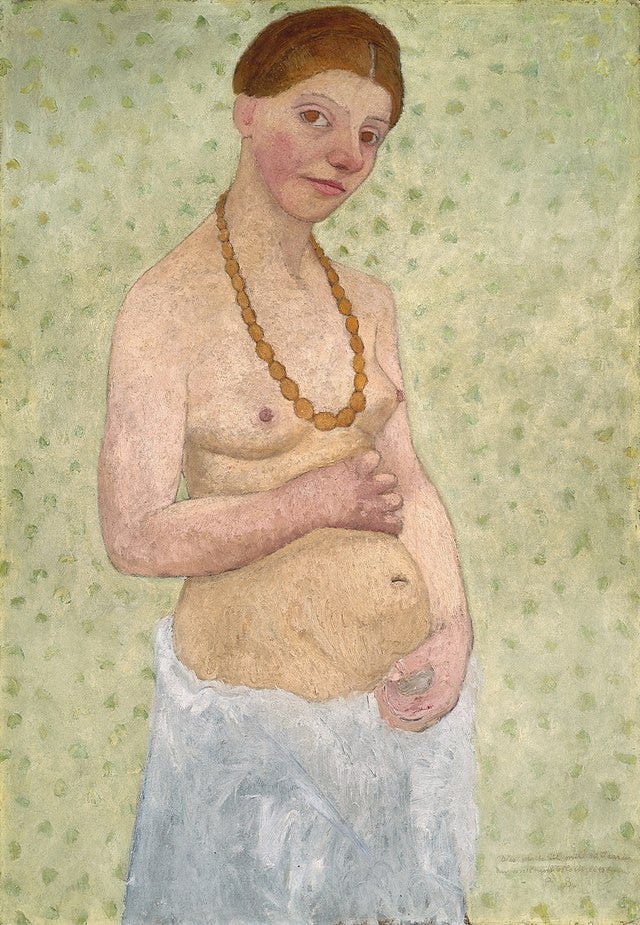
Paula Modersohn-Becker, Self-Portrait on 6th Wedding Anniversary, 1906, public domain via wikimedia commons

Another Powerful Woman Artist Forgotten

What if there were a woman born in the late 1800s with the ambition to paint a way no woman had ever painted before, to paint women in a way women had never been painted before, to bring the female sensibility and perspective to art in a way it had not been seen before?

What if that woman had a lot of ambition and fought her position, status and the misogyny and sexism of the day and actually succeeded in doing everything she had set out to do?

If there were such a woman and she did accomplish all that, wouldn’t we have all heard of her and know her as much as we know Cézanne, Van Gogh, Picasso and Gauguin?

The answer is no. Because that woman did exist, did have all those ambitions and did succeed in accomplishing them, but most of us have never heard about her.

If we have heard about her, it is in the context of her being a friend of the famous poet Rainer Maria Rilke, or through the poetry of Adrienne Rich, but not for her accomplishments in art.

We also may not know that she was the first woman to paint herself nude and the first European woman to have a museum dedicated solely to her art.

Her name is Paula Modersohn-Becker. She was a German woman, artist and feminist:

“With her bold experiments in subject matter, color, modeling, and brushwork, Modersohn-Becker was among the painters, along with Picasso and Matisse, who created modernism in the first years of the twentieth century.”

Paula Modersohn-Becker’s Groundbreaking Work

I first heard about Paula Modersohn-Becker (1876–1907) in the poem “Paula Becker to Clara Westhoff” by Adrienne Rich.

Rich’s poem captivated and moved me. I read it over and over and felt how much it expressed the situation of so many female artists through time. Their lost voices.

I was intrigued by the artist colony in Worpswede, Germany where Becker met Rainer Maria Rilke and Clara Westhoff, her best friend. How she and Clara worked together side by side both possessing ambition, dreams and drive: Westhoff ending up slaving in Rodin’s studio in Paris, Modersohn-Becker ending up dead three weeks after giving birth at age 31, Rilke going on to write one of his most famous poems about Becker, her art, her drive, their friendship and her death.

But I knew little about the story of Paula Modersohn-Becker’s painting and her impact on Modern Art. I knew that Worpswede was outside of Bremen, and yet did not know until I was actually in Bremen a few years ago that there was a whole museum dedicated to Modersohn-Becker.

“The first European Museum dedicated solely to the art of a woman.” In fact the museum brochure goes so far as to state: “The Paula Modersohn-Becker Museum was the first museum in the world to be dedicated to the work of a female painter.”

There, I was able to stand before her paintings and feel their power for myself. Then it was that her world opened up to me and I began to learn more about this singular woman and all that she was able to accomplish and change for women for all time.

“Modersohn-Becker had a ten-year painting career, during which she executed more than seven hundred paintings, pushed limits, experimented with technique, and revolutionized female body imagery. She also produced hundreds of drawings and a dozen etchings”(Radycki 94).

Paula Modersohn-Becker’s Ambition

Paula Modersohn-Becker set out to do what she did. And she succeeded. We should know that and understand that and we should know her name and her art.

I want to know about the woman who wrote this:

“I love color. It must submit to me. And I love art. I kneel before it, and it must become mine. Everything around me glows with passion. Every day reveals a new red flower, glowing, scarlet red. Everyone around me carries them. Some wear them quietly hidden in their hearts. And they are like poppies just opening, of which one can see only here and there a hint of red petal peeking out from the green bud.”

She studied in Berlin, at The School of the Association of Women Artists, (1896–1898), she studied in Paris, at the Académie Colarossi, Ecole des Beaux-Arts, and when she was back in Bremen, she studied at Worpswede. Anything to keep on studying and doing her art. Becker even married the painter Otto Modersohn so that she could keep on painting as the deadline her father had set for her to remain single and still receive his support had passed.

“Lack of money rivets us to the ground,” she wrote. “One’s wings are clipped.”

Her letters and journals document her struggles with her work, her aspirations:

“I feel an inner relationship from the antique, mainly the early antique, to the Gothic, and from the Gothic to my sense of form”(Radycki 199).

And her understanding that she was actually accomplishing what she wanted to. Modersohn-Becker to her sister Milly, May 1906:

“I am becoming something — I am living the most intensely happy period of my life. Pray for me”(Radycki 135).

This was not just some woman who stumbled upon her fame or was discovered after she died because of her tragic death. This was a woman intentionally setting out to do all the things she did and writing about her disappointments and challenges as well as her intense passion to keep pursuing. She took in the current artists of the day, sat in the Louvre and studied the “masters.”

“I am even, I believe, developing a connection with the sun. Not with the sun that divides up everything and puts in shadows everywhere and plucks apart the image into a thousand pieces, rather with the sun that broods and makes things gray and heavy and combines them all in this gray heaviness, so that they become one”(Radycki 96).

She worked non-stop and was committed to painting things as she saw them, not as she was told to paint.

“How happy I would be if I could give figurative expression to the unconscious feeling that often murmurs so softly and sweetly within me.”

The First Nude Self-Portrait by a Woman Artist

She fought for her vision, to capture “the gentle vibration in things,” and took risks that are hard for us to see or imagine today. Being the first woman to paint herself nude was a huge break with tradition and daring subject to attempt. It is not that she did now know this. She knew when she stood in front of her mirror and painted herself that she was doing just that. And that needs to be appreciated and celebrated.

“Modersohn-Becker shifted paradigms that, over the course of the twentieth century, continued to change with the person and the practice of the woman artist. From Frida Kahlo to Cindy Sherman and beyond, the legacy of Modersohn-Becker stretches through all those whose representation of women have challenged art”(Radycki 158).

Paula Becker painted the female body, her own and other women from the point of view of a woman. And this was groundbreaking and new.

“There is no male precedent for what she was doing, nor could there be. She painted the female body from within its immanent life, a radical spectacle of skin and pubic hair. In her work the erotic body no more wars with a maternal body than culture disconnects from nature. Any comparison for her paintings comes not from art’s history of the female nude, but from the future twentieth-century body imagery.

Baby, baby, not only could she do it, she did it first”(Radycki 180).

We must take a moment to understand this: It had never been done before.

Can you imagine? In 1900 this had not been done? And she knew it and she did it over and over and over again.

She was also the first woman to paint herself pregnant. Do you hear this long lists of firsts?

That is Paula Modersohn-Becker. Learn her name. Google her work and if you are ever in Bremen, Germany, go to her museum.

©Theresa C. Dintino

Works Cited Colapinto, John. “Paula Modersohn-Becker: Modern Painting’s Missing Piece,” The New Yorker, October 29, 2013.

Radycki, Diane. Paula Modersohn-Becker, The First Modern Woman Artist,(New Haven: Yale University Press, 2013).

Women
Society
Culture
Feminism
Artist
Recommended from ReadMedium