
Radioactivity Was Discovered By A Woman
Her name was Marie Curie
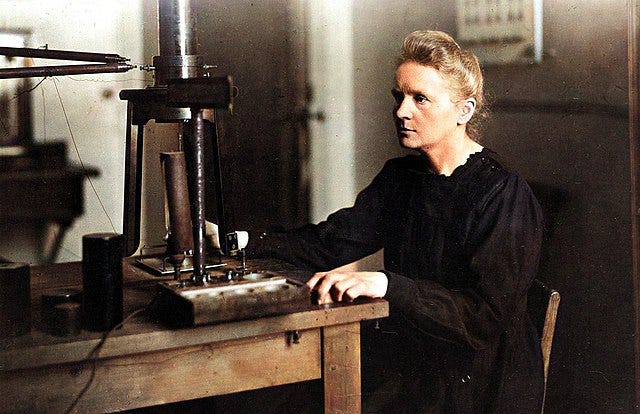
Before Marie Curie, (1867–1934) no one had uttered the words radioactive or radioactivity.
She was a woman in science at a time when women were not in science, breaking glass ceilings one after another.
In 1898 Marie Curie presented a paper detailing her research which “contained two revolutionary observations: the assertion that radioactivity could be measured thus providing a means to discover new elements, and that radioactivity was ‘an atomic property’”(77).
Though she perceived and proved the existence of this mysterious quality, she did not understand where the radioactivity came from. The general belief was that the atom was indivisible.
The birth of atomic science
For a while after the discovery of electrons, scientists of her time believed it was the electrons generating the mysterious rays. The understanding that radioactivity is a product of the breakdown of the atom’s nucleus wouldn’t be introduced until later.
Though Marie suspected for a while the radioactivity was generated by the disintegration of the atom, she cannot claim that discovery for her own. A man named Ernest Rutherford would finally be able to prove that in 1911. But it took Marie Curie’s research to detect this mysterious quality called radioactivity, then isolate the elements that were producing it, which led to the eventual understanding of nuclear physics that we have today.
Atomic science has changed our lives; it brought about the tech revolution we are currently living. At the beginning of the 20th century, the discovery that atoms are indeed made of components catapulted us into a new era that most of us still don’t appreciate. Marie Curie was at the forefront of this. She could see the future coming; she could feel she was at the edge of it and it was this that kept pulling her forward.
Discovery of Radium
In the laboratory that was aglow with what Marie referred to as “fairy light,” she worked with her husband and partner, Pierre, to isolate the elements she had theorized, sifting through pile after pile of the mineral pitchblende. The pitchblende had the uranium removed from it, so it was less expensive for them to acquire. They processed tons of this “waste product” to extract the tiny quantities of radium left in it to acquire samples of the radium for their continued work.
I include the above quote to make sure it is clear that the work was physically strenuous and that it was Marie’s persistent dedication and devotion to her work that made it possible. Above all, Marie Curie’s “greatest achievement was in employing an entirely new method to discover elements by measuring their radioactivity”(88).
Marie was able to make very detailed and precise measurements. She was meticulous in her work both with the measuring as well as the theorizing.
Marie Curie’s rigorous scientific process
Marie Curie had a genius and visionary mind and was able to communicate it to others so that they may understand and apply it to their own work. She placed a high value on the good that science could bring and on sharing openly discoveries that could lead to humanitarian advances.
Along with all of her discoveries, Marie Curie created protocols and developed standards and research techniques to improve the scientific method. She also built laboratories and factories to subsidize and support her own research. She published detailed books and papers about her discoveries and theories. This was a very ambitious and hard-working woman.
Her consistent scientific inquiry is what allows you to sit at your computer today.
“A great discovery does not issue from a scientists’s brain ready made, like Minerva springing fully armed from Jupiter’s head, it is the fruit of an accumulation of preliminary work.” ~ Marie Curie
She also developed the use of x-rays and began the branch of radiation therapy still used in health care. She helped with the war effort in WWI by driving around portable x-ray machines called “little Curies” to the front lines with her daughter, Irene.
To love a deadly substance
In the beginning, Marie and Pierre did not know the dangers of radioactive material but they were eventually warned that it may not be healthy. Though they were both continually ill, they chose to ignore this.
Marie Curie was in love with her work and the isotopes that she isolated. She carried glass tubes of radium bromide in her pockets. This image has always remained with me. She carried them around in tubes in her pocket like a child carries her “lovies” or a superstitious person carries their charms.
I was a person who had “lovies.” I felt I wanted them with me always. Small dolls or stuffed animals, even a rabbit’s foot for a time. They were imbued with magic. I felt safe and happy having them with me. Marie Curie felt this way about the elements she had discovered and continued to analyze and probe for their mysteries.
I am interested in this idea of being in love with work that can or is possibly killing you. Being that devoted. There is a certain kind of human life that requires that. I don’t believe it is as simple as denial or martyring oneself. I think there is more to this phenomenon.
I think it is more about living out the contradiction that is life as a mortal. In some cases, it is blatant and obvious. Most of the time it is more subtle. For instance, I am still driving a car (hybrid) and consuming plastic and other products even though I know I am participating in killing the planet. It’s not that I don’t care or that I don’t know, I just cannot find a way to truly live my life without participating in this reality. I know I could go off-grid but honestly, I can’t and don’t want to live that kind of life. I am living with that contradiction every day.
I am a member of a country that commits atrocities across the globe. I know that and yet I live as a continued member of it without railing against it every day. I don’t want to move and also don’t want my whole life to be about that battle. I make choices and live with the contradiction. We all do.
But for some people, it’s not subtle. Their lives are all about this, and purposely so. Marie Curie’s was explicit. After a while, especially once her husband died from being hit by a carriage — his bones were so frail from the radiation they just fell apart on impact — she could no longer say she did not know, and yet, she continued. And we have all benefitted from that. I guess some could argue that it wasn’t something we benefitted from but I think most people like their cell phones and the internet.
It seems to be a special kind of genius who lives the razor’s edge the way Marie Curie did and was willing to die for her passion.
A woman of 1sts
- 1st woman to secure a degree in physics at the Sorbonne (1893). The following year she received a 2nd degree, in mathematics.
- 1st woman to be appointed professor at the Sorbonne
- 1st woman to receive not only one but two Nobel prizes. The 1st in physics along with her husband, Pierre, and Henri Becquerel (for the discovery of radioactivity). The 2nd, eight years later, in chemistry (for the isolation of the elements polonium and radium).
- 1st woman to be elected to the 224-year-old French Academy of Medicine
Marie Curie was not French, she was Polish. Her name was Marya
She was born Marya Salomee Sklodowska in Poland when it was occupied by Russia. Curie had a very poor upbringing. But education was valued. Polish people were forbidden to speak their own language at the time of her birth and throughout her childhood. Polish culture was being wiped out. Marya did not like this. She rebelled against it; a fighter from the start.
She worked on a farm as a tutor saving her money for her older sister, so that she may go study at the Sorbonne in Paris first. As an extra bonus, she taught Polish to the peasant children on the farm — a crime that could have sent her to Siberia. Once her sister completed her studies, Marya enrolled in the Sorbonne herself.
In Paris, she changed her name to the French equivalent: Marie. The Sorbonne was free at the time. Living in a small “garret room” with no heat in the Latin quarter, she worked hard in perfecting her French.
At the Sorbonne, she was one of 23 women among 2000 in the School of Sciences.
“All my mind centered on my studies. I divided my time between courses, experimental work and study in the library In the evening I woke in my room, sometimes very late into the night. All that I saw and learned was a new delight to me. It was like a new world opened to me, the world of science which I was at last permitted to know in all liberty”(Goldsmith 49).
That never changed for Marie Curie. She remained fascinated until the end.
In 1934, at the age of 66, Marie Curie died of aplastic anemia, a condition caused by years of exposure to radiation.
© Theresa C. Dintino
Works Cited
Goldsmith, Barbara, Obsessive Genius: The Inner World of Marie Curie, New York: W.W. Norton & Co., 2005.


