
When My Son’s Mind Went Missing
Huge cracks in the healthcare system are letting everyone down

“Maybe it’s time to ask police to do a wellness check. What do you think?” I asked my husband one morning when we were cuddled up in bed. It was dark outside, and warm under the covers, our legs intertwined in a comforting way, my arm around his waist, pressing skin to skin. But his response jolted me out of my soft nest.
“I think you should butt out of his life,” he said sharply.
This is an old argument — the same one we’ve been having for almost 20 years, since our son developed schizoaffective disorder at age 18. I want to help him. My husband thinks he needs to suffer the consequences of his bad decisions. But does that apply when those decisions come from a disordered mind?
When he’s good, he’s very, very good. But when he’s bad…
It wasn’t long ago that our son was in pretty good shape — attending the UU church on Sundays, where he saw people he knew from childhood; considering joining the choir; planning to apply for a job at the local Clubhouse, a place where people with major mental illness can hang out during working hours. He was pleasant to be around and easy to talk to. He was eating right and dressing well.
I visited him at his HUD-subsidized apartment about once a week and enjoyed his company. In terms of cleanliness, his apartment didn’t look bad. (I’ve seen it worse.) His dad and even I looked at each other and wondered, is the nightmare over? Because we’re dumb asses. Because we’re parents. Because hope springs eternal, I guess…
But the next thing we knew, that good spell was over, and I have no idea why. Did he neglect to take his medication? Maybe. Did he take some street drugs? Maybe. Did the stress of being accused of sexual battery by his “girlfriend” (the home-visit nurse who’d been f*cking him for months) finally catch up to him after the charges were dropped? Maybe.
Those charges created an interminable, insufferable ordeal for us all, and we never did figure out exactly why they were brought, since the first thing the judge did was prohibit our son from communicating with the woman involved.
We understood the consequences though. Those were quite clear:
- A week in jail
- $1,000 spent on bail
- Loss of his familiar service providers (case worker, doctor) and their systems of care
- Loss of reputation at his old service providers’ offices where he felt comfortable and thought he had friends
- Gain of new service providers whom he doesn’t know well or necessarily trust and new systems which must be learned
- Loss of his phone, which was confiscated by police
- Trauma and confusion re: thinking this woman might be starting to love him and finding out the contrary in the rudest awakening possible
- Months of court hearings with the spectre of jail hanging over his head
I blame that fiasco for destabilizing him. His mental health is a balancing act, and that’s a lot to fall on the “fail” side of the scale without throwing him into a psychotic abyss.
But anyway, for whatever reason, all his systems began falling apart. First to go was his phone — so I couldn’t call him or text. He gave some convoluted reason having to do with upgrading his tech. He needed to shut everything down so he could then fire it up another way and thereby stymie those nefarious hackers who are constantly plaguing him. But he never fired it back up.
Next went his internet, so I can’t email him. He also can’t go to Zoom appointments with his new psychiatrist, who hasn’t seen patients in person since Covid-19. He says he needs a new ipad for $1,200 to get his internet working. But I just bought him a new phone for $750 — because police confiscated his old one and said they had to keep it for the duration of the hearings, which lasted months — which he also said would solve his internet problems. It didn’t. (See above.) So I haven’t (yet) shelled out more cash.

Then he lost his Clipper card, which gets him on public transit. Then his ID, which he needs to pick up his property (that phone) that was confiscated by police when they threw him in jail after his nurse/girlfriend complained that he had blocked the doorway for a minute when she wanted to leave his bedroom. Police called that false imprisonment and sexual battery.
Then he locked himself out of his apartment. I called and paid for a locksmith. That was $300.
Then came confusion re: his funds. He’s on disability, and should have money in his bank account to pay bills and buy food, but he can’t seem to access it.
There’s no use taking a floridly psychotic person to the hospital these days, because now they won’t accept them unless the person in question asks to come in. I guess they decided to adopt the vampire code.
He says his toilet doesn’t work, but I don’t want to call the landlord—dread calling him — since I imagine my son is probably on the landlord’s short list for eviction, because he’s annoying and insane. I would line up and pay for a plumber myself, but my son needs to be home to let the plumber in, as he won’t give me or anyone else a key. But he’s not home — or not answering the door — and his new service providers, who are supposed to check in on him three times a week, can’t locate him.
I’m not sure how hard they’re looking. They have lots of other things to do.
In addition to all that, my son started calling me in the middle of the night to curse me out and yell nonsense into the phone about needing to hunt down the ballet director Alonzo King to talk to him about an asymmetrical rib. I replied that Alonzo King wasn’t a doctor, but that didn’t change his mind.
These calls — from the one remaining pay phone in the universe, at my son’s local train station — are perversely comforting. I hang up on him when he starts yelling at me, but at least I know he’s still alive. Only problem is, he can’t even pay for those anymore. (Do they cost a quarter? A dollar? Three? I don’t know.) He called collect from that pay phone once and they charged me $20! Then I told him I would not accept collect calls any longer.
It’s not like he’s going to give me any useful information, or listen to a word I say. It’s not like he’ll even let me say a word at all. Basically, I paid $20 for him to yell at me. After that, there were half a dozen calls during which we managed to shout something to each other over the robot reciting the charges and fees. But now that I’m not accepting the charges, he’s not calling anymore.

A new development
Then a few days ago, my daughter got a call from HUD (Housing and Urban Development) saying my son had gone into their offices and told them he was moving. He also asked them to take me off the emergency contact list and put his sister and father on instead. Of course his dad, who gives him little (while I give him all), gets the favorable nod. But I’m not bitter!
The HUD worker told my daughter that he has to fill out some paperwork if he wants to give an official 30-days notice of vacating. Then he’ll have 180 days to find a new apartment before they revoke his subsidy. Great. My only hope is he forgets to file the paperwork.
It was extremely hard to find him an apartment in the first place, which we did “together,” meaning I did everything. You have to find someone both willing to accept a government subsidy and willing to accept my son. If he doesn’t find one, I suppose everything I bought for his apartment — couch, bed, table, chair, dishes, sheets, silverware, a multiplicity of spices — will be lost. Then he’ll be homeless again.
All this sounds eerily like a story we read in the New York Times about another young man with schizoaffective disorder. They could be psychological twins. The symptoms are similar.
Lost in the rain
Then one night we got a call from a kind young woman who works at a park on the south side of San Francisco. It was dark and raining pretty hard. “I have your son here,” she said, “and he appears to be lost.” We agreed to come pick him up.
We’re old, and our car is rundown, and we can’t see all that well in the dark. We don’t usually drive at night. If we go out at all, we like to take the bus. But we bundled up and got in the car and located the obscure park we’d never been to before via GPS, with my husband hunched over the steering wheel and peering out through the wipers and the rain.
The park had the whimsical name of Minnie and Lovie Ward Park. I hoped that bode well for our mission. It was certainly lucky that he’d found a kind woman willing to shelter him in the gym and call his parents despite his odd behavior. She called us once again on our way over, wondering how long we would be. He’d started throwing the basketball at players, so she wasn’t sure how much longer she could shelter him inside, but she’d brought him into the office and given him a blanket and some snacks. We assured her we were getting there as quickly as possible.
We planned the discourse in advance. His dad suggested I keep my mouth shut, so as not to fan any flames, and I agreed. Our son often hates me when he is unhinged. His dad would say “Get in. We’ll take you home,” and nothing more.
We planned the discourse in advance. His dad suggested I keep my mouth shut, so as not to fan any flames, and I agreed. Our son often hates me when he is unhinged. His dad would say “Get in. We’ll take you home,” and nothing more.
Our son was soaking wet and indeed confused about where he was but generally cooperative, so that was a blessing. Still, I didn’t try to engage in any conversation, because things can turn on a dime. I didn’t speak but I listened as our son bounced from topic to topic and I thought I heard him say he’d been to the hospital a couple of times trying to pick up medication but they’d told him he had to have an appointment. His dad whispered at one point that “Maybe we can say he’s a danger to himself since he’s soaking wet and lost?” That meant he was considering taking him to the hospital psych ward. That’s the test they apply when considering whether or not they will admit someone: danger to self or others.
But there’s no use taking a floridly psychotic person to the hospital these days, because now they won’t accept them unless the person in question asks to come in. I guess they decided to adopt the vampire code. And there was no way that our son would ever ask to be locked in a psych ward. So we just took him home.

Next, I spent a few days texting back and forth with one of his case workers. It’s kind of a miracle that I have his phone number and that he responds to my texts at all. I told him I thought my son was unable to get his meds, and asked what he knew. He said he thought they’d been delivered to his apartment, but he’d check into it.
With his old service providers, my son would walk to the nearby pharmacy where he’d pick up his meds from a former student of mine who was always friendly and helpful to him. But new providers means new systems. (Thanks, nurse/pretend girlfriend!) Turned out they had not delivered the meds because there was a $4 co-pay and they didn’t have a credit card on file.
No avoiding the landlord
Next thing I know I’m getting a dreaded call from the landlord who says our son has been arrested. He was shouting threats out his window at no one in particular and scaring the neighbors. Eight police cars showed up, according to the landlord, and took him away. The landlord was worried they’d tase him or something but they did not, he reported.
He also said this was the last straw. He was going to evict him. I had the call on speaker phone. My husband mentioned how his new service providers hadn’t gotten him his meds. I asked if he’d been taken to the hospital or jail. The landlord didn’t know. But awhile later he texted again to say he’d had a chance to talk to one of the police officers and learned our son had been taken to the hospital on a 5150, or three-day hold.
That was a relief. Now maybe he would get some meds on board?
Nope.
They let him out the next day with no explanation. They don’t have to explain themselves. It’s their call.
Changes in the mental healthcare system are on the table
A friend contacted me recently to ask what I thought of Proposition 1 on the California ballot March 5. I took some time to look into it before giving her an answer. I’m going to vote Yes.
The proposition is Governor Gavin Newsom’s plan to float a bond to pay for housing and treatment centers for people who have mental health problem, including ssubstance abuse. It also re-allocates money already being raised via a tax on people who make more than one million a year.
This is what I read in the San Francisco Standard:
Newsom and supporters tout the proposition as a potential solution to the state’s dual opioid and homelessness crises. According to their estimates, the bond would build 4,350 housing units, with roughly half set aside for veterans, as well as 6,800 mental health and addiction disorder treatment slots.
Researchers estimate California has a shortage of roughly 8,000 in-patient adult treatment beds. More than 171,000 Californians live on the streets, 6% of whom are veterans.
Lack of treatment beds for people with major mental illness has been a problem since the 1950s when the government started closing all our mental health hospitals. According to the Treatment Advocacy Center, we’ve lost 97% of our treatment beds nationwide since 1955.
That’s why we have so many crazy people on the street in San Francisco. That’s why one-third of prisoners nationwide are people with mental illness. There are no hospital beds for them, so they are sent to jail.
That’s why they let my son out of the hospital after only one night — before he was stable. There’s no room at the inn.
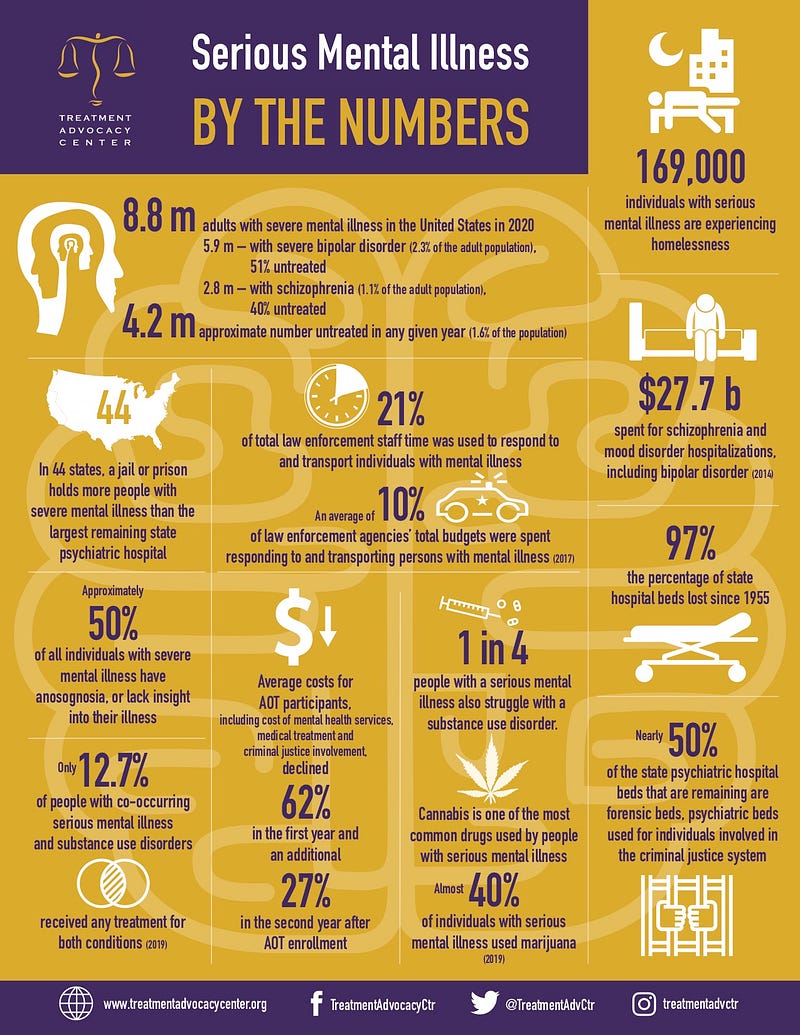
A national problem
The problems my son is having are replicated across the country, which is finally trying to turn some kind of corner to provide substantive care for people who struggle with major mental illness, including substance abuse. But the road to helping them is rocky and unclear.
Here’s how the New York Times story put it:
Before the money ran out, Andrey had to make a choice: Would he accept that he needed treatment, as his parents hoped, and move into a group home? Or would he go back to living in a tent? Was there another way?
These are questions challenging the whole country. As affordable apartments all but vanished in American cities, a whole tier of people with disabling mental illness were forced onto the street, where they now live in numbers large enough to disrupt civic life. Many of them are shunted into the criminal justice system, only to return to homelessness upon their release.
In an effort to interrupt this cycle, many communities are expanding involuntary treatment, a practice the country repudiated decades ago. Patient rights groups warn that forced treatment alone will never work — that in the absence of a robust social support system, it only feeds people with mental illness back into the circuit of catch-and-release. Better to persuade them to accept treatment.
Most families of people with major mental illness believe in involuntary treatment, as do I. My son can’t make good decisions about his welfare unless he’s in his right mind. He needs involuntary treatment to get there.
Slowly, some communities are beginning to agree. From the same Times story:
They are part of a much larger ideological shift taking place, as communities grope for ways to manage ballooning homeless populations. California, one of the first states to turn away from involuntary treatment, has passed new laws expanding it. New York has made a billion-dollar investment in residential housing, psychiatric beds and wraparound services.
Assisted Outpatient Treatment
Currently, my son has what’s called Assisted Outpatient Treatment (AOT) which is a team of case workers who are supposed to help him manage his life; a federal housing subsidy (he pays 1/3 of his income on rent); Medicaid for healthcare; food stamps (EBT) for food; and both disability and supplemental security income for money, which add up to around $1,000 a month.
That may sound like a lot of help, but it’s much less than it would cost to keep him in a psychiatric hospital 24/7, which comes in at about $30,000 a month. Plus it allows more opportunity for him to enjoy life…I think.
But honestly? I guess it depends on the facility. I’ve seen him enjoy life in locked psychiatric wards, too, especially when they are co-ed. He met his baby mama in one. And had a girlfriend in another, where they went to classes like yoga and dancing together. But when I came to visit, there was sometimes disturbing screaming in the background, which makes me think he must be happier in his own apartment.
He says he is.
What’s next?
I’m hoping my son is taking his medication, which was finally delivered, too late, after he’d already entered a psychotic state.
I’m hoping he’s settling down.
I’m waiting for his next call from the pay phone, or from a stranger’s phone. He often talks strangers into letting him use their phone to call me. He can be very charming — at times.
As far as I can tell, there’s not much I can do for him. I could drive the hour south to his apartment, hoping he’ll answer when I knock on the door. And if he does? What would I say to him? Help is coming?
But is it?
When?
For further reading:
Besides writing stories about movies, books, mental illness, and politics on Medium, I edit the feminist publication Fourth Wave and I’ve published two novels here: Thirsty Work and Count All This. Check them out! Get an email whenever I publish. And if you’re a writer with a passion for social justice, submit to Fourth Wave.


