
Why is My Son in Jail and Not the Hospital?
America punishes people for being ill
The week before my son was arrested for vandalism under $400 (a misdemeanor), I had called the police twice asking them to do a welfare check at his apartment and take him to the hospital if he needed to go.
Even though it really shouldn’t be their job, the police in his town have kindly done this for him in the past — taking him to the hospital two or three times in the last 12 months. Once there, he’s given the medication he needs to counteract his mania and come back to earth.
This time, though, police decided he was “not a danger to himself or others,” which is the criteria for taking people to the hospital on a psychiatric hold. “He’s clearly mentally ill, but he’s not hurting anyone,” the officer told me on the phone when he reported back after the check.
Then five days passed, during which I didn’t hear from my son or his landlord, who had called twice the week before to complain that my son was harassing his neighbors and about to get evicted, so I called police again to file a missing person report.
“Oh, wait a minute…we have him,” the officer said on the phone while he was taking the information. “He’s in jail.”
He also said they’d found his library card in the lobby of one police station, and that he’d delivered a message in a matchbox to another. Why was he wandering from police station to police station? No one knows. But to me, it seems likely he was trying to get help — the kind of help that’s cruelly missing from the American healthcare system.
Jail is not shelter or treatment
When I heard he was in jail, I felt relieved. I was relieved he wasn’t dead. Relieved he wasn’t hurt. Relieved he wasn’t lost somewhere or truly missing. Relieved that people with sane heads on their shoulders would be protecting him and keeping him out of harm’s way. That he’d be fed and clothed and sheltered.
But that was four months ago. Now I’m wondering when he will be released. Because as it turns out, the care he’s receiving in jail is not very good, which shouldn’t be surprising, since police officers aren’t trained to be nurses or doctors, and even if they were, therapeutic treatment isn’t what’s delivered in most American jails.
Our jails weren’t built for treatment, but for punishment.
So why are we punishing people for being mentally ill? Isn’t that cruel and unusual? Isn’t that in violation of the U.S. Constitution? Why isn’t the ACLU suing our prison system for locking up people for being mentally ill?
Jail can make mental illness worse
Because my son won’t sign a Release of Information form, no one at the jail will tell me what’s going on with him. I can find information on something called an “inmate locator” though, which I noticed on the jail’s website. That’s how I learned he’d been arrested for misdemeanor vandalism.
Then a few weeks later, a second charge appeared: Resist, Obstruct, Delay Of Peace Officer Or EMT. And a few weeks after that, a third: Damaging Prison Or Jail. Clearly, my son is not getting better in jail. He is getting worse. And I have no way to help or intervene beyond writing emails and making phone calls to people who have no obligation to respond.
When he was first arrested, I waited for him to contact me. We’ve been through this before. With a diagnosis of schizoaffective disorder, it’s typical to experience your first psychotic break at age 18, and that’s what happened to our son. He’s now 35. And when he was jailed in the past, I would always get a collect call from him within days, so I expected that to happen this time, too. But it didn’t.
Eventually, I decided to visit him. That turned out to be one of the worst experiences of my life.
Visiting takes preparation, and isn’t easy. Besides the fact that the jail is an hour and a half away from my apartment by car, I had to call 24 hours in advance to notify officials I was coming, check in with my ID, put my valuables in a locker, wait in line to go through a metal detector, then take the elevator to a room with several visiting booths behind wooden doors, where I had to pace up and down the hallway, looking into the little window on each door periodically, to see if he’d arrived on the other side of a plexiglass barrier.
When he finally did come, he had three officers with him. His hands were chained to his waist. He was in an orange jumpsuit and couldn’t make the phone system work, so started shouting through the plexiglass barrier. He shouted the entire time we were together — directions and complaints and outlandish theories. He was extremely agitated, and it looked to me like he was having a psychiatric emergency. After trying several times to get a word in, I burst into tears. I asked an officer “why aren’t you medicating him?” He said he didn’t know. That I should contact Jail Mental Health. That his job was only to transport the prisoners.
Later, after having a breakdown in the lobby, I asked Jail Mental Health why they weren’t giving my son the meds he needs to think straight. They said they can’t do that without his permission. Yet if he’d been taken to the hospital, they would have given him the meds that are medically indicated without asking. Doctors don’t ask patients to make important decisions while in a psychotic state.
What’s an ethical person to do?
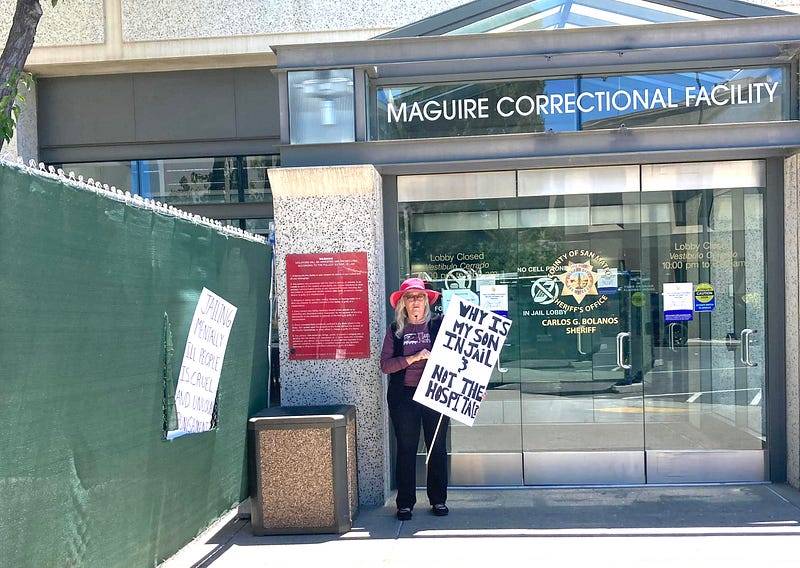
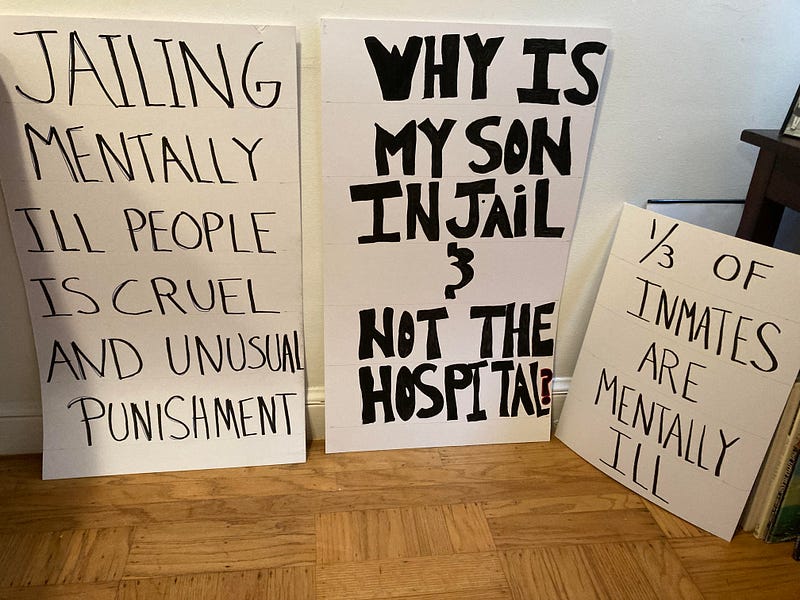
I was telling a friend all these things, and complaining that there was nothing I could do, when I got the idea. “I guess I could sit in front of the jail with a sign asking Why is My Son in Jail and Not the Hospital?” I said half-heartedly, like a joke. But the more I thought about it, the more I liked the idea. It might not change anything directly, but it could raise awareness, and would feel like at least I’m doing something for my disabled son.
And it’s not just my son, either. Thirty to forty percent of the population at the particular jail he’s being held in are mentally ill. That’s a common percentage at jails across the land, since we’ve closed almost all the mental hospitals and treatment centers in the country, losing 97% of the psychiatric beds we had in the 1950s, and leaving vulnerable patients who are experiencing a crisis to suffer on the streets or in jail.
While I sat outside the jail, several people gave me a thumbs up, including people who worked inside.
When are we going to correct our course? When are we going to take care of ill people instead of putting them in jail? When are we going to be ethical and respect the rights and protections established in our Constitution? I have no idea.
But I support California Governor Gavin Newsom’s plan to establish a Care Court to get people who have mental illness out of the criminal justice system. That proposal is currently being discussed as SB 1338 in the Assembly Appropriations Committee. I hope it will pass.
And in the meantime, I’ll sit outside the jail with my signs. It might not change anything, but it’s not nothing. It’s what I can do.
My writing is free from links on social media, but if you want more, click here to join Medium for $5 a month to get access to thousands of stories and writers and support Fourth Wave at the same time. For an email when I publish a new story, click here. Find more stories about mental health on this List. And for more of the good stuff, follow Fourth Wave, where we’re changing the world for the better, one story at a time. Got one of your own? Submit to the Wave.