
My Son is Not the Same, But…
What constitutes identity?

My adult son has a major mental illness which he developed at age 18 — the normal age that men develop this disease. Women typically get it a little later. Prior to that, he had a particular personality and behaved a certain way. Afterwards, he behaved differently. I remember the day his cousin made the plaint that “He’s not the same person!” in a teary tone. He wanted me to commiserate, but I refused.
“He is the same person,” I responded adamantly. No one really agreed.
My daughter, whom we all consider the smartest person in the family, sided with her cousin. He’s not the same, she echoed. But what did that mean? Was he no longer her brother? No longer my son? Had he lived through a different childhood? Had his history been erased?
Stocking the cupboards
I’ve been thinking about identity lately, particularly in relation to this son. One day recently he asked me to take him grocery shopping. He had written out six or seven recipes on different sheets of paper and listed all their ingredients. Among them were maybe 15 spices.
“There are too many spices,” I said. I cared because I would be paying the bill. “Spices are expensive. Why don’t we just go shopping for one or two dishes now, and then after you make those dishes we go again?”
But my son didn’t like my idea, so we began to dispute it. Soon enough, he raised his voice. We were in a cafe, which made me sensitive. Like most people, I don’t like to be yelled at, and I especially don’t like to be yelled at in public. There have been times in the past, in the privacy of our home, when I raised my voice to match his level of intensity, foolishly imagining that I could back him down.
But this time, I wasn’t going there. We parted company instead. He stormed off down the street at an angry clip. I went to my car, and by the time I was ready to follow, he had disappeared. So I called him. This is sometimes how dates go with us. We can’t tolerate each others’ company in person, but we can talk on the phone, or text.
“I’m just saying that’s going to cost a lot of money,” I said gently. “I don’t understand why we can’t do it in two or three trips.”
“I want to set up my kitchen so I can really use my apartment,” he said, “so I’m not just a homeless person staying indoors.”
I bought all the spices.
Re-joining the community
Besides stocking his kitchen, my son also went to church recently — three weeks in a row. I use the word “church” loosely. He was raised in a Unitarian Universalist church which we joined when our three kids were small because I wanted them to have religious education but not indoctrination. I’m an agnostic. My husband is an athiest. The UUs welcomed us both.
Unitarian Universalists don’t have a creed but agree to abide by seven principles, two of which are:
- A free and responsible search for truth and meaning; and,
- Acceptance of one another and encouragement to spiritual growth in our congregations.
What that means is, religion is personal and individual. You’re allowed to believe whatever makes sense to you.
My son went back to his childhood church, which he still lives close to. He saw people he knew there. He spoke to them. When he told me about it later, I was thrilled and happy to hear it — the kind of low-volume, careful happiness I allow myself in relation to him. After the third time, he told me there had been some kind of kerfuffle. He’d sat next to an old friend. Another person he knew from the mental health community was giving a presentation, and he called out a question. Then his friend told him he shouldn’t have done that — that he was interrupting. The two of them argued, which he found ironic, since that likely created an interruption of its own.
Now he’s asked me to call her, but not to apologize for him or act as an intermediary. He wants me to talk to her about how both of us jump to conclusions about him — assuming that he’s doing something wrong when he isn’t. That’s an interesting idea, and I agreed to call her. But what’s even more interesting to me is that he plans to go back to church next Sunday, which will make it four times in a row.
We’ve been urging this son to do something (anything!) for many years, but he’s never been interested until now. As far as I can tell, his principle activities are walking around looking for cigarette butts on the ground (which gives me apoplexy when I’m in his company), sorting papers into piles while planning how to write his novel, moving the furniture around, drinking & smoking, and talking to homeless people, which sometimes turns into him bringing them back to his apartment where they’ve been known to steal things, break things, make an unholy mess, and occasionally make a ruckus which then draws the attention of police.
Going to church is better.
On personal values
I’ve also been thinking a little about personal values, by which I don’t mean the things you value, but how valuable you are. I had a minor argument in the comments about this recently. I had complained that CEOs make 399 times more than workers do in the U.S., and a commenter said that that’s because they’re worth more.
And sure, one person may be worth more than another in terms of a company’s productivity or value added to its bottom line, but on a human level, we are all equally valuable.
I wish I believed in a particular god because if I did, I could explain my point of view better. God put the breath of life in each one of us, and that’s what gives us each value — that breath of life, I would say. But even as an agnostic, that makes sense to me. One person is not better than another person. In fact, the idea that one person is better/more important/more valuable than another is the basic misunderstanding that is ruining our world. Belief in essential inequality is the basis of sexism, racism, homophobia, colonialism, and every other thought plague which allows one group of people to justify harming another. It’s evil. It’s wrong. And it’s obvious.
One person is not more deserving of a decent life than another. Just no. This brings me back to the UU principles. The first one is a belief in the inherent worth and dignity of every person. That includes my son, who is as welcome in the UU church as the next person in the pew.
On changing identities
The fact that this son is going to church now and feels inspired to stock his kitchen seems to indicate that his identity is changing. It’s not changing as radically as it did when he was 18, but it’s changing nonetheless. And whose isn’t?
I am not the “same person” I was in my 20s — thank god. I’m not the same person I was in my 30s, 40s, or 50s either. As I age, I learn more, understand more, become more flexible and forgiving. In fact, my experience has been the exact opposite of the aging stereotype. I’m not calcifying into a caricature of my most recent self. I’m loosening and expanding — and I don’t mean my pants size. (Although that’s happening, too.)
And as that metamorphosis is unfolding, as scales are falling from my eyes, I can’t help but notice how much of my personality was just a social construct in the first place — like a paste applied on top of my soul (that breath of life) that obscured the truth and threatened to smother me.
How much of your personality is constructed by marketers?
There’s no doubt that much of what we like and dislike — select and reject — is just a product of the culture we live in. In the U.S., that’s shaped by advertising. Just look at how hair and clothing have changed over the years to verify this. Styles change, and people’s preferences change with them. And even if you’re in a group that rejects mainstream fashion, you’re likely to dress and style your hair exactly the same as every other person in your “protest” group. Your preferences are determined by your group, not your individual personality. Your preference is to fit in.

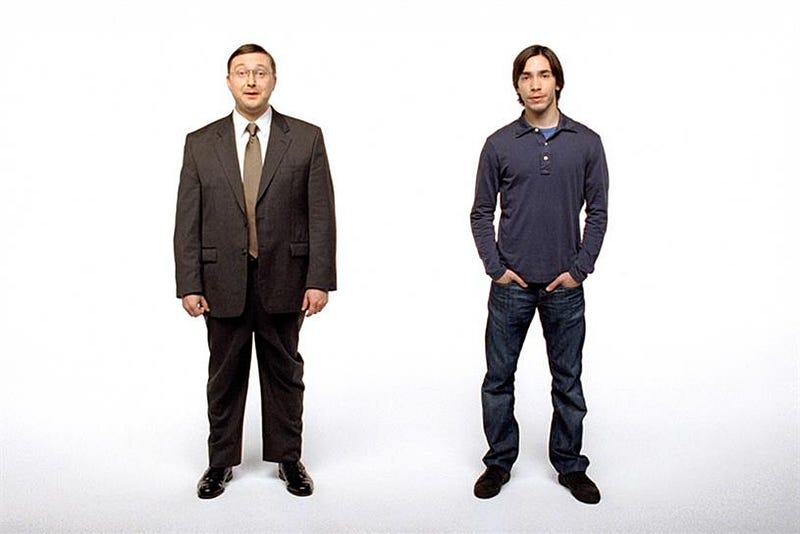
Groupthink about what’s acceptable and what isn’t happens on a national level, too. Back when I taught high school, there was a popular ad airing for Apple Computers in the U.S. in which a hip young man in jeans represented an Apple computer while a stodgy older man in a suit represented a PC. A student who regularly visited China told me that the ad campaign was unsuccessful in that country, because Chinese people preferred the guy in the suit.
Self vs. Nonself
While U.S. culture is all about “finding yourself” and idolizes the “rugged individual” (who dresses, thinks and acts just like everyone else in his social group), some Eastern cultures question whether the self even exists.
The maintenance/strength of self is a very core concept in Western psychology and is particularly relevant to egoism, a process that draws on the hedonic principle in pursuit of desires. Contrary to this and based on Buddhism, a nonself-cultivating process aims to minimize or extinguish the self and avoid desires, leading to egolessness or selflessness. — From Self to Nonself: The Nonself Theory
That kind of thinking is a little over my head, and I’m certainly not ready to give up pleasure and desire in order to avoid suffering, but parts of the philosophy make sense to me — the parts about identity. According to Buddhist theory, imagining we have a unique personality is a trick the ego plays on us to strengthen itself and keep us under its delusional spell.
The Buddha’s teachings are aimed at attaining an authentic, durable happiness by cultivating a transition from the self state to the nonself state (Dalai Lama, 1995a, 2005). Buddhism holds that personal identity is delusional (Giles, 1993), that each of us is a self that turns out to not actually exist (Dalai Lama, 1995b, 2005). Clinging to or being obsessed with the delusional self is the major cause of suffering (Dalai Lama, 1995a) — From Self to Nonself: The Nonself Theory
That language reminds me of Jung’s idea of an oversoul which connects us all together on some metaphysical plane. Sure, we may each have a little individual breath of life in our bellies, but it’s connected to an enormous lake of life which we can access through our subconscious and to which we will all return upon death.
Both theories seem to peek out from behind this doctor’s story about how his father changed when he got dementia.
“His world had shrunk, but so too had his desires, his perspective, his expectations of what constituted a worthwhile existence. The man who’d craved recognition and respect more than anything else no longer seemed to care about those fickle rewards,” the author wrote, noting that his father now enjoyed spending time with his caregiver and his grown children, watching television and eating ice cream — and never expressed a desire to die.
The author and his brother disagreed about whether or not to honor the advance directive that their father had written when he was still physically fit and in his “right” mind. Was it time to unplug?
To my brother, our father was no longer the person he once was. To me, he was still the same person, just a changed one.
And that’s the crux, isn’t it?
In the course of living and reading, I’ve come upon many cases of “changed persons.” My aunt, who has some dementia, has changed. A man who got a brain injury in an accident and wrote a story about it on Medium has changed. The subjects of Oliver Sacks’ book Musicophilia, who got hit by lightening, changed. But I would argue they are still the same people — someone’s wife, someone’s father — and just as valuable as they ever were.
And of course, I feel that way about my son. He’s still in there, even when you can’t find him. He’s still valuable, even if he’s changed. It’s true he changed dramatically when he was 18 and developed a major mental illness. And it’s true he appears to be changing now — from a person who sees himself as a homeless man living indoors to someone who goes to church and has a well-stocked kitchen. And yet all along, he’s been that charming and handsome and troublesome son who’s opened our eyes and shaped our family’s experiences for 37 years. He’s the same person. And I’ll fight anyone who tries to tell me otherwise. He’s the same.
Besides writing stories about movies, books, spirituality, mental illness, and politics on Medium, I edit the feminist publication Fourth Wave and I’ve published two novels here: Thirsty Work and Count All This. Check them out! Get an email whenever I publish. And if you’re a writer with a passion for equality, submit to Fourth Wave.