
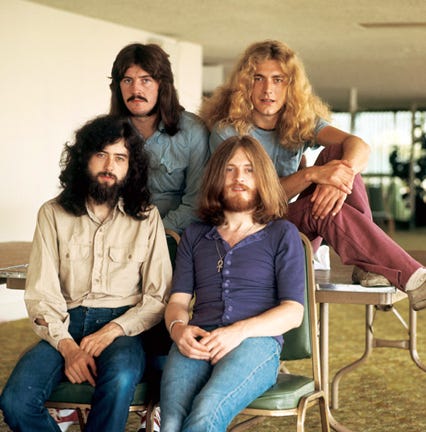
When Led Zeppelin and Elvis Presley collided on Letterman’s ‘Late Show’
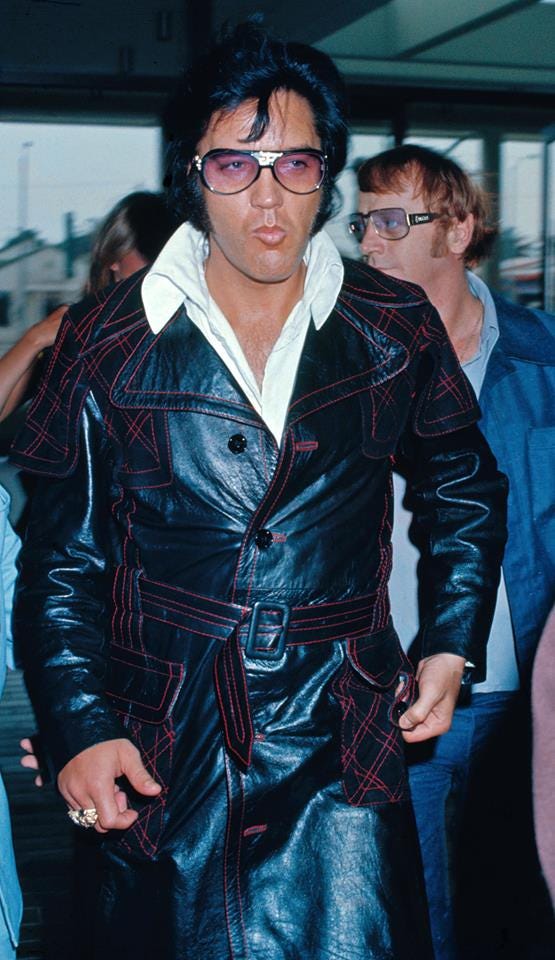
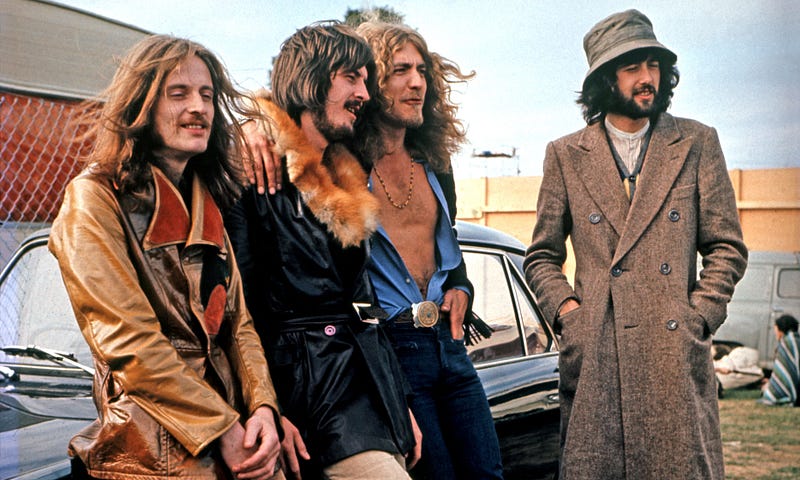
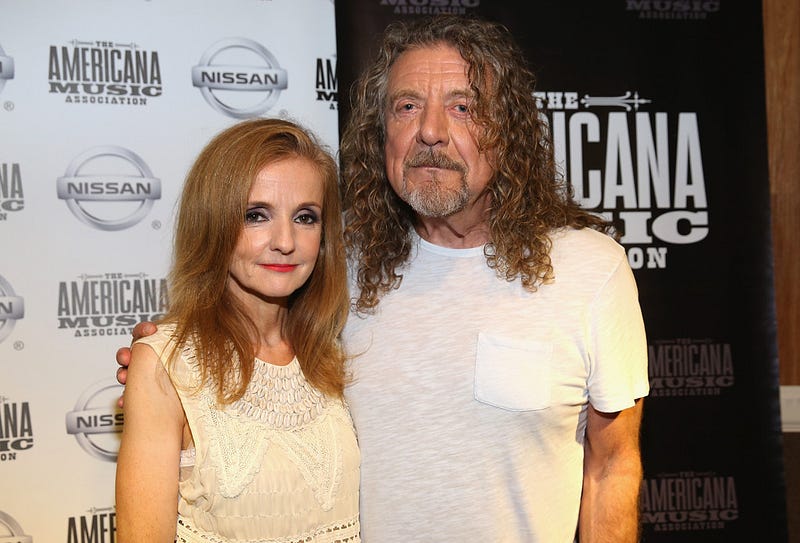
Robert Plant has reinvented himself as an authentic roots rock singer, having released two soon-to-be-classic solo albums in the aughts, the Grammy-winning, Album of the Year Raising Sand with Alison Krauss and Band of Joy with former flame Patty Griffin. Although fans continue to clamor for any news of a Led Zeppelin reunion, Plant is dead set on following his arrow.
A February 4, 2011, summit on CBS’s The Late Show with David Letterman touched on Plant’s love of American music and one rock and roller in particular, Elvis Presley [Plant has been a musical or interview guest with the venerable host six times. His final Late Show appearance arrived in December 2012 when he brought Jimmy Page and John Paul Jones to celebrate Led Zeppelin’s Kennedy Center induction with fellow honoree Letterman].
What follows is Plant’s conversation with the innovative late night trailblazer in slightly edited form to improve readability. Letterman set the gold standard for fascinating late night interviews of substance.
David Letterman: When you began your professional music career, you were pretty much a kid, right?
Robert Plant: I was fourteen and a half, a semi-pro musician. We were trying to sound like we came out of Chicago, which was a bit difficult coming from Worcestershire. The whole thing about British music is — we looked across the pond. Our own music was always some kind of rip-off of an American theme.
It’s ironic, because a lot of the music I’m attached to now, and I’m learning about more all the time, is derived from Ireland and Scotland. A lot of the roots originated in the South, in Tennessee and the Smoky Mountains. The Irish and the Scottish who came to America brought their music with them, and it kinda goes ‘round and ‘round in circles.
Letterman: Who did you like when you were growing up?
Plant: UK radio was kinda dire in the mid ‘50s — there was nothing going on at all. However, American Forces Network Radio broadcast out of Germany. If you were lucky, you’d hear Muddy Waters, Howlin’ Wolf, or Little Richard coming through the airwaves, and that was spectacular.
The whole British pop culture was still celebrating that post-war kinda stuff, like the crooners. Bit by bit, we started miming rock and roll, trying to get it right, but we never really got it. We had our mini Elvis stars, though.
Letterman: Did you respond to that music because it was exotic and coming out of the ether from a country you knew nothing about?
Plant: Little kids in England had no idea about big bad America. We didn’t have the same cultural exchange that you have — one where you come to terms with your massive culture. We didn’t have black America — we had Asian guys coming in and West Indian music a little bit. But you couldn’t turn the radio dial in England and get an absolute amazing kaleidoscope of music.
Letterman: Do you remember the first time you heard Elvis Presley on the radio?
Plant: I heard “Heartbreak Hotel” [1956]. It was the sound of Elvis’ voice and the echo, a kind of exotic calling. When I was in the bathtub one night — it didn’t take long [both men and the audience laugh] — I pulled the plug out and sat there ’til all the water went away.
I sang into the overflow and I got this amazing sound. I went, ‘Wait a minute, that’s me.’ The sound kinda came up just under my legs. That’s how I invented echo, so forget about Les Paul — he was not important at all [laughs].
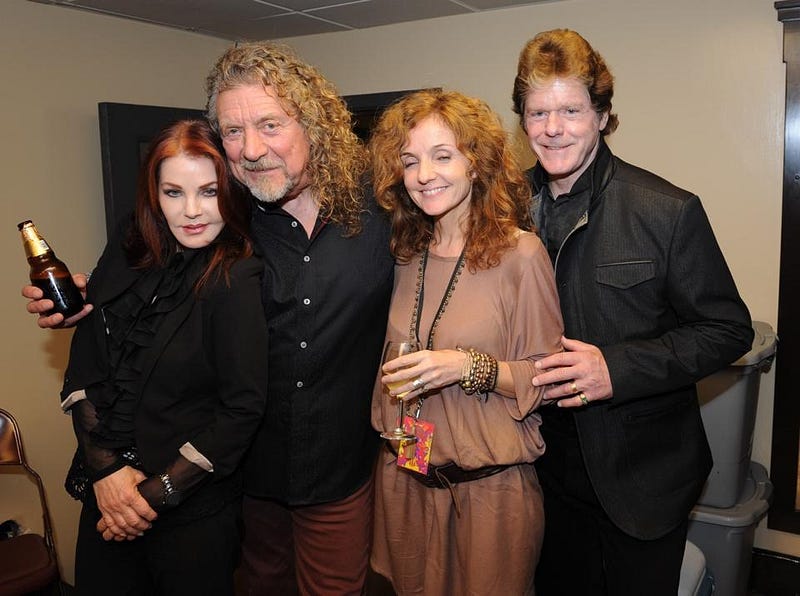
Letterman: Did your paths eventually cross?
Plant: Yeah…Elvis was involved with the same agents that we had during the ’70s [i.e. Tom Hulett and Jerry Weintraub of Concerts West], and he wanted to know who this bunch of guys were who were selling tickets quicker than him. We wanted to know who we were, too [laughs].
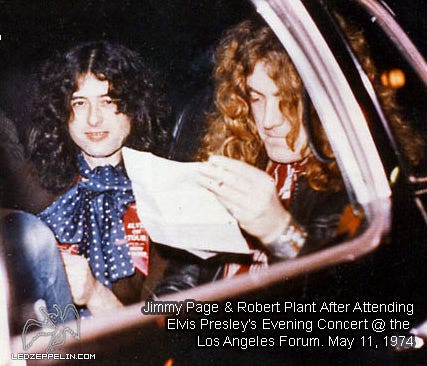
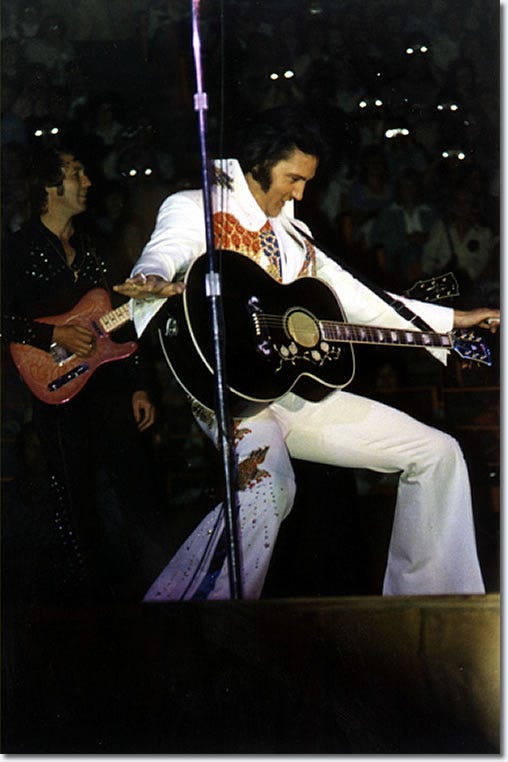
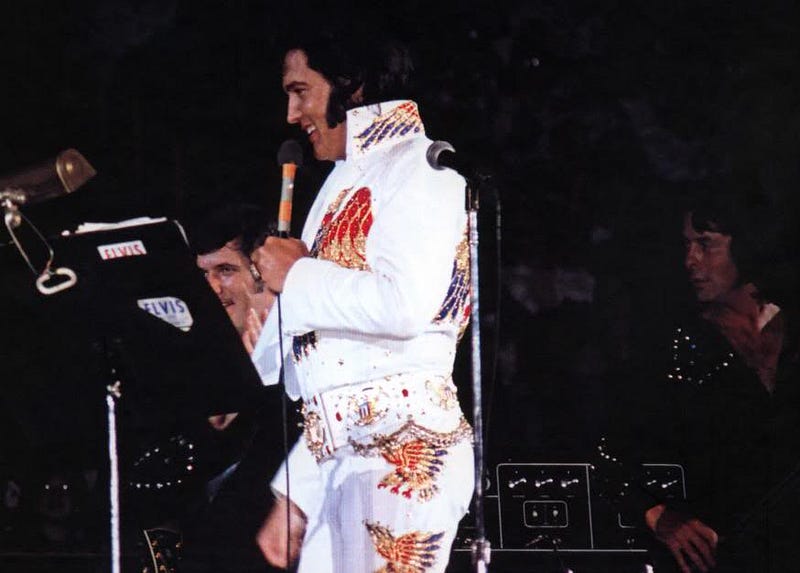
So, Elvis played the Forum in L.A. [one afternoon and one evening show on May 11, 1974], and I’d seen him a couple of times before that. I was so in awe of him as a singer, and I loved the way he could send himself up. Singers generally are all one trick ponies. Sometimes they can’t see the humor in it but he did.
Jimmy Page and I met him after the evening show. We went to the top floor of whatever the cheap hotel was, and a couple of gorillas were at the elevator. They moved us down into kinda this holding station, a long suite where a door opens into another door, like Get Smart. The whole place was full of Sandra Dee, Stella Stevens types — a pencil skirt, beehive and white stilettos, which was perfect for me. That shows my age, doesn’t it?
When the room was suitably full, the door opened at the end, and this guy came in [Plant gets up and demonstrates how Elvis swaggered around the couches]. Elvis was doing a better show in that suite than he was at night onstage.
We talked for about an hour and a half. The amazing this is, it was so natural and funny. Of course, music was the key. We definitely talked about what his music meant to us.
Elvis was very aware of the impersonators; you can imagine how I felt. Through the ’70s, everyone took their shirt off, but they just didn’t have the right chest [Letterman joked that he never did].
Elvis said, “What are your music roots?” And we all had the same roots — that sort of blues out of Memphis and Mississippi. And he asked, “Do you do a lot of rehearsals?” Of course, Led Zeppelin didn’t show up until the gig was almost over in those days — we didn’t do many sound-checks. When we did, I liked to sing his songs in those big arenas, ’cause they sounded even bigger.
Elvis wanted to know which song of his we liked. I said, “Well, I like loads of ’em, but I do like this song called ‘Love Me’” [Plant sings the first line: “You can treat me like a fool…”]
[Author’s Note: Written by Mike Leiber and Jerry Stoller, the parody-tinged country ode was recorded by numerous black artists with minuscule notice until the superstar rendered his version on wax at Radio Recorders in Hollywood on Sept. 1, 1956. Released on his second album, the eponymously titled Elvis, “Love Me” was not officially released as a single. However, Elvis took a liking to the ballad and sang it on several major national television appearances including Ed Sullivan. Deejays began spinning the album cut in full force, causing it to shuttle all the way to №2 on Billboard’s Hot 100 as well as №10 C&W and №7 R&B].
We talked awhile, said goodbye, shook hands and said we’d all meet again. As we went out in the corridor heading toward the elevator, suddenly Elvis swings around the door and yells, “Hey Robert!” He started singing, “Treat me like a fool, treat me mean and cruel, but love me,” and I started singing to him, and we were all crying [Plant’s remarks to Letterman end here].
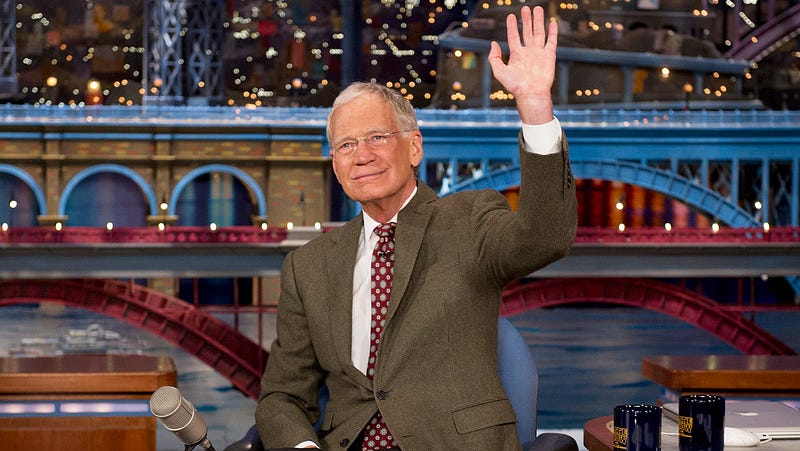
After the brief interview segment, Plant and backing group Band of Joy performed “House of Cards,” originally recorded by British folk-rock duo Richard and Linda Thompson on their 1978 album, First Light. The outstanding, atmospheric “House of Cards” is the second cut on the critically acclaimed Band of Joy full-length record.
Singer-songwriter Patty Griffin and producer-lead guitarist Buddy Miller were singled out by Letterman just before the performance materialized. Griffin was on hand to add a prominent harmony vocal. A respected artist in her own right, Griffin provided mesmerizing backing vocals throughout Band of Joy, toured behind the album, and entered a serious relationship with the lion-maned wailer for a season.
The live version of “House of Cards” as seen on Letterman lacked the massive wall of reverb-drenched guitars brandished on the earlier studio counterpart. Nevertheless, in witnessing Plant dance hypnotically and genuinely interact with Griffin and the musicians it was utterly obvious that he had successfully kindled another creative rebirth in his Band of Joy, a name coined after the struggling late ’60s band fronted by Plant shortly before he joined the Led Zeppelin behemoth. From the near unanimous response of the appreciative crowd, it was evident that they wholeheartedly agreed.
******************DON’T GO ANYWHERE YET!********************
Further Reading: Elvis Presley and Johnny Carson were two kings in their respective fields who admired each other’s work immensely. However, Presley swore off watching The Tonight Show on the evening of his 40th birthday after Carson supposedly uttered a “fat and forty” joke in his nightly monologue. Subsequent retellings of the episode by members of Elvis’ Memphis Mafia have painted Carson in a negative light. But did the King of Late Night actually say those words 40 years ago? A viewing of the original televised clip and accompanying Tonight Show transcript presents stone cold evidence that will lay the claim to rest. Investigate “What Johnny Carson Really Said About Elvis…” for the complete lowdown.
Further Reading No. 2: Jordanaire Ray Walker counted Presley as a close friend for two decades. In fact, the genial bassist’s debut recording session with the King of Rock and Roll yielded a million selling record — “(Now and Then There’s) A Fool Such as I.” He recently relived the experience of sitting front row center during an Elvis recording session. Later when the “Alabama Wild Man” himself, Jerry Reed, unexpectedly showed up to add some patented gut-string guitar to a few country rock numbers, the session got especially rambunctious. Visit the following article, “Bass Maestro Ray Walker Evokes Sizzling Nashville Nights with Elvis and Jerry Reed,” for further rockin’ instruction.
© Jeremy Roberts, 2011, 2016. All rights reserved. To touch base, email [email protected] and mention which story led you my way. I appreciate it sincerely.