
When Greece Had a Larger Population Than Africa and Japan Combined
A reminder of how our understanding of the modern world can skew our perspectives on the past.
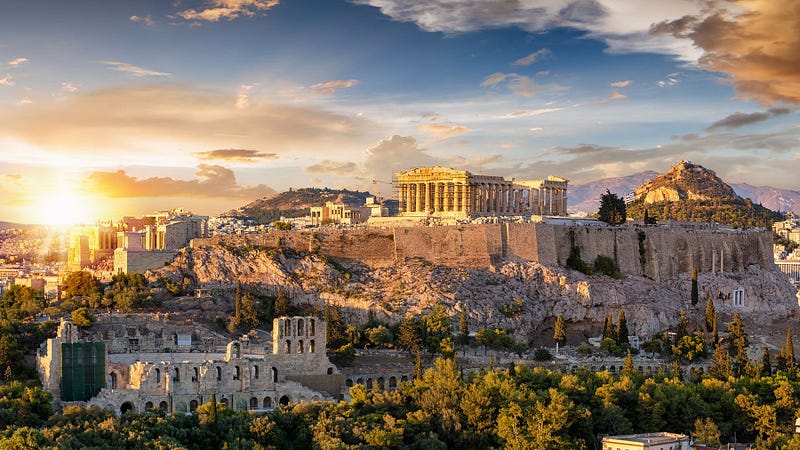
Today Greece has around 10 million inhabitants, Japan has 125 million inhabitants and Sub-Saharan Africa has 1.14 billion people. But what was the world like when famous philosophers such as Socrates, Archimedes, Plato, Democritus and Pythagoras lived? The period around 500 BC.
While writing an earlier story about population size and science, I began reflecting on how such a tiny country as Greek could be such a giant within philosophy, mathematics and engineering. But then I realized that I had subconsciously thought of ancient Greece as being a small country, because it is small today. By “small,” I don’t mean geographical size alone but population. Canada has an enormous landmass but not that many people for instance.
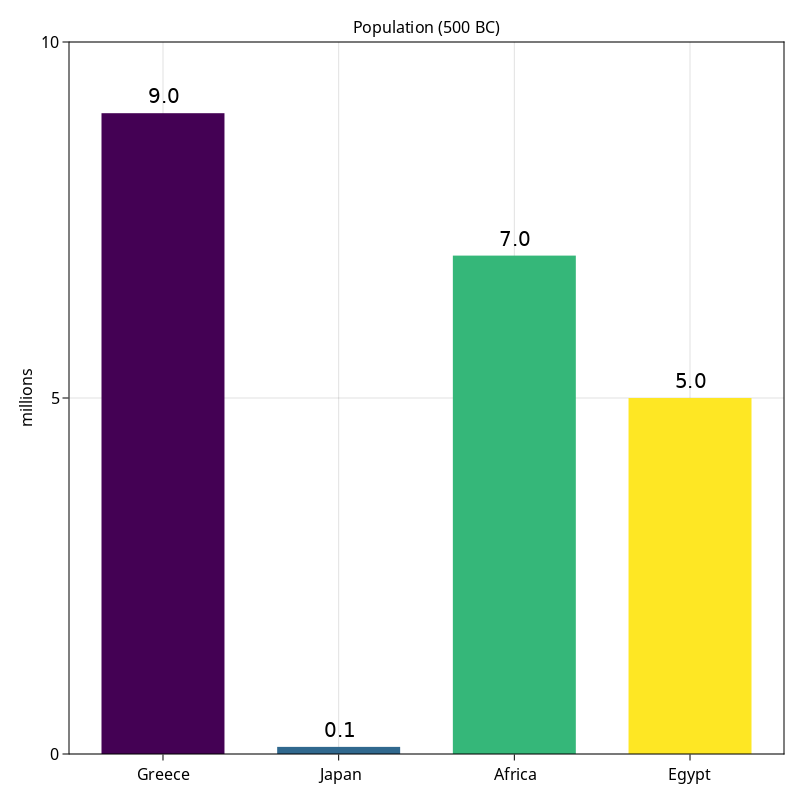
This assumption is a profoundly wrong. Here is a simple example: What was the population of Greece relative to Japan back in 500 BC? Make a guess before reading further. Today Japan has roughly 12 times greater population than Greece. However 500 BC, Greece had a population 100 times greater than Japan! Think about how crazy that is. Greece had a population of eight to 10 million people while Japan only had 100,000 people.
What explains this enormous difference? Farming had already existed in Japan for a long time, but wet rice farming only arrived in Japan 400 BC. Wet rice farming is what allowed countries such as China and Japan to create such enormous populations.

What about Africa? 500 BC Sub-Saharan Africa had a population of only 7 million people. Thus tiny Greece had a larger population than the whole of Africa. Today Africa has 114 times higher population than Greece. Why this huge difference?
A key reason is that agriculture developed late in Africa. 3000 BC to 1000 BC agriculture spread across West Africa. However it was not before 500 BC that the Bantu people started spreading farming to the rest of Africa. From then on Sub-Sharan African population began to rapidly increase.
Why did agriculture develop so late in Africa compared to elsewhere? Given that humans have lived in Africa the longest, shouldn’t agriculture have developed before anywhere else? A bit counterintuitive this is precisely the reason agriculture developed late in Africa.
Read more: The origins of Agriculture in Africa.
Because humans first evolved in Africa, hunting techniques also evolved there first. An arms race evolved between animals and humans. Animals would evolve to counter human hunting techniques. When humans began spreading out of Africa, animals outside of Africa got caught in a situation similar to that of Native-Americans when Spanish conquistadors arrived in the New World. Native-Americans were not prepared for European iron weapons , armor, gunpowder and mounted soldiers. It meant Europeans rapidly conquered the New World.
Animals outside of Africa got caught in the headlights. They have not evolved to counter human hunting techniques. Thus they quickly got hunted down and killed. This pattern repeated itself in the the Americas, Australia and elsewhere. This is why large game went extinct so many places. Humans were simply too effective at hunting.
We human did what we typically do: We destroy our own livelihood by overtaxing the environment we lived in. Humans outside of Africa did not turn to farming because they thought it was such a neat idea, but because they were forced to. There was simply not enough game left to hunt.
This did not happen in Africa, because animals were good enough at evading humans to avoid extinction. This allowed a hunter gatherer lifestyle to continue much longer in Africa.
These facts about human history may make it clearer why Greece could be such a scientific and technological powerhouse in ancient times. In relative terms Greece was actually quite populous. Farming began at least 7000 BC. E.g. the Minoan civilization was flourishing on Crete and surrounding islands already 3500 BC. This is what helped Greece get a relatively large population early on.
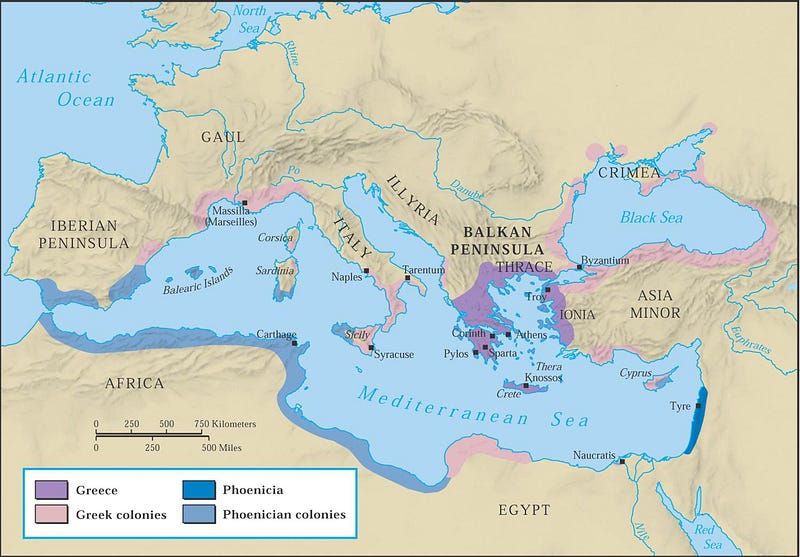
The second important observation is to realize that the Greek world was much larger than today. A large fraction of present day Turkey was populated by Greeks. Turkish people had not yet arrived in Turkey in ancient times. What was then called Anatolia was mainly inhabited by Greeks, Armenians and Lydians.
There were numerous Greek colonies on Sicily and Southern Italy. Thus thee Greek world covered a larger area than today. That meant that Greece represented a much larger fraction of the world’s population than today.
In 500 BC, the world population is estimated to about 150 million people. The Greek population of eight to 10 million, thus represented 6% of the world population. If Greece had made up that large portion of the 7.7 billion people who live on the planet today, then we would have had 500 million Greeks. In other words, Greece would have had a larger population than America today, which is around 330 million people.
This may give a better sense of why Greece in the ancient times was actually kind of a big deal. For instance a powerful civilization such as Egypt had only five million inhabitants, half of that of the Greek world.
The Persian Empire had a population of 17 million people. Greece was thus not as unevenly matched against Persia as one would have imagined from various stories. Hence, it is easy to see why Alexander the Great’s Greek and Macedonian Army conquered the Persian Empire.
The strength and weakness of Greek civilization was that it was not united. It was made up of independent city states. If these states cooperated, then the Greek world could mount an impressive show of force. If the cities acted alone they would be very weak against an empire like Persia.
Anyway, the whole point of this story was really just to get you to reflect upon how we view the past. Civilizations which are tiny today could have been huge in the past. Likewise civilizations which are large and powerful today could have been insignificant in the past.
For instance France and Britain are of roughly equal population today. Yet in 1700, France had more than twice the population of Great Britain and almost 60% larger population than Russia. You probably had not imagined that?
Other Stories of Interest
If you are interested in my writing on history, civilization and economics you can check out some of my other stories:
- Guide to Historic Iron Making — Iron and steel is one of the most important metals in the history of human civilization. Yet reading anything about iron making tends to be confusing. Pig iron, steel, wrought iron. It is all a bit confusing. This tries to clear up many misconceptions and explain why humans went from bronze to iron (not quite the reasons you might imagine).
- Bow, Crossbow and Musket Tactics Compared — Anyone interested in military history and technology might find this discussion of muskets, crossbows, javelins, slings and longbows interesting. The unique advantages and disadvantages of different range weapons and the tactics required to use them effectively.
- How Norway Got Rich Against All Odds Before Oil — Economic and political history of Norway from 1800 to 1940s.
- How Fjords Made Norway Rich — Both Greece and Norway prospered as seafaring nations. This goes back to Viking times and explore how the Norwegian landscapes contributed to developing a seafaring tradition and the long term effects of becoming a maritime nation on economic and technological development.
- Why England Industrialized First — A discussion of why it would have been next to impossible for other nations to industrialize before Britain, due to very peculiar geographic and climate requirements only met in Britain.
- Why are Cold Countries Richer than Hot Countries? — Rebutting some common misconceptions about why the rich-poor divide exists between cold and warm countries.
- Geography and Economics — How the shape of countries affect their economic development. The importance of rivers coastlines, fjords and climate for economic and technological development.
- Why Could The Ancient Greek Steam Engine Not Power an Industrial Revolution? — Many believe the Greek Aeolipile with a little bit of more work could have given us an industrial revolution hundreds of years before Jesus was born. But was that really possible?


