avatarErik Engheim

Free AI web copilot to create summaries, insights and extended knowledge, download it at here

5213

Abstract

sh it down.</p><p id="9edd">This was accomplished by spraying cold water inside the cylinder. This would cause the steam inside to rapidly condense and form water, thus causing a pressure drop.</p><p id="bd1c">Once the piston had been pulled down, the steam would gradually fill up inside the cylinder again, equalizing the pressure, and causing the piston to move up. Thus we had a piston going up and down repeatedly. This contraption drove pumps in British mines for 50 years until James Watt began experimenting with improvements.</p><p id="b72b">Without Watt there would have been no industrial revolution and making his steam engine proved <a href="https://en.wikipedia.org/wiki/James_Watt">extremely difficult</a>:</p><blockquote id="5e02"><p>The principal difficulty was in machining the piston and cylinder. Iron workers of the day were more like blacksmiths than modern machinists, and were unable to produce the components with sufficient precision. Much capital was spent in pursuing a patent on Watt’s invention. Strapped for resources, Watt was forced to take up employment — first as a surveyor, then as a civil engineer — for eight years.</p></blockquote><p id="d443">As you can see, just having the idea of a steam engine by no means makes it possible to make one. It took many years and lots of money. It is extremely hard to make a large smooth cylinder in which a piston can move smoothly:</p><blockquote id="53c7"><p>Through Boulton, Watt finally had access to some of the best iron workers in the world. The difficulty of the manufacture of a large cylinder with a tightly fitting piston was solved by John Wilkinson, who had developed precision boring techniques for cannon making at Bersham, near Wrexham, North Wales.</p></blockquote><p id="6902">This should give some clues as to why the Greeks could not have made a workable steam engine. But let’s look at this in more detail.</p><h1 id="b805">The Technological Prerequisites the Ancient Greeks Did Not Have</h1><p id="afef">Precision-boring of holes was something that developed over hundreds of years in Europe in relation to cannon and gun making.</p><p id="a2c5">It is a hard problem. However, immense resources were thrown at this problem over hundreds of years because it had direct application in warfare which was important to all European states. If you could bore better holes in your barrels and cannons then you would have better weapons than your rivals.</p><p id="642f">To get there required massive amounts of iron production. You needed to perfect this technique by making lots of guns and cannons. How were these quantities of cheap iron obtained? Through blast furnaces operated by water wheels. But these produced crappy pig iron. You needed water wheel powered <a href="https://en.wikipedia.org/wiki/Trip_hammer">trip hammers</a> in other mills to turn this iron into wrought iron you could use to make a musket, for example.</p><p id="ac9a">Read more: <a href="https://readmedium.com/historic-iron-making-for-dummies-57afe7b5e33">Guide to Historic Iron Making.</a></p><figure id="ee0d"><img src="https://cdn-images-1.readmedium.com/v2/resize:fit:800/1*6Uyl9hValsMTwYz-6yyXIQ.jpeg"><figcaption>A blast furnace is a large water wheel powered operation. These required access to rivers with steady water-flow through the year, which was rate in Greece and Italy.</figcaption></figure><p id="e60a">This technology was not widely used in the ancient world. Romans to my knowledge did not have blast furnaces (they used <a href="https://readmedium.com/historic-iron-making-for-dummies-57afe7b5e33">bloomeries</a>), and if they did they could not have had them in large numbers.</p><p id="8f04">The Italian peninsula is poorly suited for water wheels. The same applies to Greece. Britain, especially the Manchester area, is much better suited. Britain was also well suited for canal digging so that coal and iron ore could be transported to cheaply.</p><p id="826c">Perhaps more importantly, the Greeks and Romans did not have gunpowder, cannons and guns. This was what drove the development of the technology to create smooth, straight bores. Exactly what you need for a functional steam engine cylinder.</p><figure id="24ee"><img src="https://cdn-images-1.readmedium.com/v2/resize:fit:800/1*sHa2BEIlKYLgabbaipWYbw.jpeg"><figcaption>John Wilkinson cannon boring machine. Without this technological prerequiste you could not make smoot cylinders for your steam engine.</figcaption></figure><p id="134d">Britain — with its many canals, lots of iron, coal and water wheels powered by blast furnaces — could crank out lots of cheap iron that could go into weapons-making, which was crucial to perfect this technology.</p><p id="1dca">It took hundreds of years to go from primitive cannons before they could make muskets. In short, developing technology for accurate boring was very time-consuming and resource intensive.</p><p id="3a15">Next there was a need to create intricate mechanical mechanisms. This developed from making the firing mechanism of muskets as well as for making mechanical clocks. None of these technologies existed in the Greek and Roman world. In fact <a href="https://en.wikipedia.org/wiki/History_of

Options

_timekeeping_devices#History_of_early_oscillating_devices_in_timekeepers">mechanical clocks</a> were a medieval invention.</p><figure id="037a"><img src="https://cdn-images-1.readmedium.com/v2/resize:fit:800/1*XRUVw-mtC6XteVEGgowYmA.jpeg"><figcaption>The firing mechanism of a flintlock musket. This kind of intricate iron work was perfected due to the importance of gunpowder weapons, unknown in the Greek-Roman world.</figcaption></figure><p id="31ed">Creating high-quality wrought iron or steel is a very hard process to master which took very long time to perfect. Without quality steel and quality cylinders, a steam engine would risk blowing up and killing people. This happened repeatedly during the industrial revolution when understanding of science and mathematics was far beyond that of the Ancient Greeks.</p><h1 id="2985">The Greeks Lacked the Science and Mathematics</h1><p id="fb04">Even in the time of James Watt, thermodynamics — which is crucial in making steam engines — was in a very primitive stage.</p><p id="a74b">However, vacuums and atmospheric pressure were concepts that were well understood at that time. The first vacuum pump was made in 1654 by Otto von Guericke. Hero actually tried to create a vacuum but never succeeded. This stuff was simply hard and required many great minds. Experiments with vacuums were going on for a long time before people actually managed to measure it and prove its existence.</p><figure id="a483"><img src="https://cdn-images-1.readmedium.com/v2/resize:fit:800/1*vlBJoEOn5PWNTpwuok2TQg.jpeg"><figcaption>Early vacuum pump. Developing the first steam engines required developing and understanding of vaccum.</figcaption></figure><p id="96df">Keep in mind that the steam engine got invented after the minds of Isaac Newton, Blaise Pascal, Kepler, <a href="https://en.wikipedia.org/wiki/Christiaan_Huygens">Christiaan Huygens</a>, and many other great scientists had advanced scientific and mathematical understanding considerably.</p><p id="91d2">A practical steam engine required a way to regulate its motion to keep it constant. Otherwise you cannot do actual industrial work. Windmills have the same problem, which is why Christiaan Huygens invented the <a href="https://en.wikipedia.org/wiki/Centrifugal_governor">centrifugal governor</a> — which James Watt used in his steam engine. That Greeks and Romans should have decided “We need a steam engine” and then invented all this stuff in succession seems highly implausible.</p><h1 id="33a1">Innovation Requires Numerous Sources of Inspiration</h1><p id="161e">What I hope to show here is that to make something of profound importance like a steam engine you need to utilize innovations from a vast selection of areas. James Watt relied on vacuum pumps, the smooth boring techniques from making high quality cannons, cheap iron from water wheel powered blast furnaces and the <a href="https://en.wikipedia.org/wiki/Centrifugal_governor">centrifugal governor</a> used in windmills.</p><figure id="c9d7"><img src="https://cdn-images-1.readmedium.com/v2/resize:fit:800/1*FMOMNgtbgKvpJ3VGr8EiOA.png"><figcaption>Centrifugal governor used to steady the flow of steam to keep the speed of rotations stable.</figcaption></figure><p id="4e75">This is pretty typical. Gutenberg’s printing press used a <a href="https://en.wikipedia.org/wiki/Screw_press">screw press</a> from olive presses. The types used for the printing were made using a hand mould, which was likely inspired by the hand moulds that had been used for a long time to <a href="https://en.wikipedia.org/wiki/Cast_bullet">make musket bullets</a>.</p><figure id="1164"><img src="https://cdn-images-1.readmedium.com/v2/resize:fit:800/1*0-rHCQztDLDupuastqwC1A.jpeg"><figcaption>An old printing press. Notice screw-press going through the middle, which allows the ink to be pressed hard against the paper. This is very similar to an screw press for olive oil and wine making.</figcaption></figure><p id="4800">It is very unlikely for one person to invent all these difference pieces of technology themselves. They need to see solutions used elsewhere and combine these to make their invention work. Thus you can see how inventions derive from a complex web of other inventions and insights often in apparently unrelated fields or industries.</p><p id="d621">Thus technology doesn’t just forge ahead in one branch. Technologies are related to each other. Thus the idea that ancient Greeks could develop a James Watt-style steam engine without advanced guns, wind mills, machining tools, improved mass production systems for iron production, etc., is rather unthinkable. It is a bit like thinking a society could make a space rocket before having created trains, cars and calculators.</p><p id="841c">Innovation doesn’t happen in isolation. Innovation feeds of a multitude of other inventions and insights.</p><h1 id="f0b9">Related Stories</h1><ul><li><a href="https://erik-engheim.medium.com/when-greece-had-a-larger-population-than-africa-and-japan-combined-369a457238bb">When Greece Had a Larger Population Than Africa and Japan Combined</a> — In classical times the Greek world was a lot larger than most would imagine.</li></ul></article></body>

Why Could The Ancient Greek Steam Engine Not Power an Industrial Revolution?

Around 10–70 CE, Greek-Egyptian mathematician and engineer Hero of Alexandria invented the Aeolipile, a primitive form of steam engine. Many believe that with improvement this could have powered an ancient industrial revolution.
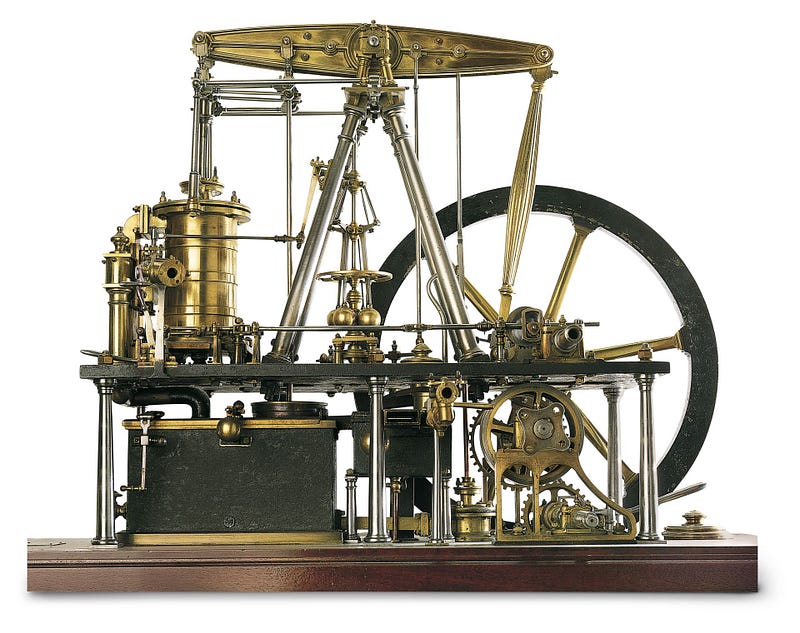
The James Watt Steam Engine

We all love alternative histories about what could have been. Many people, when they first learn about the primitive steam engine, the Aeolipile, invented by the ancient Greeks, think that an industrial revolution did not happen because the Greeks failed to see its potential. But did they?

No, there is simply no way the Aeolipile could have served as a starting point for a industrial revolution in the classical era. In this story I will delve into the details of why, and in doing so give an insight into the nature of technological innovation.
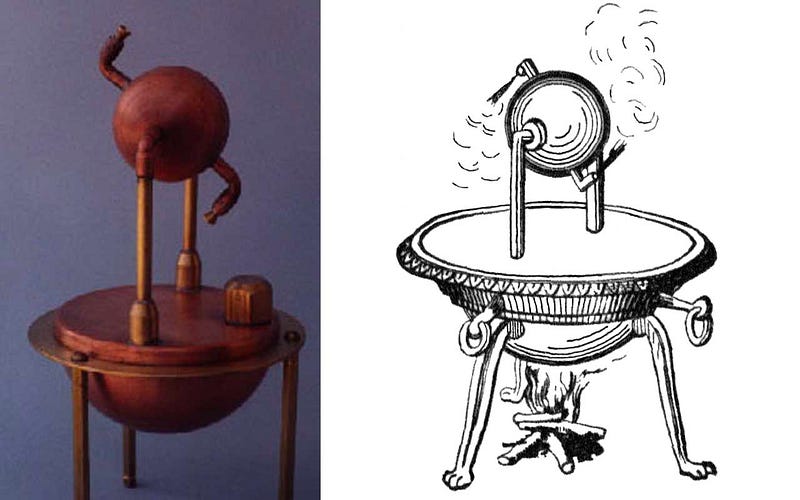
Model recreation of the Aeolipile. Steam exits from the small brass arms causing the ball to spin around.

The Aeoliphile was extremely inefficient and offered far too little power to be used as something to drive industrial machinery.

Could it have had other practical applications? An Aeoliphile-like contraption was invented by Taqi ad-Din (1526 –1585) in the Ottoman Empire hundreds of years later to turn a roasting spit, using steam power. This however is far away from an industrial application. In fact this was more of a novelty as it was simply more practical to use animals inside a wheel to drive the spit, as shown in the picture below.
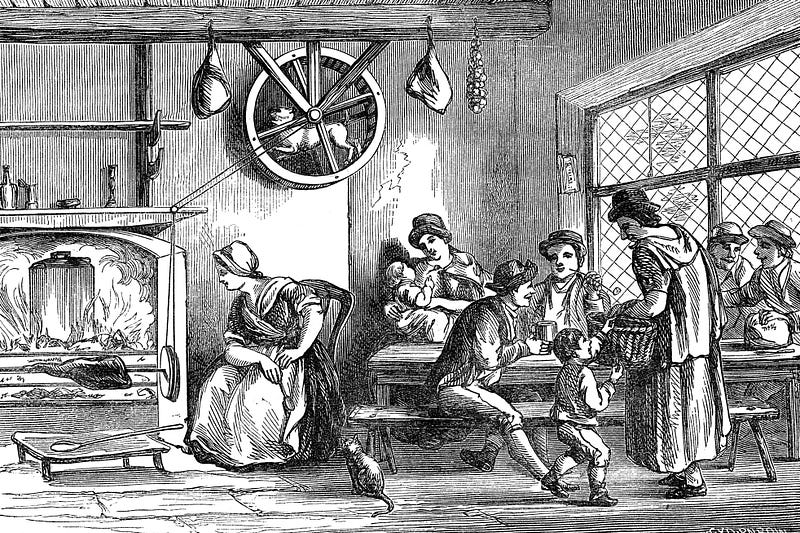
A roasting spit turned around by a dog inside a wheel. Taqi ad-Din used steam to drive the spit around.

Gathering huge quantities of wood to drive a relatively weak piece of machinery, would have made no sense when a windmill or waterwheel would have provided far more power, without the need for constant transportation of fuel to keep the machinery operating. This also underscores an important misconception about the industrial revolution. People think it was driven primarily by steam engines. It wasn’t. Most factories until 1820 were in fact driven by water wheels not steam engines.

Read more: Why England Industrialized First.

But what if the Greeks and Romans had somehow envision a steam powered future and just kept at it trying to improve the Aeoliphile to make it more efficient and powerful?

No, that would require developing something like a gas turbine, which is equivalent to suggesting that ancient Greeks could have made a fighter jet if they had just kept at it. That is just too technologically advanced.

Could the Greeks Have Made a Cylinder-Based Steam Engine?

But what about a James Watt-style steam engine? The kind where you have a piston moving up and down inside a cylinder.

This engine operates on such a fundamentally different principle that it would not have been obvious to someone making an Aeoliphile. The fact that both utilize steam does not make these approaches related.

Let me clarify why: the James Watt steam engine derived from an atmospheric engine. These are not what you think of as steam engines but more akin to steam-driven vacuum pumps.

Scientists had for a while begun to understand the principle of pumps. To their astonishment they had discovered that the atmosphere actually created a substantial pressure.

This made them realize that if you created a vacuum, you could utilize the atmosphere to push things with great power. There is nothing about the Aeolipile that makes you realize this. It does not operate based on any understanding of vacuum or atmospheric pressure.
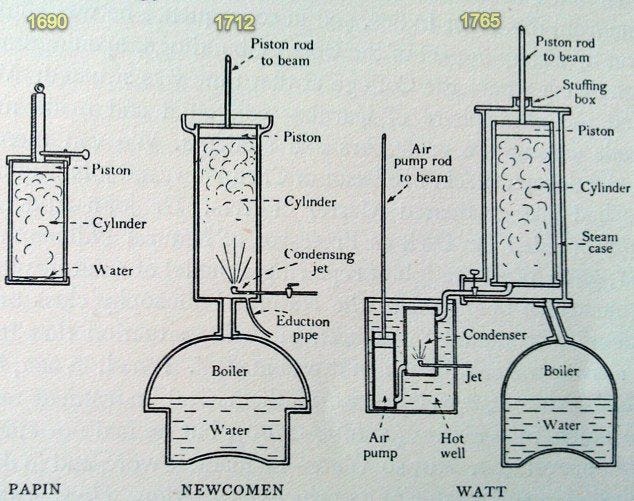
How the steam engine developed in stages.

In 1712, Thomas Newcomen created an atmospheric engine, which was the precursor to an actual steam engine. Steam was used to push a piston up but only with modest power. Relatively low steam pressure was used.

Instead the actual work was performed when the piston went down. This was because a vacuum got created inside the cylinder, pulling the piston down. Or rather the atmosphere outside would push it down.

This was accomplished by spraying cold water inside the cylinder. This would cause the steam inside to rapidly condense and form water, thus causing a pressure drop.

Once the piston had been pulled down, the steam would gradually fill up inside the cylinder again, equalizing the pressure, and causing the piston to move up. Thus we had a piston going up and down repeatedly. This contraption drove pumps in British mines for 50 years until James Watt began experimenting with improvements.

Without Watt there would have been no industrial revolution and making his steam engine proved extremely difficult:

The principal difficulty was in machining the piston and cylinder. Iron workers of the day were more like blacksmiths than modern machinists, and were unable to produce the components with sufficient precision. Much capital was spent in pursuing a patent on Watt’s invention. Strapped for resources, Watt was forced to take up employment — first as a surveyor, then as a civil engineer — for eight years.

As you can see, just having the idea of a steam engine by no means makes it possible to make one. It took many years and lots of money. It is extremely hard to make a large smooth cylinder in which a piston can move smoothly:

Through Boulton, Watt finally had access to some of the best iron workers in the world. The difficulty of the manufacture of a large cylinder with a tightly fitting piston was solved by John Wilkinson, who had developed precision boring techniques for cannon making at Bersham, near Wrexham, North Wales.

This should give some clues as to why the Greeks could not have made a workable steam engine. But let’s look at this in more detail.

The Technological Prerequisites the Ancient Greeks Did Not Have

Precision-boring of holes was something that developed over hundreds of years in Europe in relation to cannon and gun making.

It is a hard problem. However, immense resources were thrown at this problem over hundreds of years because it had direct application in warfare which was important to all European states. If you could bore better holes in your barrels and cannons then you would have better weapons than your rivals.

To get there required massive amounts of iron production. You needed to perfect this technique by making lots of guns and cannons. How were these quantities of cheap iron obtained? Through blast furnaces operated by water wheels. But these produced crappy pig iron. You needed water wheel powered trip hammers in other mills to turn this iron into wrought iron you could use to make a musket, for example.

Read more: Guide to Historic Iron Making.
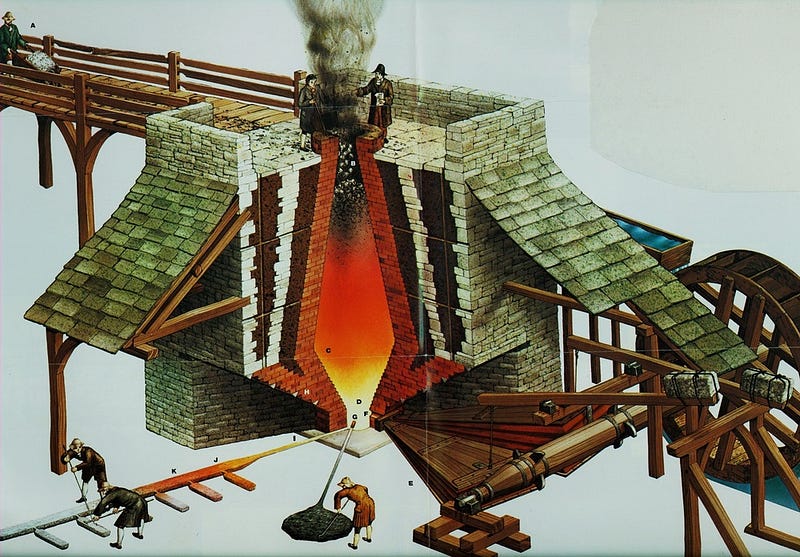
A blast furnace is a large water wheel powered operation. These required access to rivers with steady water-flow through the year, which was rate in Greece and Italy.

This technology was not widely used in the ancient world. Romans to my knowledge did not have blast furnaces (they used bloomeries), and if they did they could not have had them in large numbers.

The Italian peninsula is poorly suited for water wheels. The same applies to Greece. Britain, especially the Manchester area, is much better suited. Britain was also well suited for canal digging so that coal and iron ore could be transported to cheaply.

Perhaps more importantly, the Greeks and Romans did not have gunpowder, cannons and guns. This was what drove the development of the technology to create smooth, straight bores. Exactly what you need for a functional steam engine cylinder.

John Wilkinson cannon boring machine. Without this technological prerequiste you could not make smoot cylinders for your steam engine.

Britain — with its many canals, lots of iron, coal and water wheels powered by blast furnaces — could crank out lots of cheap iron that could go into weapons-making, which was crucial to perfect this technology.

It took hundreds of years to go from primitive cannons before they could make muskets. In short, developing technology for accurate boring was very time-consuming and resource intensive.

Next there was a need to create intricate mechanical mechanisms. This developed from making the firing mechanism of muskets as well as for making mechanical clocks. None of these technologies existed in the Greek and Roman world. In fact mechanical clocks were a medieval invention.
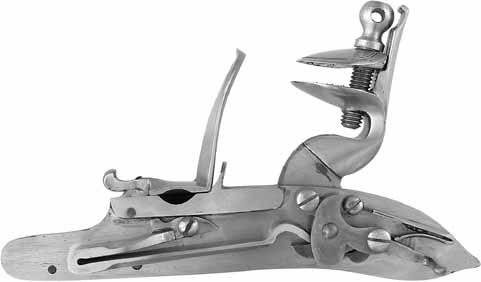
The firing mechanism of a flintlock musket. This kind of intricate iron work was perfected due to the importance of gunpowder weapons, unknown in the Greek-Roman world.

Creating high-quality wrought iron or steel is a very hard process to master which took very long time to perfect. Without quality steel and quality cylinders, a steam engine would risk blowing up and killing people. This happened repeatedly during the industrial revolution when understanding of science and mathematics was far beyond that of the Ancient Greeks.

The Greeks Lacked the Science and Mathematics

Even in the time of James Watt, thermodynamics — which is crucial in making steam engines — was in a very primitive stage.

However, vacuums and atmospheric pressure were concepts that were well understood at that time. The first vacuum pump was made in 1654 by Otto von Guericke. Hero actually tried to create a vacuum but never succeeded. This stuff was simply hard and required many great minds. Experiments with vacuums were going on for a long time before people actually managed to measure it and prove its existence.
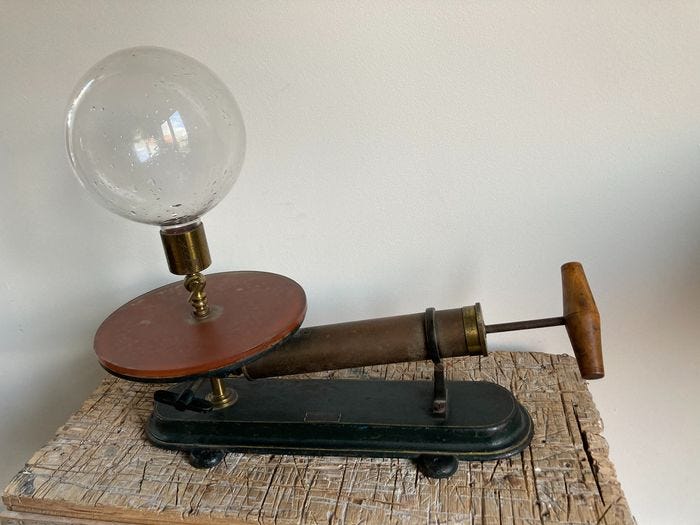
Early vacuum pump. Developing the first steam engines required developing and understanding of vaccum.

Keep in mind that the steam engine got invented after the minds of Isaac Newton, Blaise Pascal, Kepler, Christiaan Huygens, and many other great scientists had advanced scientific and mathematical understanding considerably.

A practical steam engine required a way to regulate its motion to keep it constant. Otherwise you cannot do actual industrial work. Windmills have the same problem, which is why Christiaan Huygens invented the centrifugal governor — which James Watt used in his steam engine. That Greeks and Romans should have decided “We need a steam engine” and then invented all this stuff in succession seems highly implausible.

Innovation Requires Numerous Sources of Inspiration

What I hope to show here is that to make something of profound importance like a steam engine you need to utilize innovations from a vast selection of areas. James Watt relied on vacuum pumps, the smooth boring techniques from making high quality cannons, cheap iron from water wheel powered blast furnaces and the centrifugal governor used in windmills.
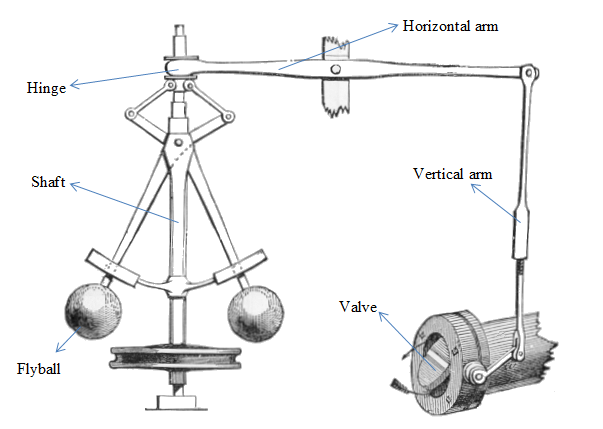
Centrifugal governor used to steady the flow of steam to keep the speed of rotations stable.

This is pretty typical. Gutenberg’s printing press used a screw press from olive presses. The types used for the printing were made using a hand mould, which was likely inspired by the hand moulds that had been used for a long time to make musket bullets.
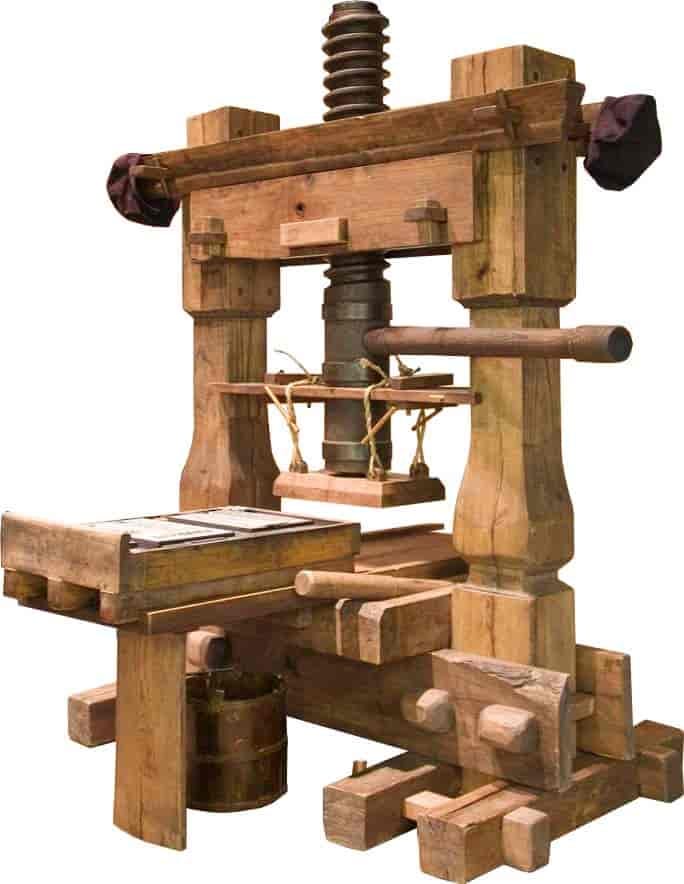
An old printing press. Notice screw-press going through the middle, which allows the ink to be pressed hard against the paper. This is very similar to an screw press for olive oil and wine making.

It is very unlikely for one person to invent all these difference pieces of technology themselves. They need to see solutions used elsewhere and combine these to make their invention work. Thus you can see how inventions derive from a complex web of other inventions and insights often in apparently unrelated fields or industries.

Thus technology doesn’t just forge ahead in one branch. Technologies are related to each other. Thus the idea that ancient Greeks could develop a James Watt-style steam engine without advanced guns, wind mills, machining tools, improved mass production systems for iron production, etc., is rather unthinkable. It is a bit like thinking a society could make a space rocket before having created trains, cars and calculators.

Innovation doesn’t happen in isolation. Innovation feeds of a multitude of other inventions and insights.

Related Stories

Steam Engine
History
Science
Technology
Innovation
Recommended from ReadMedium