
Guide to Historic Iron Making
The different types of iron and iron producing processes explained.
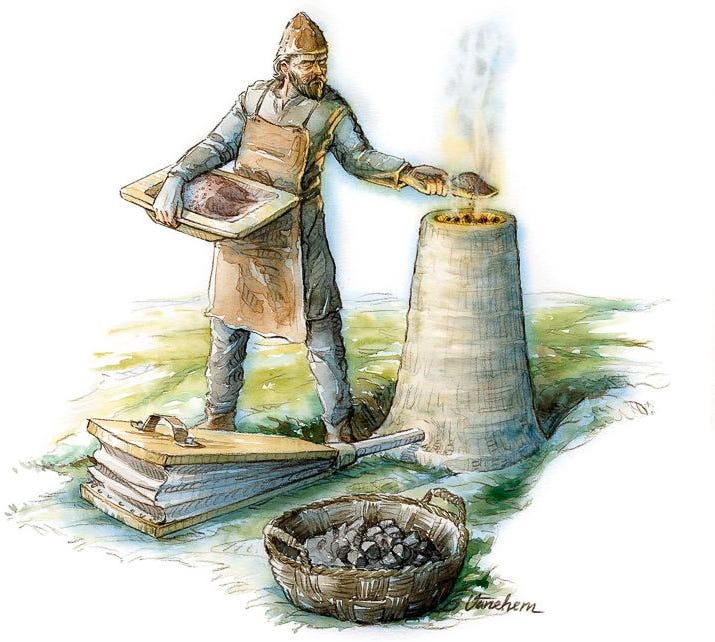
Pig iron, wrought iron, sponge iron, cast iron, steel, slag, bloomery furnace, bloom, blast furnace… yeah, it is pretty confusing isn’t it?
When it comes to iron making there are a lot of different concepts and jargon which make make your head spin, and places like Wikipedia don’t do a great of giving you a sensible overview.
Types of Iron
To better get a handle of how everything about iron making is tied together, let us look at a simple overview of all the different types of iron and how they are related and their usage.
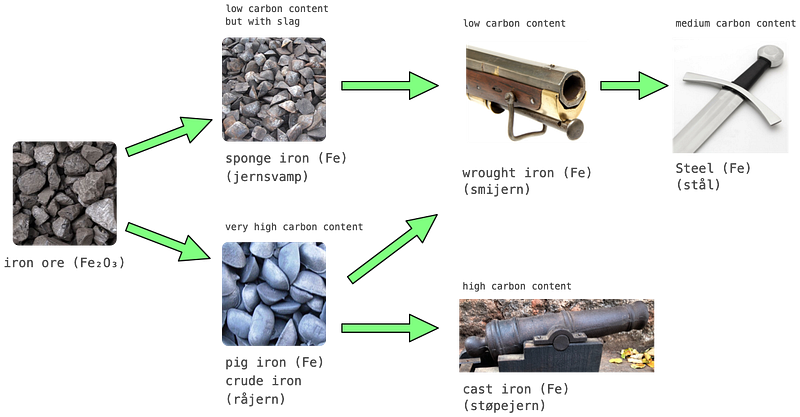
A little digression about the diagram. You will see Norwegian names for each type of iron in parenthesis here. Part of the reason for that is that I found Wikipedia is pretty bad at covering this material, while Store Norske Leksikon, a Norwegian free online encyclopedia, is very good. Hence I needed the Norwegian terms to cross reference.
Common Confusions Regarding Iron and Steel
A lot of explanations of the difference between iron and steel will typically confuse people more than enlighten them.
Iron is usually explained as a pure element, a metal in the periodic table with symbol Fe. Steel is explained as an alloy of iron and carbon.
While this is technically correct, it doesn’t make people less confused. Why? Because most stuff with iron in its name isn’t pure iron, but alloys of iron and carbon just like steel.
So get this straight: pig iron, cast iron, wrought iron and sponge iron are all iron-carbon alloys, just like steel. So when people talk about the Iron Age, it didn’t mean people used pure iron tools. Nobody ever used pure iron tools. It has always been iron alloys.
Wasn’t Steel Invented in the mid-1800s?
There is another common misconception, namely that steel was somehow invented in the the mid-1800s with the Bessemer process, patented in 1856. This is simply not true. We have used steel for a long time. Swords and armor are usually made of steel.
What changed was the ability to mass produce steel cheaply. The ability to make cheap steel in large quantities is what gave us monuments such as the Eiffel tower.
So think about it this way: We have always been using some kind of iron-carbon alloy with different names such as pig iron, cast iron, wrought iron and steel. However, each of these alloys have had different cost associated with them. Pig iron, for example, is very cheap. But also kind of useless, other than to be processed further to make cast iron, wrought iron or steel.
Steel has traditionally been hard to make because it hits a sweet spot in terms of carbon content: Not too much and not too little. Iron making has through most of human history been more of an art than a science.
It is not like you could just follow a simple recipe and boom! out pops steel. Rather, the blacksmith would rely on his experience to work iron in just the right way to get steel.
This would be a time consuming process where maybe only parts of the sword he made would be steel. Other parts would be made of other iron-carbon alloys.
The Bessemer process allowed the artisanship and craft of an experienced blacksmith to be replaced by a standardized industrial process.
Pros and Cons of Different Iron-Carbon Alloys
Depending on what sort of product you wanted to make, you would use different types of iron alloys. Wrought iron, which has low carbon content, is very easy to shape and bend, especially when heated.
Cast iron and wrought iron could be thought of a bit as the difference between glass and clay. Glass is strong up to a point at which it fractures. It doesn’t easily bend. Clay in contrast doesn’t retain shape as easily as glass. On the other hand it never fractures.
Thus you want wrought iron for things like chains, bolts, nuts, boiler tubes, swords, armor etc. Cast iron can be used for anything that doesn’t take sudden heavy shocks: lamp posts, water pipes, building columns or any machine part that doesn’t need to deal with sudden shocks.
The properties of steel is a bit in between, which is perhaps not surprising, given that its carbon content is also in-between.
There are at times some uses that seem inconsistent. While both cannons and muskets shoot projectiles, they aren’t made in the same way at all. Cannons are cast using cast iron, while muskets and other early handheld guns were welded and hammered into shape using wrought iron.
Cast iron being brittle is a bit of a problem. Cast iron cannons did at times explode and fracture. It was one of the reasons that bronze cannons got used at times. However bronze is way more expensive, which explains the limited use.
Part of the reason why steel and iron have almost mythical stories about iron smiths making exceptional swords is because working iron alloys is such an art form. Getting the right carbon content and remove impurities made such a big difference in how strong and flexible the sword would be.
This contrasts with bronze, which did not require that same level of artisanship. Bronze swords could actually be cast. Casting an iron alloy sword is unthinkable as cast iron is too brittle for use in a sword.
Ways of Making Iron-Carbon Alloys
I want to put the different ways of creating iron alloys into historical context, so you can see how the different iron making techniques relate to each other and what drove their development. I will focus primarily on historical iron making. So this story is cut short when the age of steel begins with the Bessemer process.
Bronze Age to Iron Age Misconceptions
In most people’s head the transition from Bronze Age to the Iron Age goes something like this: Civilizations such as the ancient Greeks and Egyptians used bronze for tools, weapons, and armor. Then at some point a clever guy discovers iron and it is instantly game over for bronze.
Reality is however more complex and interesting. It also gives us a clue to the nature and complexities of ironworking. Iron was known in the Bronze Age even if it was not well understood or much used.
What held back its use was that iron requires much higher temperatures to smelt, which was hard to achieve in the Bronze Age. It also required more effort to remove impurities such as slag. Nor could iron alloys be used to cast swords and armor while you could do that with bronze.
Thus for Bronze Age people, iron kind of sucked. Bronze was more flexible and allowed you to make more stuff. The ease with which you could cast it meant you could mass produce stuff like swords and arrow heads by just reusing the same mold over and over again.
Thus if bronze was so awesome and iron alloys such a pain to use, why did people suddenly decide to give iron a chance?
Because bronze had one major Achilles heel. It required two metals: copper and tin, which are pretty much never found in the same spot. Well-developed Bronze Age civilizations had complex trade networks that allowed them to get hold of both these metals and make Bronze.
However, in 1200 BC climate change seems to have caused Bronze Age civilizations to collapse. Okay, this particular reason is debated, but whatever the causes, Bronze Age civilizations imploded. This means complex trade networks collapsed with them, and accessing both copper and tin became impossible.
People simply had no choice but to give iron a second chance. Out of necessity iron started getting used more frequently. With increased use, skills and techniques developed. Thus by the time civilizations recovered and trade networks got back online, bronze never fully recovered.
Iron was here to stay. Yet it is important to point out that bronze also did not fall entirely out of use. Both iron-carbon and bronze alloys got used in parallel. However as iron smelting, forging and welding techniques advanced, iron would increasingly replace bronze usage. Iron may have been technologically difficult to use, but it had huge benefits over bronze in economic terms: It was far more abundant and easily accessible.
Bloomery Furnace — Batch Processing
Since getting high temperatures is hard to achieve, the first iron smelting techniques were based on lower temperatures. The first solution was a Bloomery furnace. The picture below shows what they looked like.
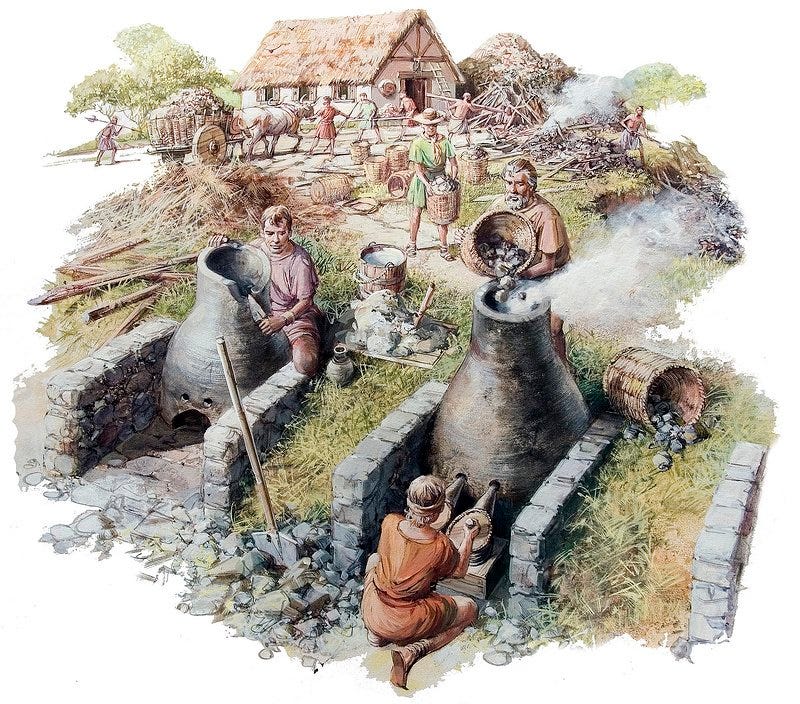
On the side of the furnace you can see holes. These contained tubes or pipes we call tuyeres, which allowed the people working the furnace to blow air into the furnace. This was needed to push up the temperatures inside enough to smelt the iron ore.
Except the temperature wasn’t actually high enough to melt the iron. It was only high enough to melt the non-iron part. The undesirable stuff mixed in with the iron ore such as various types of Silicon (Si), Phosphorus (P), Sulfur (S) and Aluminium (Al) based minerals. Not all of these elements would be present but silicon-based minerals tend to be very common.
This would melt and start to accumulate at the bottom of the Bloomery furnace. However another important process also happens. The heat forces the iron (Fe) and oxygen (O) atoms apart in the various iron oxides found in the iron ore. This could be stuff like magnetite (Fe₃O₄) and hematite (Fe₂O₃).
Of course, as soon as everything cooled down, the iron and oxygen atoms would snap together again. Except this doesn’t happen because carbon-monoxide produced from burning carbon reacts with the oxygen to form carbon dioxide (CO₂).
But why does the oxygen bond with the the carbon monoxide rather iron? Both likely happen temporarily. The difference is that once carbon and oxygen snap together and form CO₂, they are really hard to break apart because CO₂ is a very strong chemical bond. Strong bonds require very high temperatures to break.
The bond in Fe₃O₄ and Fe₂O₃ in contrast is much more easily broken. Thus while oxygen and iron might alternative between breaking apart and snapping together in the high temperature, this does not happen with CO₂.
Thus over time the the oxygen in the iron oxides get depleted and we are left with pure iron, which trickles down to bottom. Except the iron hasn’t really melted. It is more like sticky molasses. It forms a lump of iron on top of the slag called a bloom.
Because the slag is melted we can get rid of it by opening a channel at the bottom and let it pour out.
Eventually we have to open the bottom of the Bloomery furnace to get hold of the bloom. We pull it out with pliers. What you get out is called sponge iron. It has low carbon content but it has still quite a lot of slag stuck to it.
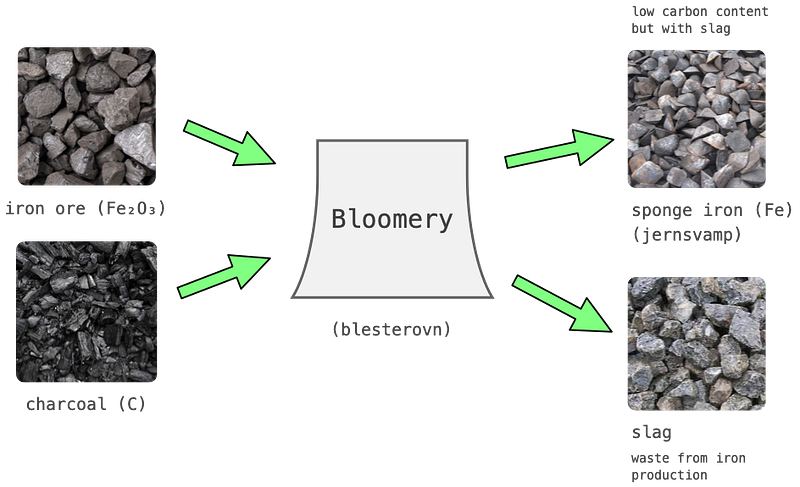
Thus typically the red hot lump is hammered and the slag knocked off it. As you work this piece of iron-alloy hammering out the slag you end up with what you could call wrought iron. The illustration below shows the process. What goes in and what comes out.
Problems with Bloomery Furnaces
This way of making iron alloys may seem fine. You get wrought iron that can be used to forge steel swords any number of practical iron tools, armor or what not.
Just a side note: A steel sword is not all that well defined. When does wrought iron become steel? There are not clear boundaries as swords would end up with different amounts of carbon in different parts of the sword and some swords would be better made than others.
Meaning some swords would be closer to steel than others. Thus you could perhaps say there are bad, good and excellent steel swords. It is on a continuum.
It is great that we get wrought iron straight out of this process, but what sucks is that it is a batch-oriented process. It is not continuous. At some point you need to break open the bottom to pull out the bloom.
Would it not be better if we could melt the iron so we could just tap it out? Then we could just keep filling in charcoal and iron ore at the top and keep going almost indefinitely. No need to shut down the whole furnace to get the iron out.
Blast Furnace — Continuous Iron Production
This is the problem solved with a blast furnace. It lets you keep going because both slag and iron melts. You can tap out both separately, and just keep going.
Naturally this makes it possible to ramp up production and cut costs. You waste less fuel when you can use an already heated furnace instead of reheating a furnace from scratch multiple times.
But there is a catch. Or rather there are many:
- To get the temperature high enough, you need to blow in a lot of air. Human-operated bellows will not be enough. You need water powered bellows. That means you need to put the blast furnace next to a river that can drive a water wheel.
- Iron mixes with the charcoal when it melts, producing a very carbon rich alloy: pig iron.
Thus a blast furnace represents a tradeoff compared to a bloomery furnace. In exchange for a continuous operation that makes iron production cheaper, you get a lower-quality iron-carbon alloy out. By lower, we mean that it is a brittle alloy that cannot be readily used to make useful stuff.
However coming out in liquid form, we can let it flow into moulds for iron bars or ingots. You can see that in the illustration below.
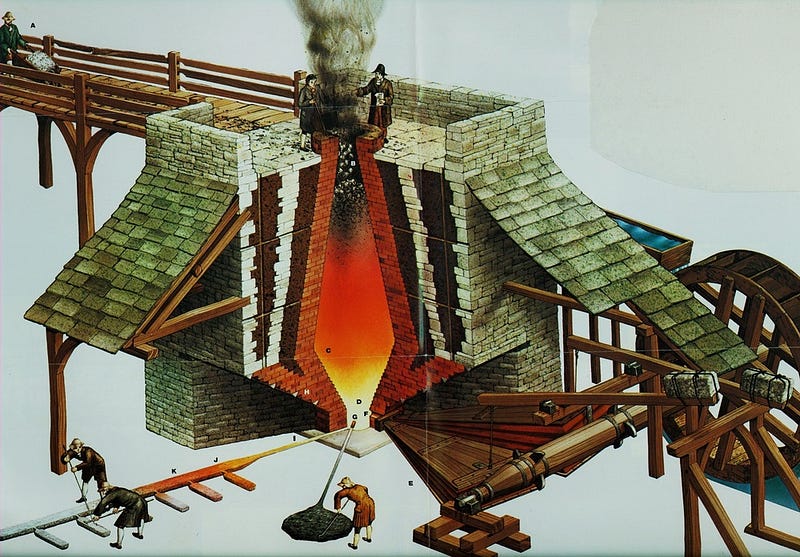
The way this works is that you keep the furnace burning until you have sufficient amount of pig iron collected at the bottom. First you unplug the tube to the top part where the slag forms. You drain out the slag. Next you untap the melted pig iron. Then you plug in the hole, wait for the iron to cool and pull out ready made pig iron bars.
Then it is just to wait for the next batch for finish before repeating the process. The beauty of this arrangement is that you never have to shut down the furnace.
Let me cover some of the details around the furnace that may not be obvious.
Why the odd shape?
The furnace is thin at the top and bottom. Why not just a tube of equal thickness the whole way?
- We want a narrow top to avoid letting too much heat escaping. At the same time there must be an opening to let gases escape and allow refilling of charcoal and iron ore.
- A narrow bottom allows iron to get collected in a smaller area instead of getting spread out thin. That makes easier to tap it afterwards.
Not all Rivers Are Suitable
The reason that industrialization happened in particular places is in large part due to the fact that not every river is suitable to drive a waterwheel.
For example, in places like India and China, water gets dumped in large quantities within a short timespan. This makes floods common. There is often too little water or too much.
Places like Britain are more ideal as it rains fairly steadily through the whole years which gives a constant and predictable flow of water. Thus the water-powered bellows could work through most of the year.
Inputs and Outputs to Blast Furnace
Let us look at the inputs and outputs of the process, because it is a bit different from the bloomery furnace.
For instance we add calcium carbonate (CaCO₃) in the form of limestone. This isn’t actually for the iron oxides but for all the stuff we don’t want. It causes many of the impurities such as the Silicon (Si) based ones to form slag that easily melts. That helps us get rid of it more easily.
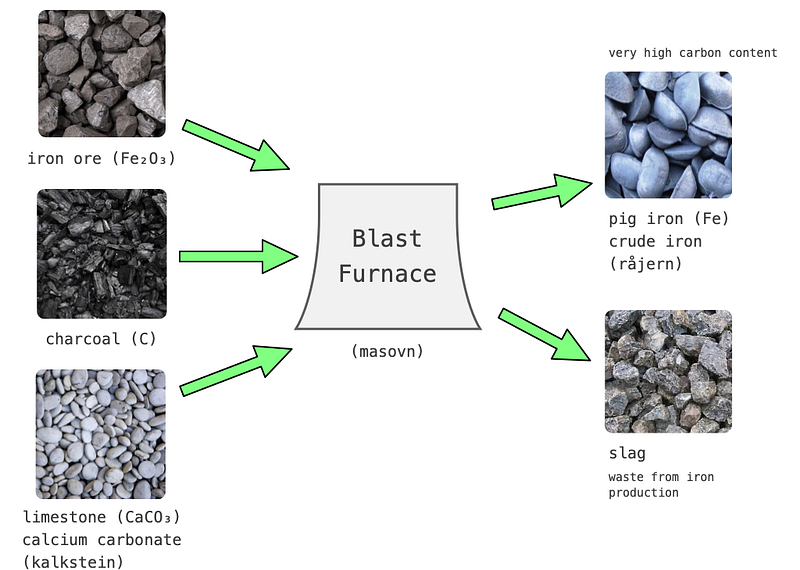
And of course we get pig iron as output. Now if you read the literature, it seems like depending on how you run this process you could get output with low enough carbon content that you get cast iron out. Thus to my understanding, some blast furnaces would cast iron directly. The melted iron coming out would be poured straight into a cannon mould, for example.
However, pig iron would normally have to be taken to a second furnace to be processed further. This could either be to create cast iron or wrought iron.
Finery Forge
To turn pig iron into wrought iron which could be used for weapons, tools and many other things you would bring the Pig iron bars to a Finery Forge.
Here excess carbon would get burned off. This was quite a different operation from a blast furnace. It was a simple open furnace as you can see in the forge of a blacksmith. You don’t have layers of charcoal, ore and limestone like in a blast furnace. Nor are you trying to get really high temperatures.
In a finery forge, you don’t want to heat the pig iron too much; otherwise you start burning it. When iron burns it forms iron-oxide and you are back to where you started.
That is why you cannot use a blast furnace to remove the carbon. It is set up to use temperatures to remove oxygen. That means temperatures that would normally cause the iron to combust.
In a blast furnace, we are trying to get the oxygen out by making it combine with carbon. In a finery forge, we are trying to get the carbon out by making it react with the oxygen.
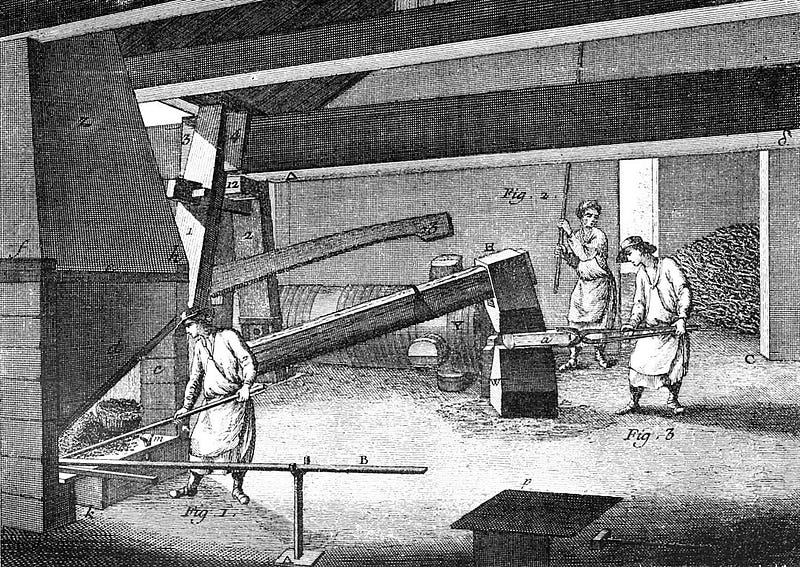
Inside the Finery forge this happens in a fireplace we call the Chafery. We pull the red hot iron bars out of the chafery and place it on an anvil. There a trip hammer powered by a water wheel is used to hammer the hot iron piece.
This knocks out the slag from the iron bar. By turning it around and hammering it several times, we get a more refined iron-alloy. This is what gives us the wrought iron. Thus this step is very similar to what happens after you pull a bloom (hot lump of iron with slag) out of a bloomery furnace.
The trip hammer can be used to hammer out flat pieces, rods or whatever you want. You could use it to make products directly or pieces for further sale and processing.
Swords, Armor and Guns
Wrought iron produced from a finery forge or directly from a bloomery furnace is what we use to make our actual tools and weapons.
Unlike bronze, you cannot cast wrought iron. So creating complex delicate metal parts and mechanisms requires a lot of training. You have to be able to shape iron in all sorts of intricate shapes merely by heating and hammering it.
For instance, unlike bronze, you could not cast a musket barrel. Instead a smith would use a Mandrel. A mandrel is really just a pipe or tube made of metal (could be other materials). So why don’t we call it a pipe then?
It is to reflect the usage. Mandrels are used in all sorts of metal working. For example, a goldsmith would use a Mandrel with varying thickness to shape a metal ring around it to fit the thickness of your finger.
A gunsmith use a mandrel to knock strips of wrought iron around it. These strips are welded together (melted and fused together), by alternating heating and hammering of the metal strips.
Thus unlike what you might assume, a gun barrel did not historically start life as a sold metal rod which just got drilled. No, the whole thing was forged around a mandrel, which would have to get pulled out afterwards. Then the inside would have to be drilled repeatedly to get a smooth straight bore.
They did not have CNC machines, so complex locking mechanisms for the gun or for locks could not be machined by cutting but had to be shaped with care by working hot metal pieces with a hammer. This gives a sense of the complexity of working with iron-alloys, and why bronze held sway for over 2000 years in human civilization.
Hammering something as big as a cannon into shape is of course not practical, which is why cannons got cast in molds using cast iron. That was not without challenges. Because cast iron is brittle, these cannons would at times fracture and explode, killing the people who were operating it. To counter that, they would try to make the cannons extra thick.
But this helps explain why Bronze was often used in cannons. Bronze, like wrought iron, is not brittle. But unlike wrought iron it can also be cast. Hence bronze was very suitable for making cannons. The reason you never saw more bronze cannons is because they are simply far more expensive to make, since bronze itself is a more expensive material, even if the process was cheaper.
Thus there was also advantages in making bronze swords as you could have far more even quality. However using iron-alloys as cheaper and if the smith was good, he would always make a better sword. Yet a poorly made steel sword would be no match against a well made bronze sword.
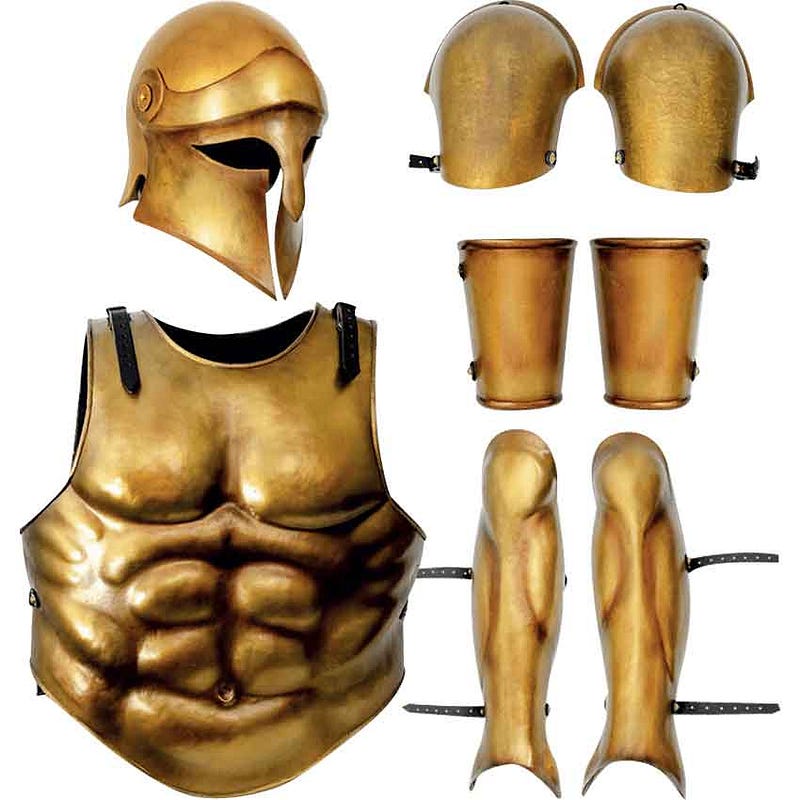
This also helps explain why plate armor developed much later for steel than for bronze. With bronze you could cast strong plate armor into complex shapes. For steel, creating plate armor would require hammering out sheet of metal into the right shapes. Clearly a far more complex process to master.


