
What’s Really at the Heart of Homophobia?
Religious indoctrination is an avenue for instilling heterosexism in people, but not necessarily the core of their animosity
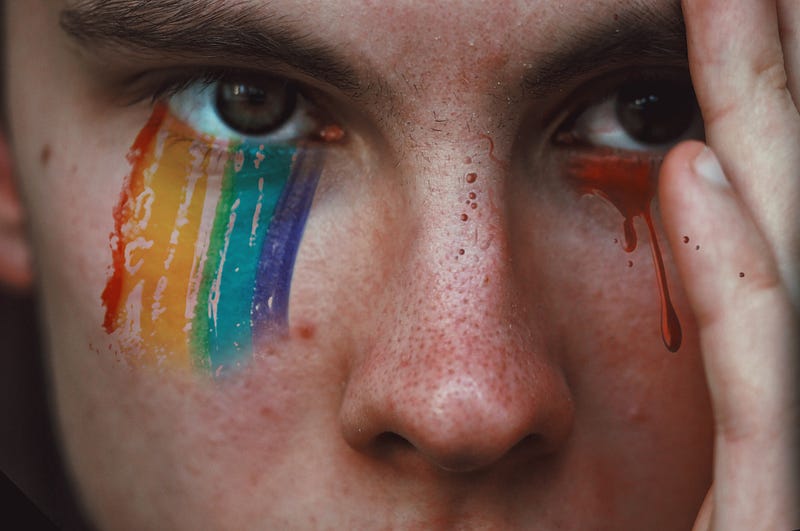
For as long as I’ve been aware that I’m a part of the Queer community, I’ve frequently meditated on why exactly LGBT+ people receive so much hatred and scorn. Americans of all backgrounds deride us, stereotype us, dismiss us, patronize us, condescend us, and pretty much treat us like an after-dinner mint at the Social Justice Buffet.
But why? What makes “them” so unapologetic about their hostility and combativeness toward “us” in so many venues of life?
For clarity’s sake, let’s look at a handful of the major factors.
Obviously, religion is at the top of the list. Specifically, theocracies that promote anti-LGBT animosity. Their followers cite passages from the Bible (which may or may not have been written by individuals with ulterior motives and/or questionable biases).
In America, the First Amendment is supposed to guarantee that no religion is state-sponsored. Interpretations of creationism may guide one’s subjective morals. But they aren’t intended to dictate secular laws for everyone else. At least, not based on subjective speculation.
And, of course, the “religious morality” justification for homophobia or heterosexism falls apart when we consider all of the liberal Christian (or liberal monotheistic) houses-of-worship out there.
Unitarian-Universalists. Quakers. Reform Jews. Al-Fatiha & MPV Muslims. Episcopalians. Buddhists. Aravani Hindus. The United Church of Christ. The Baháʼí Faith. Plus all of the polytheists, pantheists, or other progressive spiritual sects. They not only conduct marital ceremonies for same-sex couples…they’ll also usually allow LGBT+ members of their congregations to become clergypersons.
Of course, atheists and agnostics can be homophobic/heterosexist. So how would their lack of religion account for the bigotry exhibited by members of secular and irreligious groups?
That comes back to their biased views of so-called natural law. In other words: sex is supposed to be primarily for procreation or expressions of love between two people who possess complementary genitalia.
Translation: in their minds, homosexuality is “icky.”
Well, I think ketchup is icky. I just don’t eat it. I don’t try to ban the free market sales of ketchup in grocery stores and restaurants. I don’t go around disparaging people who do like the taste of ketchup. I see the human value, as friends and colleagues, in people who eat ketchup.
And, of course, there’s the old reliable stoking of political divisions. For those of you who remember the George W. Bush years, this was Karl Rove’s predatory tactic to portray the LGBT+ community as “uppity,” “shallow,” “hedonistic” Americans who wanted “special rights” for ourselves.
It worked in 2004, inflaming heteronormative fears of the unknown. At least, what was unknown to them.
But none of this explains the almost pathological compulsions of individuals who seem willing to die on that smug hill of “Homosexuality is immoral” or “Queer is perverse”…
It’s all about control.
Whether it’s through social norms or laws, they want to control the sex lives of complete strangers. They want to dictate the terms under which someone else is granted domestic sovereignty by the federal government.
So, to exert that control over others, they semantically frame homosexuality, bisexuality, and transgender identity as “behavior,” “preference,” or “mental illness.” Their endgame, here, is to return our society to a mindset where we idealize — and show favoritism toward — the traditional, heterosexual, two-parent nuclear family.
This is why so many of us view the term of “sexual preference” as offensive. Particularly when it’s used as a method for “othering” LGBT+ people vis-a-vis heterosexual people.
They are trying to evoke shame or self-consciousness in us. Telling us how “it’s never going to change” and “that’s just the way it is.” Then, they can trigger outrage, anger, and militancy amongst portions of our community.
And then, they’ll have goaded us into portraying ourselves as “unreasonable.”
How often do we hear the narrative that the “mom bod” will *NEVER* become as accepted as the “dad bod” is? Or that members of BIPOC communities are *NEVER* going to be able to walk/drive down the street without getting harassed by the police?
These self-fulfilling prophecies are generated in order to prolong resentment from Black, Indigenous, & People of Color, women, nonbinary people, and nonconforming people of all sexes and genders. The shit-stirrers who endlessly fan these flames just want White people and male-presenting people to remain in fear of a scenario where “the other” attains revenge on a massive scale.
Such techniques, by the way, are specialties of the so-called “mainstream” media. Journalistic gatekeepers thrive on sensationalizing our struggles. It’s why they give a platform to “the other side.”
As though Teletubbies and cake decorations are make-or-break scenarios for our society.
They rarely question the naïve ignorance of those who marginalize us, such as the Gus & Gert whom I once encountered in a campus elevator back during my college days.
They leave unchecked the pompous entitlement from public figures like Joy Behar who enjoy the privilege of being able to relegate us to a punchline.
They perpetuate these divisions by trivializing us.
So then…what’s the solution?
We have to show up to represent ourselves. We have to show up to claim space for ourselves. We have to support one another as Queer family.
Orientationism is the blanket term I use to refer to prejudice, bigotry, and discrimination based on someone else’s sexual orientation. Although I invoked “homophobia” in the title of this article (and “heterosexism,” earlier in this op-ed piece), orientationism isn’t limited to being spread only by heterosexual people.
Homosexual, bisexual, and pansexual people can be orientationist toward one another — and, yes, even toward heterosexual people who are in the systemic majority. Likewise, depending on context and venue, homosexual, bisexual, pansexual, and heterosexual people can all be the targets of orientationism.
And we can overcome this.
But that means we must not challenge the legitimacy of someone’s sexual attraction per se…
It means that each of us, as LGBT+ individuals, should identify whom we view as our straight allies. But, we should recognize that allyship won’t look exactly the same to each of us in every scenario. We ought to be willing to have those tough discussions.
Embrace the opportunity to educate members of the heterosexual community — but to also educate members of our Queer family, whenever we encounter somebody with different versions of sexual attraction from our own. As long as they’re willing to listen, ask questions, and engage…let’s reciprocate!
Universality is the best way to gain true allies. If we relate to other people on this fundamental level — regardless of the individual differences in our sexual orientations — we can squash these refrains about “special rights” or the alleged value of sexual conversion therapy.
Orientationism stops becoming “a difference of opinion” when it creates a hostile culture driving young people to take their lives. For some heartbreaking examples, read Linda Caroll’s Medium piece entitled “Why Do We Hate LGBTQ Kids? And Don’t Blame Religion.”
Same-sex marriage is legal in all 50 states. That’s a privilege and an advantage our community didn’t have, back during the days when I was a teenager and a college student.
But certain people want to take it away from us. Fortunately, Millennials and Zoomers and Alphas aren’t having it. And the as-of-yet-unnamed generation that succeeds Gen AA (“Gen Alpha”) will be even more enlightened.
Orientationism, as with every “-ism,” must be challenged and resisted in all forms — systemic, cultural, interpersonal, scientific, psychological, and spiritual.


