avatarWrite Mind Matters

Free AI web copilot to create summaries, insights and extended knowledge, download it at here

4650

Abstract

" type="7">“… behavioral evidence suggests that limited empathy in narcissism might be more due to lower propensity than capacity. “ — Emanuel Jauk & Philipp Kanske.</p><p id="309f">Narcissists are capable of <a href="https://www.ncbi.nlm.nih.gov/pmc/articles/PMC4415495/#:~:text=People%20with%20NPD%20in%20their,to%20disengage%20from%20empathic%20processing.">cognitive empathy</a> but lack emotional empathy, so they intellectually know someone feels a certain way, they’re just not capable of feeling it or motivated to act on empathy, unless it benefits them.</p><p id="d327"><a href="https://www.ncbi.nlm.nih.gov/pmc/articles/PMC8170532/pdf/S2513988621000018a.pdf">Studies</a> show reduced activity and grey matter volume in the anterior insula (AI) and anterior cingulate cortices (ACC) of narcissists compared to control groups. The AI and ACC are activated during both personal experiences and empathic reactions.</p><figure id="207c"><img src="https://cdn-images-1.readmedium.com/v2/resize:fit:800/0*tXJQQaQaFzbluMq9"><figcaption></figcaption></figure><p id="c1b7">Narcissists showed <a href="https://pubmed.ncbi.nlm.nih.gov/24860084/">distress during social exclusion </a>with significant activity in the anterior insula, dorsal anterior cingulate cortex and subgenual anterior cingulate cortices, known for signalling social pain.</p><p id="b6c6">The narcissistic inflated self-view does not align with research demonstrating their lack of <a href="https://scholarlypublishingcollective.org/uip/ajp/article-abstract/133/4/487/257647/The-Special-Brain-Subclinical-Grandiose-Narcissism?redirectedFrom=fulltext">self-awareness</a>, neediness and <a href="https://digital.kenyon.edu/cgi/viewcontent.cgi?article=1048&amp;context=skneuro">insecurity</a>, low or unstable <a href="https://www.sciencedirect.com/science/article/abs/pii/S0306452216300902?via%3Dihub">self-esteem</a>, hypersensitivity to social exclusion, and heightened vigilance to <a href="https://www.ncbi.nlm.nih.gov/pmc/articles/PMC8170532/pdf/S2513988621000018a.pdf">ego threat</a>, yet these are all confirmed in MRI scans and other neuroscientific studies.</p><p id="5dca">A 2021 <a href="https://journals.sagepub.com/doi/full/10.1177/20438087211044362">study</a> comparing the effects of cocaine abuse and narcissism show how similarities in the dysregulation and alteration of dopamine and serotonergic signalling may explain personality disorders.</p><p id="2287">People who abuse cocaine and grandiose narcissists (GN) exhibit personality and interpersonal dysfunction, <i>pathological personality traits (grandiosity and attention-seeking), considerable disability, treatment resistance, poorer treatment outcome, higher risk for relapse, and suicide. </i>This also suggests an angle for differentiating vulnerable from grandiose narcissism.</p><h2 id="9554">Relationships.</h2><p id="2068">Narcissists often have dysfunctional relationships within their families, at work, and on an intimate level. Narcissists rarely maintain long-term intimate relationships and if and when they do, their partners suffer more.</p><div id="7b5b" class="link-block"> <a href="https://writemindmatters.medium.com/narcissists-dont-suffer-from-npd-their-partners-do-35a17d98beea"> <div> <div> <h2>Narcissists Don’t Suffer From NPD; Their Partners Do.</h2> <div><h3>Study finds NPD causes more pain and suffering in those close.</h3></div> <div><p>writemindmatters.medium.com</p></div> </div> <div> <div style="background-image: url(https://miro.readmedium.com/v2/resize:fit:320/0*1ZL9G7c5FZzopiDN)"></div> </div> </div> </a> </div><p id="c1ad">Narcissists are <a href="https://pubmed.ncbi.nlm.nih.gov/24860084/">dependent</a> on and highly sensitive to evaluations from others. When the evaluations from others do not gratify the narcissist’s needs, they respond aggressively, particularly to rejection.</p><p id="1782"><a href="https://www.ncbi.nlm.nih.gov/pmc/articles/PMC8170532/pdf/S2513988621000018a.pdf">Deception</a> increases testosterone in male narcissists and reduces stress in grandiose narcissists (GN), with some GNs even showing enjoyment from deceiving others.</p><p id="159d">Object constancy or object relations is the learned ability to maintain and understand constancy in relationships despite fluctuations in a person’s behaviour. Narcissists lack object constancy, tending toward black and white thinking, where people are seen as good or bad, right or wrong, with no in-between.</p><p i

Options

d="144d">The plasticity of circuitry within the hippocampal-amygdala-medial prefrontal cortex regions, responsible for the development of <a href="https://www.frontiersin.org/articles/10.3389/fpsyg.2021.583743/full">object relations</a>, may provide solutions to re-establish object constancy in patients with personality disorders such as narcissism, shizoid, and borderline.</p><p id="d968">Another reason people with sublinial and clinical narcissism struggle in relationships is that they initially portray a false image in the idealiztion stage, then as their traits and <a href="https://writemindmatters.medium.com/6-strategies-to-handling-a-narcissist-1457a5145949?source=user_profile---------104-------------------------------">defence mechanisms </a>reveal themselves, the devaluation and discard stages follow.</p><div id="974f" class="link-block"> <a href="https://readmedium.com/6-strategies-to-handling-a-narcissist-1457a5145949"> <div> <div> <h2>6 Strategies To Handling A Narcissist.</h2> <div><h3>Identify and overcome narcissistic defence mechanisms.</h3></div> <div><p>medium.com</p></div> </div> <div> <div style="background-image: url(https://miro.readmedium.com/v2/resize:fit:320/0*YGmBAU6XLcRjNFim)"></div> </div> </div> </a> </div><div id="d9ea" class="link-block"> <a href="https://readmedium.com/10-signs-youre-being-idealized-by-a-narcissist-98ad83683491"> <div> <div> <h2>10 Signs You’re Being Idealized By A Narcissist.</h2> <div><h3>Identify the narcissist’s grooming phase.</h3></div> <div><p>medium.com</p></div> </div> <div> <div style="background-image: url(https://miro.readmedium.com/v2/resize:fit:320/0*GzyZDTiuOgde9ffI)"></div> </div> </div> </a> </div><p id="58c3">Neurobiology and neuroscience allow us to identify differences between self-reports and neural activity, particularly with narcissists who tend to disguise their insecurities (GNs) and <i>overestimate their social competencies</i>.</p><p id="a0f3">Although there is much more research needed, across larger and broader populations, such information provides useful data for further studies, and has the potential to support future diagnostic tools and prevention and treatment opportunities.</p><p id="25eb">Thank you for reading.❤</p><p id="8029">If you’re interested in reading more or earning money for your writing, please click the following link to join the Medium community:</p><div id="e9a7" class="link-block"> <a href="https://writemindmatters.medium.com/membership"> <div> <div> <h2>Join Medium with my referral link - Write Mind Matters</h2> <div><h3>As a Medium member, a portion of your membership fee goes to writers you read, and you get full access to every story…</h3></div> <div><p>writemindmatters.medium.com</p></div> </div> <div> <div style="background-image: url(https://miro.readmedium.com/v2/resize:fit:320/0*KcUnzMa6IM93MX6w)"></div> </div> </div> </a> </div><p id="3a95">Related stories:</p><div id="6853" class="link-block"> <a href="https://readmedium.com/the-narcissists-smear-campaign-eaf79dec2b67"> <div> <div> <h2>The Narcissist’s Smear Campaign.</h2> <div><h3>How the smear campaign can work in your favour.</h3></div> <div><p>medium.com</p></div> </div> <div> <div style="background-image: url(https://miro.readmedium.com/v2/resize:fit:320/0*zSv2TZAhyuPD7COD)"></div> </div> </div> </a> </div><div id="0388" class="link-block"> <a href="https://readmedium.com/exploring-psychedelics-for-mental-health-81321e05b9db"> <div> <div> <h2>Exploring Psychedelics For Mental Health.</h2> <div><h3>The benefits of ketamine, LSD, magic mushrooms, and ecstasy.</h3></div> <div><p>medium.com</p></div> </div> <div> <div style="background-image: url(https://miro.readmedium.com/v2/resize:fit:320/0*D_QdfCRukmZW2ujo)"></div> </div> </div> </a> </div></article></body>

Psychology.

What’s Going On In A Narcissistic Brain?

Neurobiological explanations for narcissism.
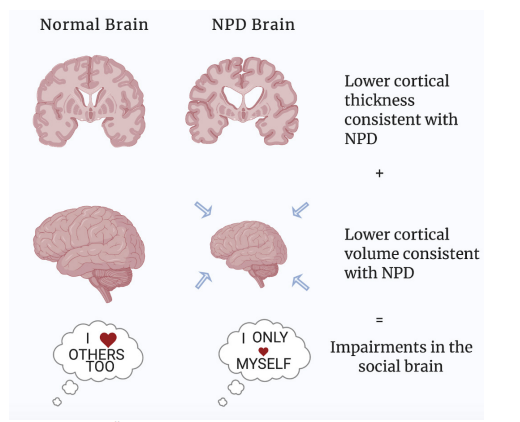
Source: Kaitlyn Griffith.

When we understand the neurobiological differences between a person with and without a personality disorder, we can isolate potential causes and treatment opportunities.

“Early life intervention also offers hope of preventing dysfunction associated with abuse, neglect and adversity that in many instances are-direct normal brain and mind trajectories toward personality disorder.” — Dragan M. Svrakic & Charles F. Zorumski.

Because narcissistic personality disorder (NPD) often leads to interpersonal dysfunction, the social brain is of particular interest; the temporal-parietal junction, posterior superior temporal sulcus, medial prefrontal cortex, anterior cingulate cortex, amygdala, and interrelated regions.

I recently shared a story highlighting studies and behaviours that suggest narcissists know they’re narcissistic:

Now, I’m writing a story that looks into the neurobiological reasoning behind narcissism. However, for the following reasons, I disagree that “… [narcissistic] behaviour is not carried out by choice — the distorted view of the reality of a narcissist is a result of grey matter deficiency in the frontal lobe of the brain’.

  1. Most studies have yet to identify whether or not the differences are a result of narcissism, or the other way around.
  2. You can increase the amount of white and grey matter in the brain and other forms of neuroplasticity.
  3. Alterations in grey matter, cortical volume, neural circuitry, and other neurobiological structures and functions can lead to any number of cognitive, emotional, behavioural, and physiological disorders.
  4. Deciding to behave in a certain way takes multiple processes across multiple regions of the brain, and narrowing it down to one region negates very rich and real historical, cultural, contextual, and environmental influences.

“…A cause is just a cause, and causation per se is not an excuse, whether the causation is ‘normal’ or ‘abnormal.’ If causation were an excuse, no one would be responsible for any conduct, because all behavior is caused by multiple variables not within the agent’s control.” — Stephen Morse.

Traits.

People with NPD fit within five or more of nine criteria which encompass a lack of empathy, grandiose fantasies, arrogance, attention-seeking, and exploitativeness.

Empathy and perspective-taking are differentiated in neural activity. Empathy activates the anterior insula and anterior cingulate cortex while perspective-taking activates the medial prefrontal regions, temporal poles, and the superior temporal sulcus.

“… behavioral evidence suggests that limited empathy in narcissism might be more due to lower propensity than capacity. “ — Emanuel Jauk & Philipp Kanske.

Narcissists are capable of cognitive empathy but lack emotional empathy, so they intellectually know someone feels a certain way, they’re just not capable of feeling it or motivated to act on empathy, unless it benefits them.

Studies show reduced activity and grey matter volume in the anterior insula (AI) and anterior cingulate cortices (ACC) of narcissists compared to control groups. The AI and ACC are activated during both personal experiences and empathic reactions.

Narcissists showed distress during social exclusion with significant activity in the anterior insula, dorsal anterior cingulate cortex and subgenual anterior cingulate cortices, known for signalling social pain.

The narcissistic inflated self-view does not align with research demonstrating their lack of self-awareness, neediness and insecurity, low or unstable self-esteem, hypersensitivity to social exclusion, and heightened vigilance to ego threat, yet these are all confirmed in MRI scans and other neuroscientific studies.

A 2021 study comparing the effects of cocaine abuse and narcissism show how similarities in the dysregulation and alteration of dopamine and serotonergic signalling may explain personality disorders.

People who abuse cocaine and grandiose narcissists (GN) exhibit personality and interpersonal dysfunction, pathological personality traits (grandiosity and attention-seeking), considerable disability, treatment resistance, poorer treatment outcome, higher risk for relapse, and suicide. This also suggests an angle for differentiating vulnerable from grandiose narcissism.

Relationships.

Narcissists often have dysfunctional relationships within their families, at work, and on an intimate level. Narcissists rarely maintain long-term intimate relationships and if and when they do, their partners suffer more.

Narcissists are dependent on and highly sensitive to evaluations from others. When the evaluations from others do not gratify the narcissist’s needs, they respond aggressively, particularly to rejection.

Deception increases testosterone in male narcissists and reduces stress in grandiose narcissists (GN), with some GNs even showing enjoyment from deceiving others.

Object constancy or object relations is the learned ability to maintain and understand constancy in relationships despite fluctuations in a person’s behaviour. Narcissists lack object constancy, tending toward black and white thinking, where people are seen as good or bad, right or wrong, with no in-between.

The plasticity of circuitry within the hippocampal-amygdala-medial prefrontal cortex regions, responsible for the development of object relations, may provide solutions to re-establish object constancy in patients with personality disorders such as narcissism, shizoid, and borderline.

Another reason people with sublinial and clinical narcissism struggle in relationships is that they initially portray a false image in the idealiztion stage, then as their traits and defence mechanisms reveal themselves, the devaluation and discard stages follow.

Neurobiology and neuroscience allow us to identify differences between self-reports and neural activity, particularly with narcissists who tend to disguise their insecurities (GNs) and overestimate their social competencies.

Although there is much more research needed, across larger and broader populations, such information provides useful data for further studies, and has the potential to support future diagnostic tools and prevention and treatment opportunities.

Thank you for reading.❤

If you’re interested in reading more or earning money for your writing, please click the following link to join the Medium community:

Related stories:

Psychology
Mental Health
Narcissism
Life Lessons
Neuroscience
Recommended from ReadMedium