
What’s a Nice Jewish Girl Like Me Doing in a Christmas Book?
Telling a Story and Representing my Tribe
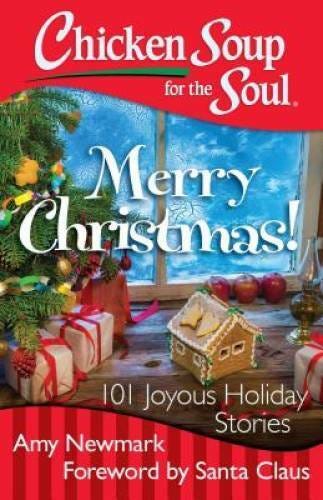
I’m a Jewish writer who was included in a “Chicken Soup for the Soul” Christmas collection that promised the reader 101 Joyous Holiday Stories. (Actually, my own contribution was more Flippant than Joyous. But 100 Joyous Holiday Stories and One Flippant Holiday Story doesn’t really fly as a subtitle.)
Over the years, Chicken Soup has welcomed a number of Jews into their holiday collections.
“I was in the last one,” my pal Risa Nye tells me. “Oy! My bubbe would plotz.”
But my pal Deb jokes, “If there’s chicken soup, there should be at least one Jew, right?”
There were, in fact, seven Jews in the book my story was in. So what did we write about?
Shari Cohen Forsythe described the time a law school friend’s family welcomed her into their home for the holidays. “Talk about a gefilte fish out of water!” But her friend’s mother had taken the time and trouble to seek out the one synagogue in town and ask the rabbi what a Jewish girl would want for Hanukah. It was, of course, a menorah and candles!
“I learned,” concluded Forsythe, “that simple acts of kindness can remain in your heart forever.”
Judy Davidson wrote about the night that she, her husband and their young kids created a Christmas celebration for a local homeless shelter. Did these observant Jews have any problem with staging a fabulous Christmas? Not at all.
“Judaism teaches that helping others is a commandment,” wrote Davidson, noting that performing this mitzvah only solidified her own family’s sense of Jewish identity.
Susan J. Gordon took on the topic of secular businesses who attempt to honor Jewish traditions they don’t understand, in a piece about coaching a well-meaning local bank manager on the fine points of lighting a menorah, which, she had to explain, is a sacred act central to the celebration of Hanukah, and not just the Jewish equivalent of putting up a Christmas tree.
My own contribution, “When Should the Christmas Lights Come Down?” was inspired by a friend’s decision to leave his holiday lights up all winter “to ward off winter gloom” and the responses he got when he posted about this on Facebook, ranging from “Great idea!” to “Bah humbug.”
Several of the stories were about mixed marriages. Andrea Bates, married to a non-Jew, described “raising our little Jewish southern girl” in a home in which her daughter placed her Hanukah gifts beneath a Christmas tree — which was crowned with a Star of David. Ferida Wolff, whose daughter married outside the faith, told of crafting an impromptu Christmas tree for visiting grandchildren.
Lisa Pawlak, whose mom was Protestant and whose dad was a Jew, ended up marrying a Panamanian Catholic, resulting in a wealth of holiday traditions, including a menorah, dreidels, latkes, stockings, a tree, fireworks and arroz con pollo.
“We embrace a spirit of adventure,” she wrote, “along with the richness of our family’s cultural diversity and absolute certainty of our underlying love for each other.”
The one thing these stories have in common is a strong sense of Jewish identity. All of us have found that, even as we encounter and embrace a diversity of traditions, we remain Jews.
You can have a Christmas tree in your house, put on a Santa suit and distribute holiday gifts to the homeless, or delight in the gigantic illuminated rotating Frosty the Snowman on your neighbor’s roof and still be Jewish.
Why be a Jew in a book destined to be shelved in the “Christian Living” section? When I asked my fellow contributors, I got a variety of responses:
“In the long tradition of Barbra Streisand, Neil Diamond and Irving Berlin,” said Shari Forsythe, “Jews like to sing, compose songs and write about Christmas — I guess I’m no exception.”
“Culture and custom and celebration all blend at the holiday time, whether Christmas or Hanukkah,” observed Ferida Wolff. “And anything that brings people closer together is a joyous thing.”
“I expect that virtually all of the readers will be non-Jews,” Susan J. Gordon told me. “I hope that my story will encourage them to reflect on how the holiday world looks from a non-Christian perspective.”
Being a Jew at Christmas can be a challenge. As the airwaves fill with carols and the stores crowd with holiday shoppers, you can feel as if you’re being steamrolled by a gigantic Christmas Cheer machine, driven by Santa and spewing songs, gifts and tinsel.
It’s enough to make a person feel invisible. And nobody likes that. Being a Jew in a Christmas collection is an opportunity to tell its largely Christian readership: We’re here! We’re Jewish! And here’s what “the most wonderful time of the year” means to us.
Writing Coach and editor-for-hire Roz Warren, who writes for everyone from the Funny Times to the New York Times, can help you improve and publish your work. Drop her a line at [email protected]. (That’s Ros with an “s,” not a “z.”)


