avatarEric Sentell

Free AI web copilot to create summaries, insights and extended knowledge, download it at here

6805

Abstract

els.">Nephilim</a> angels, men, or giants?</p><p id="1235">The circles of belief helps us realize that faith isn’t “all or nothing.”</p><figure id="c7d6"><img src="https://cdn-images-1.readmedium.com/v2/resize:fit:800/0*q4b-zqfMG09zJ5q5"><figcaption>Photo by <a href="https://unsplash.com/@gusmorettaa?utm_source=medium&amp;utm_medium=referral">Gus Moretta</a> on <a href="https://unsplash.com?utm_source=medium&amp;utm_medium=referral">Unsplash</a></figcaption></figure><h2 id="1a59">Apologize</h2><p id="f27d">When people share their skepticism or reveal how the Church hurt them, it’s only human nature to get defensive. But it’s far better to apologize.</p><p id="8e94">When either non-believers or the devout say they believe something different than the accepted view in Christianity or a particular faith community, Christians usually roll out their best arguments for what they believe and why it’s far superior to the skeptic’s ideas. Then they wonder why the person doesn’t bend to their will.</p><p id="a9ac" type="7">Or am I the only one who’s made that mistake?</p><p id="17b8">When people reveal that the Church hurt them, whether physical abuse or judgment and condemnation, Christians are often too quick to explain that other churches aren’t like that — or worse, to blame the victim.</p><p id="9d43">Your apology might be the first apology that the hurt person may have ever received on behalf of the Church. Don’t miss the opportunity.</p><figure id="6cc5"><img src="https://cdn-images-1.readmedium.com/v2/resize:fit:800/1*nqezNLyH8TJzSFA_MY_KvA.jpeg"><figcaption>President Trump holding a bible upside down after clearing peaceful protesters from in front of St. John’s Episcopal Church outside the White House</figcaption></figure><h2 id="6df1">Disentangle Politics and Faith</h2><p id="1f45">The fusion of politics and religion has pained countless people (especially in America). To respond to skepticism in others and ourselves, we may need to tackle politics head-on.</p><p id="67a8">People who grew up in church were taught to be moral and kind. Then the people who taught them those values supported Donald Trump.</p><p id="227c">They were taught to be pro-life. Then the people who taught that position supported taking away poor people’s healthcare by <a href="https://www.commonwealthfund.org/blog/2020/repealing-affordable-care-act-just-when-people-need-it-most">overturning the Affordable Care Act</a> (a.k.a. Obamacare) and separating children from their parents and putting them in <a href="https://www.nytimes.com/2020/10/23/us/politics/trump-child-separation.html">cages at the U.S.-Mexico border</a>.</p><p id="8d2b">They were taught Jesus is lord and savior. Then the people who preached about Jesus began describing Trump and the GOP with savior language — he became God’s instrument, a “<a href="https://www.vox.com/identities/2018/3/5/16796892/trump-cyrus-christian-right-bible-cbn-evangelical-propaganda">King Cyrus</a>.”</p><p id="cdbd" type="7">Nothing good comes from fusing religion and politics.</p><p id="b450">People outside the faith heard that Christianity values loving and accepting others unconditionally, just as Jesus did, and caring for the poor and vulnerable, as the bible commands.</p><p id="e9ac">But they saw the Church condemn gays, lesbians, and trans people. They witnessed the people who claimed to follow Jesus and the bible bind themselves to anti-immigrant and anti-refugee policies, demonizing and cutting welfare programs, and “religious liberty” laws whose main purpose appears to be licensing discrimination on religious grounds.</p><p id="b3cb">Nothing good comes from fusing religion and politics. When people share that it’s a stumbling block or that they were hurt by it — when <i>we</i> are stumbling or hurt by it — we’ve got to repent, to turn away, and separate our faith from our politics.</p><p id="ed71">Perhaps we tell the skeptic, we’re not like other Christians when it comes to the role and place of politics. Maybe we tell ourselves, we don’t have to be like that to continue loving God and others — indeed, not being like that would actually help with loving God and others!</p><p id="9d59">(I have many more thoughts about the damaging fusion of politics and religion.)</p><div id="f37c" class="link-block"> <a href="https://readmedium.com/christians-follow-christ-not-politicians-f371e256a237"> <div> <div> <h2>Christians Follow Christ — Not Politicians</h2> <div><h3>How Christians ought to (not) do politics</h3></div> <div><p>medium.com</p></div> </div> <div> <div style="background-image: url(https://miro.readmedium.com/v2/resize:fit:320/1*vqLihDNdt2usOFWs-wFiAg.png)"></div> </div> </div> </a> </div><figure id="f9c1"><img src="https://cdn-images-1.readmedium.com/v2/resize:fit:800/0*O-ZpFeiFltM3e9Iy"><figcaption>Photo by <a href="https://unsplash.com/@freestocks?utm_source=medium&amp;utm_medium=referral">freestocks</a> on <a href="https://unsplash.com?utm_source=medium&amp;utm_medium=referral">Unsplash</a></figcaption></figure><h2 id="c4e2">Ask Why They’re Not More Skeptical</h2><p id="510c">If the main goal is empathy, then the main activity should be asking questions.</p><p id="f2fa">But we must ask those questions to learn, not to debate. I hate it when someone doesn’t really listen to my answers because he or she is too busy refuting them, twisting them around, or coming up with unrelated points and “what-abouts.”</p><p id="2740">None of that happens when we’re asking because we genuinely want to know the answer, because we authentically care.</p><p id="3145">If you must ask questions aimed at persuasion, then ask simply, “Why aren’t you more skeptical?”</p><p id="7390">That question prompts the person to supply his or her own reasons for belief. It helps them recognize where common ground might exist.</p><figure id="4174"><img src="https://cdn-images-1.readmedium.com/v2/resize:fit:800/0*cv22wekgVMPbt_j4"><figcaption>Photo by <a href="https://unsplash.com/@nasa?utm_source=medium&amp;utm_medium=referral">NASA</a> on <a href="https://unsplash.com?utm_source=medium&amp;utm_medium=referral">Unsplash</a></figcaption></figure><h2 id="8804">Disentangle Science and Faith</h2><p id="8195">Science and faith can’t be reconciled like people wish, yet they also don’t conflict like they think. The more we separate our scientific and religious perspectives, the better we can handle skepticism in others and ourselves.</p><p id="1476">Science doesn’t even attempt to study what it can’t observe, measure, and prove or disprove. God is literally beyond the scope of scientific study.</p><p id="9fb4">Faith, or religi

Options

on, assumes that some things can’t be conclusively proven or disproven. It asks very different questions than science.</p><p id="f886">Because of their differing ways of making sense of reality, science and faith will never reconcile the way that many people wish. That is, they’ll never become fully united in their pursuit and demonstration of truth. The questions they ask and answer are just too fundamentally different.</p><p id="6c7f" type="7">Science and faith deal with fundamentally different questions.</p><p id="c11d">Therefore, they don’t actually conflict the way many people think. Indeed, they can complement each other, with science explaining the <i>what</i> and <i>how </i>and religion exploring the <i>why</i>.</p><p id="1716">Far too many Christians have debated Creationism vs. the Big Bang and evolution in ways that pit science and faith against each other; that create spiritual crises for teens who attend college and learn that science isn’t crazy; and that lead people who grow up outside Christianity to view Christians as irrational at best and mean-spirited at worst.</p><p id="940d">The debate presupposes that Genesis is a scientific account. But it isn’t, and it isn’t trying to be.</p><p id="5c7d">In Genesis 2, we read a creation account that <i>ends </i>with Adam and Eve. In Genesis 3, we read a creation account that <i>begins </i>with Adam and Eve. If we <a href="https://bibleproject.com/podcast/science-faith/">read Genesis on its own terms</a>, then it’s obvious that Genesis is neither security camera footage nor a scientific explanation of creation.</p><p id="161a">Separating our religious beliefs from science can end the tension that many Christians experience when they can’t ignore or deny science’s differences from scripture as well as minimize the friction non-believers may feel when approaching spirituality.</p><figure id="f5f9"><img src="https://cdn-images-1.readmedium.com/v2/resize:fit:800/0*OO_cZaGRnQvXfjxU"><figcaption>Photo by <a href="https://unsplash.com/@dvbarrantes?utm_source=medium&amp;utm_medium=referral">Diana Vargas</a> on <a href="https://unsplash.com?utm_source=medium&amp;utm_medium=referral">Unsplash</a></figcaption></figure><h2 id="7a64">Offer New Ways of Thinking about God</h2><p id="cf3a">Skeptics are skeptical for a reason. Trying to convince them, or yourself, to stop being skeptical is a fool’s errand.</p><p id="cc70">Christians who don’t believe in, say, biblical inerrancy probably won’t believe it because you say they must. If you’re uncertain about it (or something else), it’s because of something in your life experience, discipleship, or heart. You’re unlikely to put the genie back in the bottle.</p><p id="cf78">A non-believer who’s been burned by judgmental, condemning Christians won’t suddenly convert because you present the benefits of giving your life to Christ, or insist that other Christians are better, or suggest that they should be more forgiving.</p><p id="fe00">Instead, simply offer others and yourself new ways of thinking about God, Jesus, the Holy Spirit, the bible, Christians, and so on. There’s no shortage of resources.</p><ul><li>Unsure about biblical inerrancy? Check out <a href="https://peteenns.com/">Pete Enns</a>’ blog, books, and podcast.</li><li>Confused about anything in the bible? Check out the <a href="https://www.googleadservices.com/pagead/aclk?sa=L&amp;ai=DChcSEwjMwvLjld3tAhUj9-MHHTa-CBoYABAAGgJ5bQ&amp;ae=2&amp;ohost=www.google.com&amp;cid=CAESQeD2nWZtg5d7qlHdIVbqsJyZrzu9KWbd2koB7wOhoIqbkARZaVgsw8Jo-EtiGcBpsvI4hIf5oEkSvwNXG2y1m1Ll&amp;sig=AOD64_0ypysJ3Bf7QXB3rAf8pXF2Ybl6Yg&amp;q&amp;adurl&amp;ved=2ahUKEwjR_-fjld3tAhUGT6wKHezIA1IQ0Qx6BAgdEAE">Bible Project</a> videos, podcast, and blog.</li><li>Perplexed by the idea of hell as eternal conscious torment? See what <a href="https://reknew.org/">Greg Boyd</a> says about <a href="https://reknew.org/2008/01/the-case-for-annihilationism/">annihilationism </a>or how C.S. Lewis presents universalism in <a href="https://en.wikipedia.org/wiki/The_Great_Divorce"><i>The Great Divorce</i></a>.</li><li>Dissatisfied with the typical answers to the problem of evil? <a href="http://thomasjayoord.com/">Thomas Jay Oord</a> has an interesting perspective you might not have heard yet.</li></ul><p id="5003">Of course, you don’t necessarily need to read a dozen books or listen to a hundred sermons so that you can present a range of belief options. <b>If you just encourage searching for resources, then you’ll have done enough.</b></p><h2 id="98c6">Summary</h2><p id="43f9">Well, I warned that you’d be disappointed with this essay. I didn’t deliver the fool-proof steps to persuading skeptics, or at least demolishing their arguments and leaving them in a heap of nihilistic dread and despair.</p><p id="891f">It’s interesting to contrast the verbs I use above with the actions many Christians associate with responding to skepticism.</p><p id="47e3">Empathize. Give grace. Apologize. Ask questions to learn. Present new belief options. Encourage.</p><p id="4d8d">Defend the faith. Quote the bible. Cite Christian apologists. Dismantle atheism as a belief system. Argue. Persuade. Convince.</p><p id="5272">I think we all know which set of actions can be considered synonyms for the verb love.</p><p id="a551">Ultimately, we’re called to love, and love is the best evangelism.</p><p id="fea6">This is the third part in a series. Read parts one and two.</p><div id="bc2e" class="link-block"> <a href="https://readmedium.com/talking-god-with-doubters-927be93f15f5"> <div> <div> <h2>Talking God with Doubters</h2> <div><h3>Or, how to listen, empathize, and love well (Pt. I)</h3></div> <div><p>medium.com</p></div> </div> <div> <div style="background-image: url(https://miro.readmedium.com/v2/resize:fit:320/0*KiMu8LAFVURvzszE)"></div> </div> </div> </a> </div><div id="eafc" class="link-block"> <a href="https://readmedium.com/the-diversity-and-mystery-of-god-d6f947becf26"> <div> <div> <h2>The Diversity and Mystery of God</h2> <div><h3>How to listen, empathize, and love well (Pt. II)</h3></div> <div><p>medium.com</p></div> </div> <div> <div style="background-image: url(https://miro.readmedium.com/v2/resize:fit:320/0*H0loGfEdRbYsgNDG)"></div> </div> </div> </a> </div><p id="41b0" type="7">Writer tackling faith, politics, relationships, writing, media, & other impolite topics. College Teacher. Podcaster. My newsletter: https://tinyurl.com/yy7znuy8</p></article></body>

What to Do with Skepticism?

How to listen, empathize, and love well (Pt. III)
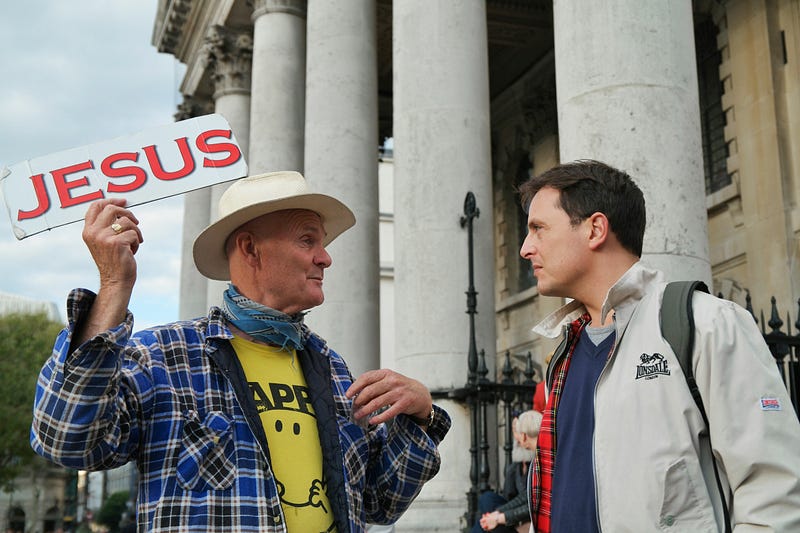
Photo by Malcolm Lightbody on Unsplash

This essay is the latest in a series about responding to spiritual doubt, skepticism, and atheism. The first essay in the series focused on creating space for questions and doubts. The second essay described how emphasizing the diversity and mystery of belief can help with doubts.

Here, I focus on engaging skeptics—and our own skepticism.

I define “skeptics” as people who are open to considering faith but don’t believe in much, or any, of Christianity. One of my friends, for instance, will casually refer to the “Sky-God,” but he’ll also listen if I open a serious conversation about faith and spirituality.

It’s important to also recognize that many Christians possess some skepticism about certain doctrines, beliefs, or practices. A little skepticism can go a long way toward undermining faith for some people.

Some of those people might even be us!

There’s a right way and a wrong way to respond to the skepticism in ourselves and others. It’s only fair to say, however, that you’re probably going to be disappointed in this essay.

Photo by Tim Marshall on Unsplash

Empathize

Whenever you enter a conversation with a skeptic—someone who’s open to discussing faith but doesn’t believe—with the goal of converting that person to Christianity, you’re likely to only harden the person’s skepticism.

Instead, make your primary goal empathizing with the person.

Put yourself in the other person’s shoes. Look at things from their point-of-view or frame-of-reference. Try to understand why they think what they think and why they feel the way they feel.

It would be easy to dismiss my friend as an insensitive jerk for joking about the “Sky-God.” It would be easy to pity my other friend who once stared off into space when I invited him to a church BBQ.

But then I’d never know that the “Sky-God” friend held very cynical views of the Church because of several high-profile financial scandals among large churches in his hometown. I’d never know about the bullying, hurt, and pain that the BBQ friend had experienced at the hands of people who claimed to be Christians.

We can’t begin to persuade skeptics unless we have authentic relationships with them, and we can’t forge authentic relationships unless we strive to understand where people are coming from. Evangelism and relationship go hand-in-hand.

Photo by Jaclyn Moy on Unsplash

What about Skeptics in Church?

Empathy is especially important when the skeptic belongs to your faith community.

Untold numbers of thoughtful, conscientious people have left their churches or Christianity because their evolving faiths faced judgment and defensiveness rather than empathy.

They expressed different beliefs or simply posed questions. The people who should’ve been there to listen, to talk, to love, instead pushed them to cling to their prior, often narrow beliefs or to stop questioning.

Wounded, they looked elsewhere for spiritual nourishment.

We must remember, as biblical scholar Pete Enns said at the Evolving Faith conference in 2018, “Evolving faith is faith.” Then we must listen with humility, openness, and love, trying to understand where they’re coming from and how we might help.

Photo by Patrick Fore on Unsplash

What about When You’re the Skeptic?

Give yourself grace. That’s what Jesus would do after all.

Jesus’ ministry was radically inclusive and welcoming. He dined with “tax collectors and sinners.” He healed the daughter of a Gentile woman even though she wasn’t Jewish. He made a Samaritan, an ethnic group the Jews hated, into a hero.

If Jesus died for us while we were still sinners, then Jesus can tolerate our skepticism.

I’ve also found the “circles of belief” analogy to be very helpful.

Imagine three concentric circles.

The core circle contains essential tenets that we ought to hold onto very tightly. It’s subjective to each person, but it’s very small by nature. Like Apostle’s Creed small.

The next circle contains important but negotiable beliefs — the kinds of things that believers have debated and advanced different theories about for thousands of years.

The last circle is filled with trivial matters. Were the Nephilim angels, men, or giants?

The circles of belief helps us realize that faith isn’t “all or nothing.”

Photo by Gus Moretta on Unsplash

Apologize

When people share their skepticism or reveal how the Church hurt them, it’s only human nature to get defensive. But it’s far better to apologize.

When either non-believers or the devout say they believe something different than the accepted view in Christianity or a particular faith community, Christians usually roll out their best arguments for what they believe and why it’s far superior to the skeptic’s ideas. Then they wonder why the person doesn’t bend to their will.

Or am I the only one who’s made that mistake?

When people reveal that the Church hurt them, whether physical abuse or judgment and condemnation, Christians are often too quick to explain that other churches aren’t like that — or worse, to blame the victim.

Your apology might be the first apology that the hurt person may have ever received on behalf of the Church. Don’t miss the opportunity.

President Trump holding a bible upside down after clearing peaceful protesters from in front of St. John’s Episcopal Church outside the White House

Disentangle Politics and Faith

The fusion of politics and religion has pained countless people (especially in America). To respond to skepticism in others and ourselves, we may need to tackle politics head-on.

People who grew up in church were taught to be moral and kind. Then the people who taught them those values supported Donald Trump.

They were taught to be pro-life. Then the people who taught that position supported taking away poor people’s healthcare by overturning the Affordable Care Act (a.k.a. Obamacare) and separating children from their parents and putting them in cages at the U.S.-Mexico border.

They were taught Jesus is lord and savior. Then the people who preached about Jesus began describing Trump and the GOP with savior language — he became God’s instrument, a “King Cyrus.”

Nothing good comes from fusing religion and politics.

People outside the faith heard that Christianity values loving and accepting others unconditionally, just as Jesus did, and caring for the poor and vulnerable, as the bible commands.

But they saw the Church condemn gays, lesbians, and trans people. They witnessed the people who claimed to follow Jesus and the bible bind themselves to anti-immigrant and anti-refugee policies, demonizing and cutting welfare programs, and “religious liberty” laws whose main purpose appears to be licensing discrimination on religious grounds.

Nothing good comes from fusing religion and politics. When people share that it’s a stumbling block or that they were hurt by it — when we are stumbling or hurt by it — we’ve got to repent, to turn away, and separate our faith from our politics.

Perhaps we tell the skeptic, we’re not like other Christians when it comes to the role and place of politics. Maybe we tell ourselves, we don’t have to be like that to continue loving God and others — indeed, not being like that would actually help with loving God and others!

(I have many more thoughts about the damaging fusion of politics and religion.)

Photo by freestocks on Unsplash

Ask Why They’re Not More Skeptical

If the main goal is empathy, then the main activity should be asking questions.

But we must ask those questions to learn, not to debate. I hate it when someone doesn’t really listen to my answers because he or she is too busy refuting them, twisting them around, or coming up with unrelated points and “what-abouts.”

None of that happens when we’re asking because we genuinely want to know the answer, because we authentically care.

If you must ask questions aimed at persuasion, then ask simply, “Why aren’t you more skeptical?”

That question prompts the person to supply his or her own reasons for belief. It helps them recognize where common ground might exist.

Photo by NASA on Unsplash

Disentangle Science and Faith

Science and faith can’t be reconciled like people wish, yet they also don’t conflict like they think. The more we separate our scientific and religious perspectives, the better we can handle skepticism in others and ourselves.

Science doesn’t even attempt to study what it can’t observe, measure, and prove or disprove. God is literally beyond the scope of scientific study.

Faith, or religion, assumes that some things can’t be conclusively proven or disproven. It asks very different questions than science.

Because of their differing ways of making sense of reality, science and faith will never reconcile the way that many people wish. That is, they’ll never become fully united in their pursuit and demonstration of truth. The questions they ask and answer are just too fundamentally different.

Science and faith deal with fundamentally different questions.

Therefore, they don’t actually conflict the way many people think. Indeed, they can complement each other, with science explaining the what and how and religion exploring the why.

Far too many Christians have debated Creationism vs. the Big Bang and evolution in ways that pit science and faith against each other; that create spiritual crises for teens who attend college and learn that science isn’t crazy; and that lead people who grow up outside Christianity to view Christians as irrational at best and mean-spirited at worst.

The debate presupposes that Genesis is a scientific account. But it isn’t, and it isn’t trying to be.

In Genesis 2, we read a creation account that ends with Adam and Eve. In Genesis 3, we read a creation account that begins with Adam and Eve. If we read Genesis on its own terms, then it’s obvious that Genesis is neither security camera footage nor a scientific explanation of creation.

Separating our religious beliefs from science can end the tension that many Christians experience when they can’t ignore or deny science’s differences from scripture as well as minimize the friction non-believers may feel when approaching spirituality.

Photo by Diana Vargas on Unsplash

Offer New Ways of Thinking about God

Skeptics are skeptical for a reason. Trying to convince them, or yourself, to stop being skeptical is a fool’s errand.

Christians who don’t believe in, say, biblical inerrancy probably won’t believe it because you say they must. If you’re uncertain about it (or something else), it’s because of something in your life experience, discipleship, or heart. You’re unlikely to put the genie back in the bottle.

A non-believer who’s been burned by judgmental, condemning Christians won’t suddenly convert because you present the benefits of giving your life to Christ, or insist that other Christians are better, or suggest that they should be more forgiving.

Instead, simply offer others and yourself new ways of thinking about God, Jesus, the Holy Spirit, the bible, Christians, and so on. There’s no shortage of resources.

  • Unsure about biblical inerrancy? Check out Pete Enns’ blog, books, and podcast.
  • Confused about anything in the bible? Check out the Bible Project videos, podcast, and blog.
  • Perplexed by the idea of hell as eternal conscious torment? See what Greg Boyd says about annihilationism or how C.S. Lewis presents universalism in The Great Divorce.
  • Dissatisfied with the typical answers to the problem of evil? Thomas Jay Oord has an interesting perspective you might not have heard yet.

Of course, you don’t necessarily need to read a dozen books or listen to a hundred sermons so that you can present a range of belief options. If you just encourage searching for resources, then you’ll have done enough.

Summary

Well, I warned that you’d be disappointed with this essay. I didn’t deliver the fool-proof steps to persuading skeptics, or at least demolishing their arguments and leaving them in a heap of nihilistic dread and despair.

It’s interesting to contrast the verbs I use above with the actions many Christians associate with responding to skepticism.

Empathize. Give grace. Apologize. Ask questions to learn. Present new belief options. Encourage.

Defend the faith. Quote the bible. Cite Christian apologists. Dismantle atheism as a belief system. Argue. Persuade. Convince.

I think we all know which set of actions can be considered synonyms for the verb love.

Ultimately, we’re called to love, and love is the best evangelism.

This is the third part in a series. Read parts one and two.

Writer tackling faith, politics, relationships, writing, media, & other impolite topics. College Teacher. Podcaster. My newsletter: https://tinyurl.com/yy7znuy8

Christianity
Spirituality
Religion
Church
Faith
Recommended from ReadMedium