
Christians Follow Christ — Not Politicians
How Christians ought to (not) do politics

Over the weekend of Dec. 11–13, 2020, supporters of Donald Trump who identify as Christian gathered in Washington, D.C., and other American cities for the Jericho March to protest the U.S. Presidential election results and “stop the steal.” This is not how Christians ought to do politics.
According to the event’s website, “Jericho March calls upon people of faith to prayer, fasting, and peaceful protest in the service of God, and in defense of life, liberty, and justice.” What?
The early Christians would be very confused by this mission statement.
Jesus showed his followers that the “service of God” is different and distinct from “defense of life, liberty, and justice.” He served God by giving up life, liberty, and justice! He taught his followers to do the same, to separate their political identities from their religious identities.
When baited with the question of whether to pay taxes to Rome or to revolt, Jesus answered, “Render unto Caesar what is Caesar’s.”
When Peter attacked a Roman soldier — likely thinking, “This is it! The revolution begins!” — Jesus rebuked violence and revolt.
Those Christians who refuse to accept the election results because they view Donald Trump as a savior have entangled their religious identity with their political identity.
Their politics have become so fervent, so zealous, that they’re willing to embrace fanciful claims of election fraud that have resulted in a 50–1 record in the courts. That they’re enthusiastic about invalidating votes they don’t like and overturning the results of a free, fair election.
Their devotion to Trump has become so intense, so devout, that they support everything he says and does. No matter that he doesn’t provide any evidence of election fraud. Who cares that he bragged about grabbing women by their genitals? Just locker room talk. Who cares that he’s credibly accused of sexual assault by 26 women? Just lies and smears.
Is Trump perfect? Of course not, but neither was King Cyrus and God used him to liberate the Israelites. Personal morality and character don’t matter for a president anyway, except when it mattered for Democrat Bill Clinton.
When politics becomes a religion, and religion becomes a political affiliation, then very bad things happen:
- Political Idolatry — investing the kind of hope and fervor usually reserved for the Gospel into political leaders, parties, or policy platforms;
- Vulnerability to Manipulation — when you view a political leader or party as your savior, then that leader or party can convince you to think, say, or do virtually anything, including adopting hypocritical positions;
- Damaged Witness — who will want to be part of a Christianity that appears to be more obsessed with wielding political and cultural power, even if it requires hypocrisy, than loving God and others?
- Religious Intolerance — centering Christianity as the default faith imposes it onto people of other faiths or no faith, undermining religious liberty;
- Opening Doors to Persecution — while politically dominant, centering your faith may seem like a good idea, but what about when a different religious group attains power?
American Christians desperately need a theology of civic participation, a recalibration of how they “do politics.”
Here are some steps toward a theology of civics.

Stop making God conservative
In America and many other countries, Christian and conservative have become synonymous. In the early 2000s, a friend in college actually mused, “I don’t think it’s possible to be a Christian and a Democrat.” In 2020, “Evangelical” is basically a synonym for “Trump supporter.”
Much of this connection results from the fusion of Christianity and conservativism on abortion. Conservatives have embraced Evangelicals’ pro-life rhetoric and policies even though regulating people’s reproduction seems like the antithesis of small-government philosophy.
It used to be possible for someone to say, “As a small-government conservative, I don’t think the government should interfere in someone’s decision of whether to have a baby.” That’s not possible anymore.
Christianity and conservativism have also fused on the issue of LGBTQI+ rights. In the U.S., Evangelicals and political conservatives alike cite the bible, not the U.S. Constitution, as their reason for opposing marriage equality.
Evidently, separation of church and state ends when consenting adults wish to marry someone of the same sex.
The upshot is that most people now view God as a conservative. Like my friend in college, like the Evangelicals at the Jericho March, they can’t fathom being Christian and also politically moderate, much less liberal.
“Most people” include non-Christians, the non-religious, and children.
Those who belong to other other faiths, or no faith, observe the fusion of Christianity and conservatism and recognize the idolatry, the hypocrisy, and the power obsession. They recognize the looming threat of centering Christianity as society’s default expression of religion.
Why would they respect the Christian faith?
Those children growing up in religious households watch as the parents and grandparents who told them “morality matters” support a man with such obvious immorality that their best excuse became, “He’s like Cyrus.”
Why would they continue in their family’s faith?
It might be hard to believe from the rhetoric and behavior of Christians, but the bible never says God is conservative.
Go to Biblegateway.com and search “conservative.”
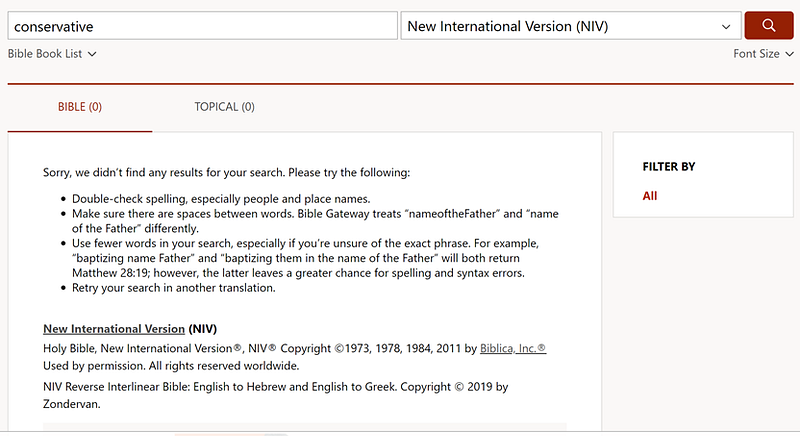
Judging by his teachings, Jesus would not feel at home in the Republican party.
Going back to the Jericho March, Jesus never equated “service to God” with “defense of life, liberty, and justice.” He never even promised his followers life, liberty, and justice in this world. He told them they’d be persecuted because of him and should look to the Kingdom of God for their salvation.
Jesus always showed concern and compassion for the most vulnerable members of society — the poor, the sick, the outcasts.
By one count, there are 100 bible verses throughout the Old and New Testaments exhorting us to care for the poor, the widow, the orphan, and (hold on to your hats) the “sojourner,” “alien,” or immigrant.
Generally speaking, conservatives would like to reduce spending on social services that help the poor, maintain or increase military spending, and restrict all forms of immigration — separating children from their parents and sticking them in cages as a deterrent to illegal immigration, even.
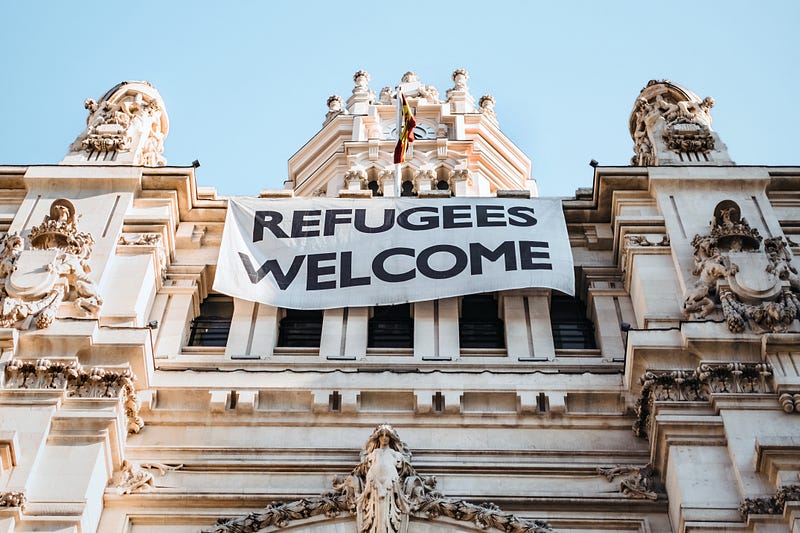
Stop making God progressive
The bible also never says that God is progressive, liberal, or Democrat.
And Jesus would not feel at home in the Democratic party either.
For one thing, caring for the poor and vulnerable in society is not exclusive to progressives, liberals, Democrats, or any political party or group. It’s something that all of us can and should do.
For another, when Jesus talked about caring for the poor and vulnerable, he meant it in a personal, intimate way.
The Good Samaritan didn’t walk past the man in need and vote Democratic because he thought universal healthcare would help people like him.
The Good Samaritan didn’t refer the man to social services or call the police and an ambulance while walking on.
He stopped and helped the man, took him to refuge, and provided for his recovery. He cared. He loved.
Laying my cards on the table, I believe universal healthcare would help the man in need (and the Good Samaritan). I’d recommend calling the police and an ambulance for him. But I like to think I would also wait for them to show up. That I’d offer ongoing help. That I’d care.
In my opinion, Christians ought to support policies that help as many people as possible, as much as possible, especially the most vulnerable. Some of those policies happen to be progressive or Democratic.
But Christians also should put themselves on the front lines of the issues they care about. Concerned about abortion? Help a pregnant woman in crisis. Start a free daycare at your church. Adopt a child. Do something to help mothers.
Do it because it’s loving — not because it marks political identity.
It’s essential that Christians never baptize any political leader, party, or policy as “the Christian one,” or else they will inevitably risk political idolatry and the fusion of their religious and political identities.

Separate your faith and political identities
In her terrific newsletter, The Cottage, author and historian Diana Butler Bass describes the effects of entangling our religious and political identities:
“…millions of white evangelical Christians literally believe that if you vote for a Democrat, you will go to hell (I’m not kidding). … Being GOP means being a true Christian, and only true Christians are going to heaven.
“…religious ‘nones’ (who are mostly Democrats and liberals) look at evangelicals and see a political identity (Republican) and Christianity. Thus, the unaffiliated can’t imagine joining a church where most or all members would judge or condemn them for their political views (this, of course, hurts churches!).
… pastors and church members alike live in fear of talking about politics or controversial issues … mainline and Catholic liberals often feel unsupported by their churches regarding issues of justice; while mainline and Catholic conservatives feel isolated or even belittled.
In short, when political identity is akin to religious identity, politics is divinized and religion becomes partisan.
When Christians turn religion into politics and politics into religion, then they harm themselves, their congregations, and their society. Inevitably, they harm their faith.
Christians must begin the hard work of disentangling our religious and political identities.
They must recognize the potential for political idolatry — investing the kind of hope usually reserved for the Gospel into our political leaders, party, or preferred policies.
Christians believe, allegedly, that they’re saved by the transformation of grace, not politicians.
They must understand that the God of the bible is neither conservative nor progressive, that Jesus didn’t belong to any political party, and that the Gospel is about love, not voting a certain way.
Christians can live out their faith beyond the pro-choice/pro-life binary.
They must begin to put themselves on the front lines of the issues they care about, forging relationships with the people most affected by those issues, listening to their needs and learning how to best support them.
As Pastor Ben Cremer said on this church’s podcast, “Imagine if the world said, ‘Christians care about those issues, and you can tell because they’re on the front lines with the people those issues affect the most.’”
“What would change?” Ben asked.
Everything, Ben. Everything.
Writer tackling faith, politics, relationships, writing, media, & other impolite topics. College Teacher. Podcaster. My newsletter: https://tinyurl.com/yy7znuy8


