
MONTHLY WRITING PROMPT
What Sitting Alone Looks Like Today
And why it may have looked better 20 years ago
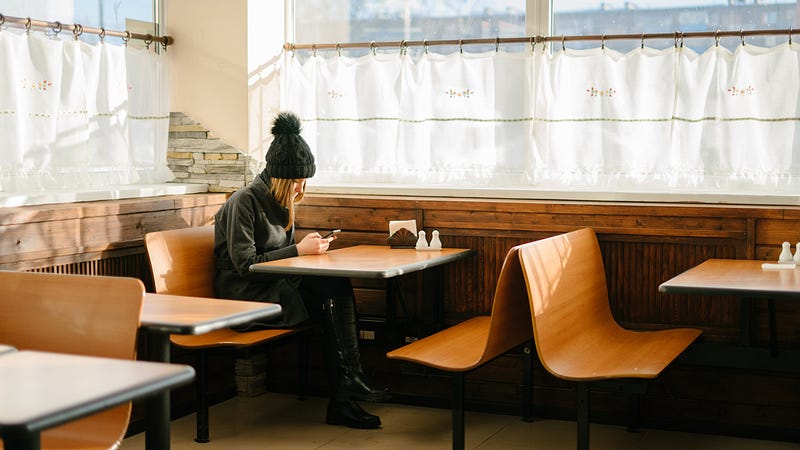
You know times have changed when you’re sitting alone in a restaurant and your impulse is to pick up your phone so that you look less alone.
Sadly, to simply sit and look at the other people around you is not really normal anymore. It could even potentially make you look like a creep, as opposed to a regular person sitting alone at a restaurant.
Yes, I’m typing this into my phone while sitting alone, at a restaurant.
But I swear, it’s just because I want to remember this thought and I don’t have a pen…
You Don’t Know What To Do With Yourself
In a world that increasingly finds ways to distract us from ourselves, it can be legitimately difficult to sit still.
In the many pockets of boredom that come up, we may resort to technology because we literally don’t know what to do with ourselves. From an increasingly younger age, we are constantly being bombarded with information and stimulus, and so naturally, when we have none, we feel strange. Empty. Almost naked.
But what if you didn’t always have to do something with yourself? What if sometimes you didn’t have to look or be entertained, busy, or engaged?
Boredom is underrated and highly necessary, because when you have nothing to do, you have everything to imagine.
So the writer in me put the phone away that night in the restaurant, as I was waiting for my friend to arrive. At first, I didn’t really know what to do with my hands or my eyes. There was some discomfort in the heightened awareness of it all. But soon enough, I got caught up in the wonders of being able to observe life in real life.
The Fear of What Lonely Looks Like From The Outside
We’re not only scared to be and feel alone, but to look alone as well. So even if you happen to be comfortable with sitting on your own and enjoying your own silence, the threat of what other people may think of that picture may lead you to pick up the phone.
And purely out of social preoccupation, you can easily find yourself scrolling back and forth past your app icons, refreshing pages, and checking for notifications.
Maybe the fear of looking alone is so big because we all experience it in some way or another. And if we all feel it, we can all identify it in each other. The trouble is, when we think we are efficiently hiding that fear behind the safety of our screens, we are really just making it more obvious.
Maybe, as a society, our egos are so inflated that to be seen as lonely would be worse than to actually feel it. Because that would make it real to others, and to ourselves.
But so many of us feel so alone, and do nothing about it out of fear of looking alone.
The way I see it, if you can’t sit with yourself, you can’t be comfortable with yourself, and that’s more terrifying than any kind of loneliness. Because in that situation, you aren’t connected to yourself, let alone to others.
What You Actually See When You Put the Phone Away
Putting distractions away means focusing on yourself, and what that feels like, but it also allows you to see others and the loneliness that exists even when people are busy on their phones, or surrounded by people.
You see the couple that’s out on a date night. She dressed up for the occasion but she looks utterly bored, or maybe she feels ignored, or worse even — comfortably accommodated. Maybe she thinks that staring at the unavailable glow of his face, illuminated by his screen, is commonplace. The habitual lull that works its way into a marriage.
But she is so young. And so is the marriage.
So maybe she’s considering just how much she’d love to be looked at. To be the source of hypnosis that his screen is stealing.
She forces a laugh, almost as if to tell others around her that she is in fact engaged. Or maybe I’m misreading her signals, and she is in fact content with this lousy excuse for a night out.
Who knows.
All I know is that when we detach from our attachment to appearing social, desired, and validated, we can finally be free.
We can finally sit with ourselves, like we used to, alone at a restaurant, with nothing but time in our hands.
Your support fuels my writing, and I appreciate you. To read more from me, click here, or sign up to receive an email whenever I publish a story. For unlimited access to my stories and those of other writers, become a Medium member and directly support me and this wonderful writing community.
Do you have any intergenerational thoughts on the topic of changing times? Check out our monthly prompt for January! We’d love to hear your story! Share your piece with us and tag “Monthly Writing Challenge”.


