
What Life as a Synesthete Looks Like: Colourful!
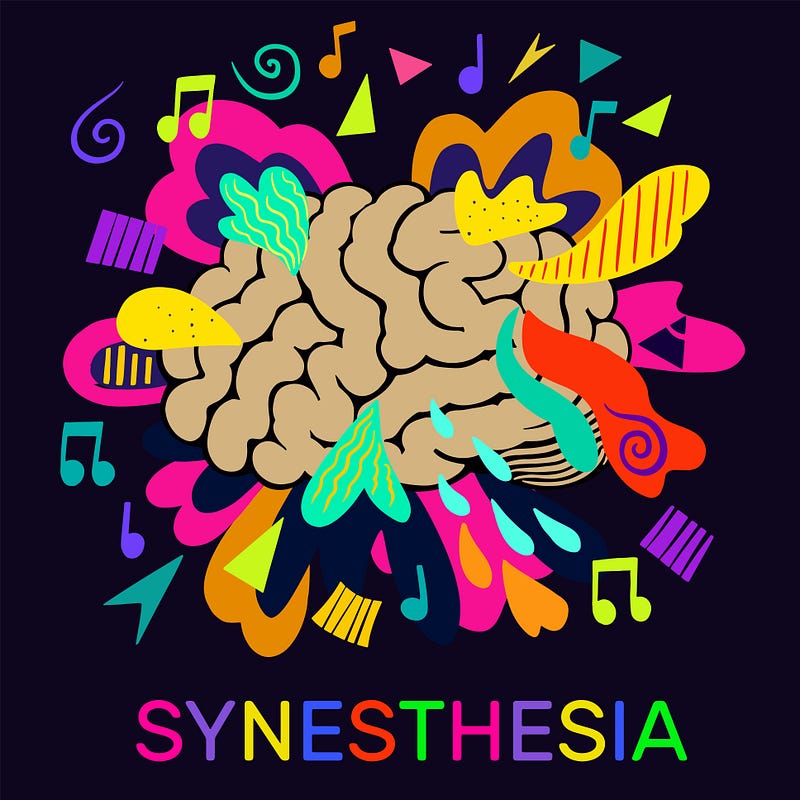
Until I was around 13 years old, I didn’t know that the way I see was extraordinary. I have never questioned whether this is normal or not. Because for me there was never another way to see. I couldn’t question it because I never had a comparison. Until — I still don’t know how I came up with it — I came online to a research site on synesthesia that offered a Germany-wide test to find out how many people perceive the world synaesthetically and if yes, in what intensity.
I immediately took this test. First, I had to answer basic questions about everyday phenomena. Whether and if so, which everyday phenomenon I even perceive. Because synesthesia is an innate characteristic of the perception of sensory stimuli. In addition to normal perception, people with synesthesia experience additional sensations when a sensory stimulus is triggered.
Because the term synesthesia comes from ancient Greek and means syn (=together) and aisthesis (=feeling), so synesthesia is the co-excitation of one sense organ when another is stimulated. This happens on an additional channel of perception. As a result, some synesthetes can also feel letters or taste words. Others can see sounds in bright colours.
For Me, It Was a Sensation
After answering the basic questions, the test found out that I have a certain tendency towards an ability: that I see letters and numbers in colours.
For me, it was a sensation. First time I understood that it’s a special ability to see what I see and there are just a few who perceive the environment in this way. Not only in black on white or otherwise. I see every letter and every number in a different colour or in shades of colour. For example: an “A” is — for me — dark red, a “B” light blue, a “C” dark white, an “H” bright white, an “S” yellow and so on. This is also the case with numbers.
Really interesting is that numbers that are shaped similarly to letters have the same colors. An “F” is similar shaped to a “7”, so the colour for both is orange. And “I” is like “1” , so they have both a special white colour. Or “S” is like “2”, so both are yellow.
After knowing that I have a special synesthetic sense, they tested how that sense works for me. So, I was shown over 100 fields with letters and numbers, irregular and repetitive and in a certain period of time, to make sure that I don’t “imagine” that, but actually “see” a certain colour for each letter. In every field I had to click on the exact corresponding colour shade for each letter from a colour wheel. The result was that there is a high 95% chance that I am a synesthete. In the end, they officially confirmed my ability to synesthesia. In total, the test took me about 60 Minutes. One hour, in which I found out this sensation, this special ability.
What Types of Synesthesia Are There?
There are several and different types of synesthetes. Many people don’t even know that they have a synesthesia. They think they are crazy, or sick, or often do not even realize that it is unusual.
The most common types of synesthesia are the following: Colour-grapheme synesthesia (like in my case), Music-colour synesthesia (to hear colours in different tones), Time-space synesthesia (a visual type in which synesthetes can perceive shapes and figures in a peripheral space, experience 2-dimensional surfaces in 3-D spaces), Mirror-touch synesthesia (they have a great deal of empathy and and feel the touch of others just as strongly as if it happened to themselves), Pain synesthesia (to see and hear pain in certain colors, shapes and tones), Person-colour synesthesia (to see colored auras around people and thereby capture their mood), Ordinal-linguistic-personification synesthesia (Affected feeling perception and formation of personification of certain letters, numbers and words), Word-taste or smell synesthesia ( to taste or smell specific words or personal names), Ticker tape synesthesia (to see or read the spoken text in a speech bubble or type it with fingers during the talk), Touch-emotion synesthesia (touching everyday objects triggers strong emotions and reactions) and many more.
Do Synesthetes Have Benefits or Disadvantages?
Interestingly, synesthetes have a more complex neural structure of the brain. This is logical considering that they evoke greater active communication between the senses than non-synesthetes. Synesthetes are therefore particularly performance-oriented, powerful and succesful. They act more intuitive oriented, are socially very competent and understand facts faster.
Research shows that certain phenomena occur more frequently in synesthetes. These include especially giftedness and increased creativity as well as sensitivity to noise and attention disorders.
The latter is the reason that there are also many synesthetes who have difficulty learning mathematical formulas because they are afraid of some “bad” numbers. Or can concentrate poorly because they are so distracted by the amount of sensory information that they can’t focus on one subject at all. This overstimulation of the senses is also described as an additional level of consciousness, because synesthetes “experience” things that other people cannot perceive.
It is a big problem especially for synaesthetic children. In schools, they are often completely misjudged. Either as fearful, shy and oversensitive children, or as high gifted, highly intelligent children. However, in both cases, the ability to learn and perceive is better developed due to the more networked brain. As soon as these children open up to others and report on their perception, they are often laughed at and referred to as freaks.
But they are no “freaks”. As described above, this is an innate ability that also brings benefits. Due to their ability to perceive, they are particularly involved in education and health care. Mirror-touch synesthetes, for example, have an overactivity of their mirror neurons, an exceptional empathy, so they feel exactly what others feel. This a great benefit e.g. to work as a pain therapist or in other similar jobs, where it is important to empathize with others. Or works of art by synaesthetic artists are particularly popular because people appreciate the artist’s special perception of colors and shapes.
Conclusion
For me there was never the feeling that I had particular benefits or disadvantages due to my ability to see. For me it is simply something exciting that draws my attention to similar perceptual experiences. Seeing letters and numbers in colours doesn’t make it difficult for me to read or write, despite much speculation from others. Over the years this vision also got weaker. I think it’s because of “overlooking” it over time, to read and write in a normal way, so that I can “work” in black and white. But if I consciously look at the words and numbers, then I see the colours very clearly again. My ability seems to me neutral, because there are other synesthesias which are more emotional and sensoric than the Colour-grapheme synesthesia. These synesthesias affect their lives much more strongly.
But I hope that in the future there will be greater awareness of synesthetes, especially among children, so that these young people will be better understood and dealt with in a much more human way than before. A perception and synesthesia test when entering school, for example, would be a great step forward towards better classifying children with learning difficulties or high-performing children.
I would like to hear your stories. Are you a synesthete or do you have a synesthetic friend? Tell me in the comments.
If you like this story, you may like the following:
Cover Photo: Synesthesia. Bright concept of human brain, notes and colorful psychedelic shapes/ Yulya — stock.adobe.com