
How Do You Learn Discipline?
Reasons why it is so hard to be disciplined…

Life is too short to be in a constant state of unproductivity, procrastination, inconsistency and failure. Everyone wants to be successful, confident, competent and mentally balanced quickly. Just like how successful people seem. If you ask them spontaneously about their secrets of success, the answer is often: 95% hard work and 5% luck. According to Thomas Edison, the answer varies in: 99% sweat and 1% inspiration.
The focus of successful people is therefore not, as is often assumed, solely on performance optimization, flexibility in areas of competence or the cognitive acceleration of the learning process. It’s about discipline and perseverance. But most people shy away from the thought of discipline and constant “work”. The material effort and the mental pressure imply expectations that are too high. It’s like changing your diet or exercising, trading or learning a language: nothing works without discipline.
But why do we often lack discipline? Why is it so difficult to learn? And how can one still acquire this virtue?
Discipline is a Virtue — not Perfection
Discipline is an ancient behavior pattern that was recognized and applied by philosophers and scholars in ancient times. Discipline literally encompasses the areas of “school, chastisement and teaching”. It refers in particular to indispensable obedience and loyal obeying to a superior.
The second definition, which came into focus later, mainly emphasizes personal mental strength. Basically, it means a trait with explicit self-control.
According to the dictionary, discipline is “the control of one’s own will, one’s own feelings and inclinations in order to achieve something”.
However, this is the greatest weakness in most people. Who wants to call themselves weak, lazy or cowardly? Having an awareness of one’s own duties, a sense of responsibility towards oneself and others, assertiveness, etc. are social skills that are unfortunately more and more lost in society or at least move into the background of personal development education. This makes it all the more difficult to sharpen your own character formation early on.
Disciplined people, however, have high demands on themselves and reinforce this with almost unconditional commitment. They never just give up until they have exhausted all options. They keep going, but they also fail. But every defeat is not an indication that a process has been terminated. No. It is almost always an indication that they have overlooked something, to think about it, to reflect on previous processes in order to possibly break new ground. So failure does not prevent them from pursuing their goals and giving themselves up, as most people would fare.
Because they admit and accept that some stages sometimes cannot be reached if there is no way out at first. Disciplined people know that nobody can be perfect and nobody can do everything (immediately). But they know that with hard work, perseverance and a goal in mind, every project may ultimately be successfully implemented.
Successful disciplined people are consequently not perfect — on the contrary. But they have great will to make it and remain patient and level-headed even in difficult times. They know that above all the most difficult phases have to be overcome in order to be ultimately successful. This makes patience and discipline the greatest asset and the greatest attribute of successful people.
Why Is It so Difficult to Be and Stay Disciplined?
It’ seems to be very simple: we just have to stop lying to ourselves and change our previous “bad” habits. Everyone knows that the attitude definitely makes the difference. But temptations lurk around every corner. Advertising, the circle of friends or social media are daily tests that constantly drain our stamina. How can you even stay disciplined with all of this?
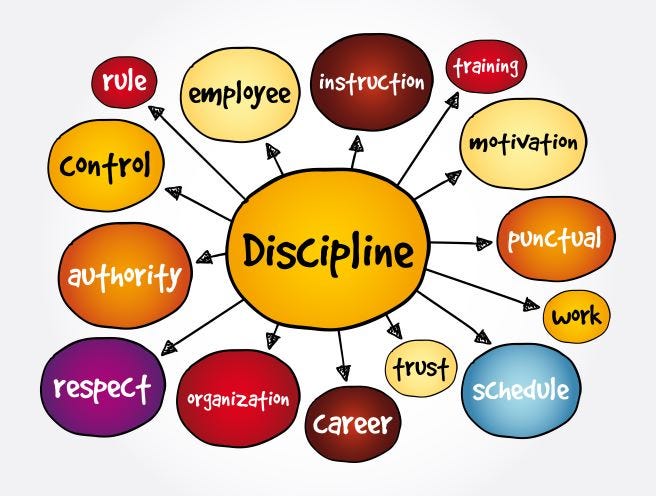
They are a dime a dozen: numerous books and coaches who incessantly explain, define and recommend how one can acquire discipline. But no matter how much you have read, learned or heard about it: in the end it is a lack of personal mood and mental attitude. Because the power of habit forces us back to behavior that has been learned, tried and maintained for years.
Because learned behavior patterns are deeply interwoven in the neural network of the brain, the basal ganglia. Exactly where the habits of automatic actions develop, the automatisms.
As a result, everyday actions, whether good or bad, are automated, almost instinctive. Once habits are firmly saved, they can neither be changed nor simply deleted. They can only be overwritten, i.e. replaced with something better. This is related to the reward center. If the result of a new course of action is afflicted with a strong emotional reward, the new behavior pattern is preferred and “replaces” the old habit, so to speak.
Our brain evaluates our experiences into positive and negative experiences and stores them with the behavior patterns acquired with them. And which behavior pattern is most likely to be saved? The one with enormous potential for use or the one with lower energy expenditure?
The first de facto because there is more stress and hormone fluctuations in the body. As soon as a moment of stress is triggered in the body, more of the body’s own processes are set in motion, which often produce a strong emotional image. And when something triggers strong feelings, it solidifies in the subconscious.
As a result, challenges are always associated with stress and additional effort, which makes it difficult to overcome learned and familiar forms of behavior and to acquire new ones. How can challenges be seen not as a stress factor but as a potential for success?
No Pain No Gain
Pretty much everyone knows this phrase. Because without effort and discipline there is no progress. The strenuous first step in overcoming it only releases the moment of success. This is the point worth striving for and wanting to be worked out. But how?
Disciplined people have a significant sense of responsibility and work ethic. It is important to them that problems are resolved by general consensus and that matters are dealt with in a timely manner, without neglecting themselves and their needs too much. They work and act largely automatically when it comes to everyday tasks, but they can make conscious and self-determined decisions when complicated problem solutions are required. They also consciously use breaks because they know that they can only maintain stable performance with a regenerated body and mind. They remain level-headed and reason-oriented in almost all situations. How does it work?

As mentioned above, controlling yourself is key. There is often a lack of awareness both of one’s own interests and of the drive for everyday life or of individual goals. So you have to be clear about what defines you personally.
Everyone knows the uncomfortable feeling when things are delayed for days and thus remain unfinished. Nobody feels particularly comfortable with it. Disciplined people, however, use this discomfort as an incentive and energy to start the pending tasks after all, or precisely because of it.
So you have to be aware that the given situation is not really bearable in the long term and that the only solution is to change your own behavior. The consequence is clear: you have to break away from hardened structures and enable a new, above all mental, approach.
Acting Out of Affect Is the Opposite of Discipline
People who act particularly spontaneously and out of situations have the greatest difficulty in learning discipline. They can quickly get disconcerted and experience uncertainty through minor cuts, be it due to the postponement of the daily agenda or due to unforeseen incidents or obstacles.
This uncertainty creates the impulsiveness that makes decision-making difficult, especially when it comes to emotional issues.
They act out of affect, which is the opposite of disciplined behavior. Capricious behavior that is subject to strong mood swings is therefore a cumbersome undertaking. These people — and few of them admit it — are in a constant state of mental tension. Remaining in such a mode, nothing useful can be brought about, nor a problem can be solved in a rational manner, let alone a competence can be learned. And certainly not discipline.
As long as this affected behavior pattern is not recognized and consciously presented as a problem, discipline cannot be learned. So you have to ask yourself whether you have mastered self-control in difficult and challenging situations and think logically or whether you decide on the next steps based on your emotions with a gut feeling. Even if affected action brings with it creativity, it runs counter to discipline.
It is beneficial to get rid of the problems emotionally. If you experience difficult situations as neutral or even indifferent and if you take on challenges courageously, it becomes easier to think and act reasonably.
You Can Not Teach Old Dogs New Tricks?
It is often said that already in childhood, literally, the wheat is separated from the chaff. Those who learn the ability to self-discipline at an early age achieve significantly more success as adults; in all areas of life.
Numerous studies confirm this assumption. They live healthier, happier and mostly more balanced. Self-control and perseverance, i.e. discipline, must therefore be learned unconditionally as a child in order to be able to react in a controlled, considered and solution-oriented manner even in difficult or overwhelmed situations. Parental methods of upbringing are therefore extremely relevant.
But why is that so? Is it because it is difficult in old age to change learned forms of behavior?
Mostly yes. We humans are known to be creatures of habit and out of convenience we often lose all motivation to complete the actual work process or even to start it. We almost always choose the easier route and are reluctant to face challenges.
Conclusion
So, are undisciplined people forever hopeless losers? Not quite. There are actually ways to get rid of bad habits and replace them with better ones. As mentioned above, the requirements lie with oneself. It takes great will to transform one’s mental weakness into a strength. It’s a lengthy process that can take an average of six months. So time has to be invested. Time that is especially crucial for mental training. Only those who are willing to face their weaknesses and possibly their deepest childhood wounds can overcome themselves and learn discipline. With regular training, e.g. using the “9 Steps to Learn Discipline”, even the most annoying procrastinator can finally learn discipline.
If you like this story, you may like the following:
Cover Photo: Mann spring über Abgrund vor Sonnenuntergang mit Beschriftung Discipline/Goals./ Bastian Weltjen — stock.adobe.com
Photo Credits:
- Discipline mind map, business concept for presentations and reports/ dizain — stock.adobe.com
- Businesswoman is sleeping at his workplace desk during working hours with the piles of paper document around/ Rogatnev — stock.adobe.com
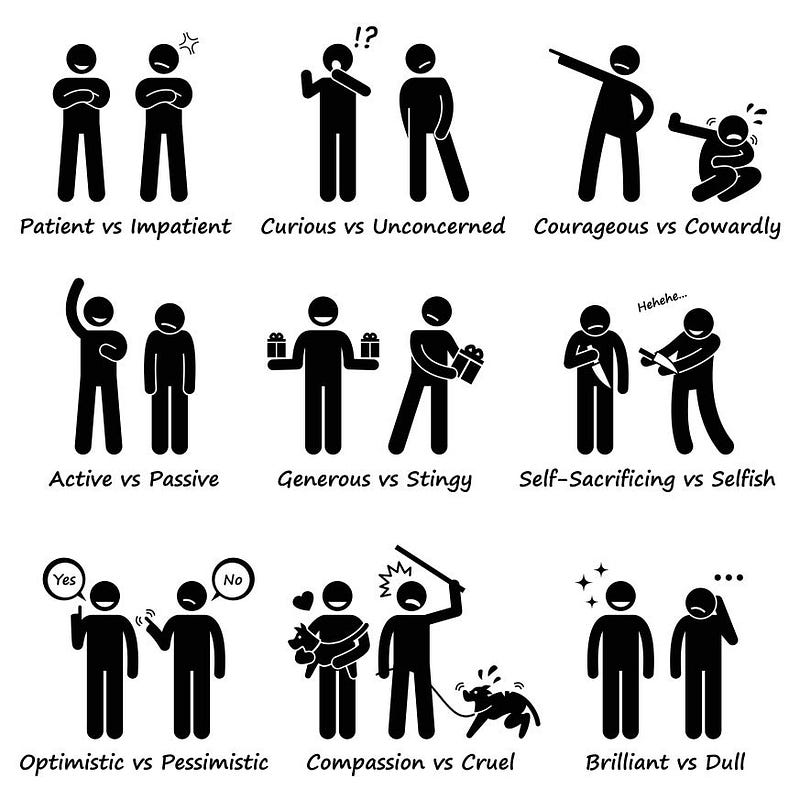
- Human Personalities Opposite Values Positive vs Negative Stick Figure Pictogram Icons/ leremy — stock.adobe.com


