
Why Digital Detox is Vital in Times of Pandemics
7 Ways to Reduce the Pandemic Stress.

A virus went around the world causing an unexpected global standstill in social and economic issues. Economic losses increased the worries of entrepreneurs, employees and the self-employed every day. But after over a year of the pandemic thousands of people are still losing their jobs. The world is still upside down. The pandemic still kills the world every day, and there is still no end in sight.
After several lockdowns, we are still told to stay at home if possible, to not travel around, to keep the distance and to communicate primarily digitally. So being virtual and digital is no longer futuristic. In one fell swoop it was the present. Home office, homeschooling, virtual conferences and video calls are an important part of everyday life in these extraordinary times more than ever.
But many people can’t stand it anymore. They want their freedom back, they long to socialize, to meet in person, but mainly to forget the last year, to forget the mental stress, caused by the pandemic.
In order not to lose the overview or even to escalate dramatically, especially after suffering from the pandemic more than a year, digital detox has become a vital necessity.
Digital Detox Enables Time for Yourself and for Each Other
But such an extraordinary time also harbors opportunities. Regardless of professional changes, the “stay-at-home” during the lockdown phases allows us more time. Valuable hours together with your partner, friends or with your family. And even more important: time for yourself. We have more time to think about your own current needs, wishes and plans. To find ourself again without great distraction from outside — be it on the part of the workplace, through social interactions, sports or learning courses, medical check-up appointments or cultural events — . All external influences are reduced to a minimum.
A small amount of time is usable for the home office, less than before in a local office. But there is a lot left. At last you get to matters that are otherwise put off. Your own projects that were only put on vacation, which can now be implemented and processed bit by bit, because you are forced to stay at home. You can read all the books you ever wanted to, do specific online courses to expand your skills, finally manage and organize your papers and work sheets and everything else. You could all do now, because you have the time for it.
Digital Detox brings Relaxation and Promotes the Ability to Concentrate
In order not to sit in front of the screen all the time to find out the latest infection numbers or the latest government decisions, it is advisable to take a digital step forward. Here, digital detox is the necessity to be able to relieve and relax emotionally in phases of extreme stress and worrying times. Digital Detox literally means “digital detoxification” and is also known under the term “offline vacation”. It points to the pathogenic danger of digital media if they are used in excess.
In pandemic times, the news are accessed more than ever, so that emotionally and mentally an overload arises.
Constant accessibility via smartphone and social apps, constant exposure to sound from smartphones, laptops or tablets as well as an oversupply of news programs on the most sensitive topics cause acute attention disorders and chronic impairment of the ability to concentrate. They bring the nerve cells into uninterrupted turmoil, so that an overstimulation and reduction of the brain capacity takes place. Attention is severely restricted and one’s own productivity drops. Such diagnoses show that the occupational limitation and thus the increased free time is no less worrying.
Troubled Times Encourage Permanent Stress and Burnout
If you do not react quickly — especially in extraordinary times like a pandemic — burnout can be diagnosed in the worst case. It doesn’t help to stay at home to protect yourself from other people and from the virus. At home, too, you shouldn’t underestimate your mental, physical and emotional weaknesses. Especially in a worried phase like this one, you shouldn’t forget yourself. Self-protection is an important endeavor. Especially with mental and emotional needs.
Constant stress is usually set in motion by negative news or personal participation.
This constant digital stress promotes the weakening of the entire immune system, so that ultimately the risk of infection is increased so much that any external protection can become null and void.
The focus must be on maintaining physical, but above all psychological strength.
Studies have shown that continuous digital stress can be life-threatening in times of crisis. Chronic stress due to daily worries in financial, health and social aspects can weaken your own immune defense to such an extent that the body collapses and regenerates with great difficulty.
As a result, in times of crisis, more people usually die of mental overload with regard to their personal circumstances than of the trigger of the emergency itself. This shows how important it is to pay attention to one’s mental and emotional stability.
7 Ways to Reduce Pandemic Stress with Digital Detox
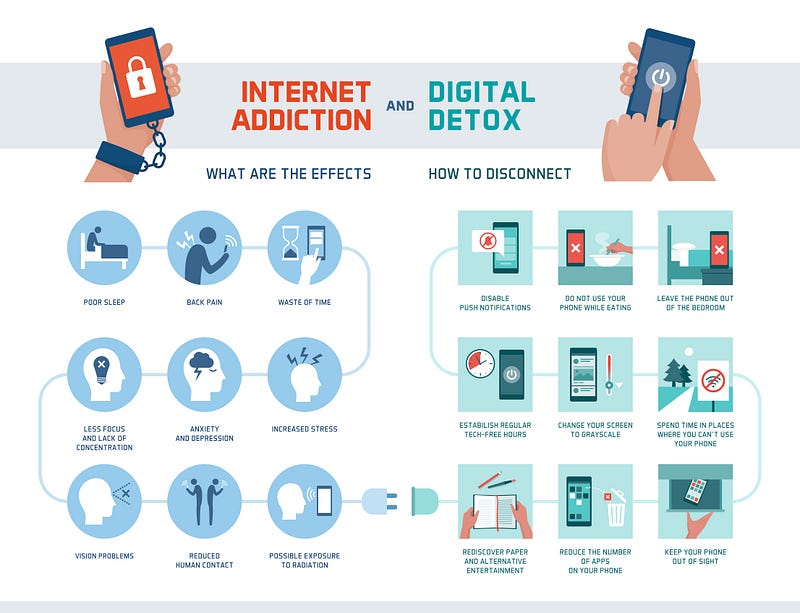
A stress-free balance is necessary to prevent all negative effects. Therefore, here are 7 ways to purify digitally in order to protect yourself without looking backward:
1. Behavior Overview
First of all, it is advisable to check where and when the dangers of digital overload take place. It helps to document over a period of several days when, where and how long digital media are in use. This behavior recording should be done as soberly and honestly as possible.
After at least two days, it is usually already clear when there is an oversupply of world news, news, messages via SMS, emails or calls, and status reports in social media apps. When this is recognized, one can consciously react to it. Once an awareness of misconduct has been established, the following options can be considered.
2. Smartphone-Free Zones
The smartphone is the ultimate distraction trap. Therefore it is necessary to reduce the usage to a few spatial possibilities. Prohibited zones for smartphones in the home are a very effective way. Both the bed, in which one should be prepared to wake up or sleep in the morning and evening, as well as the sanitary areas such as the bathroom and toilet, in which it is part of the basic hygiene not to take any easily infected or frequently used objects with you, definitely belong to the smartphone-free zone.
The desk must also be declared a smartphone-free zone. The smartphone, which reports app notifications in a continuous loop, is the greatest productivity killer, especially when working on a laptop.
3. Digital Data Organization
We tidy up our apartments every day and every year we clean out our letters, clothes and old appliances. But are we doing the same with digital media? Who regularly cleans up superfluous apps, photos, files and data on the laptop, smartphone or tablet? Too few.
In fact, it is important to take a look at the digital devices and delete useless and dispensable items directly and rearrange a lot of things from scratch. Because “A tidy screen makes a tidy head”. With a tidy workplace, laptop or smartphone, people learn and work more purposefully, with less distraction and much more effectively. It is therefore advisable to clear out digitally once every quarter.
4. Mindfulness with Offline Time
Mindfulness is an important issue. In troubled times with unpleasant news every day, it’s easy to lose track of what’s going on in the world. As a result, you overwhelm yourself and lose yourself in the needs of everyday life.
It is helpful to treat yourself to 20 to 30 minutes of digital offline time in the morning, right after getting up, or in the evening, before going to bed. Time in which you consciously concentrate on the current situation. Without digital influence. By living pure mindfulness, for example in the form of supplications or “5-minute journaling”, and feeling gratitude for general health, financial support or the moment of calm and bliss.
In times of crisis, this quiet withdrawal offers great mental added value, in which emotional strength can be recharged and stress and worries can be reduced. If this takes too much effort, you can also switch off your mobile phone while eating so that the meal can be enjoyed consciously and relaxed. Without grueling external distractions.
5. Switch Off Push Notifications
What has already been indicated in point 2 are the annoying push notifications from the apps, with which every smartphone prompts for continuous communication. Most of these notifications are, in fact, unimportant. You will be informed about this the next time you visit the app, which is why it is a must to switch off these notifications as soon as possible. Read confirmations and text notifications from all group chats should also be deactivated, as they also disrupt the daily routine and often interrupt concentrated work unnecessarily.
Self-determined communication is the better alternative here. Consciously choosing times when you dedicate yourself to digital media. If the framework conditions for all digital communication channels are self-determined, the unconscious psychological pressure to be permanently accessible through communication is significantly reduced. The physical tension decreases, the stress level drops and the immune system constantly regenerates.
6. Use Browser Function
Another step is to delete all social apps on your smartphone, which sounds radical, but is necessary if app addiction is slowly taking hold. Every social app, such as facebook, instagram, pinterest, twitter, tinder, gmail and others — game apps are also affected by this — can be fully accessed in the browser.
The advantage: there are no annoying push notifications and usage is limited to a self-determined time limit. Because with the app we are constantly tempted to check our smartphones to see if there is any news so as not to miss any news. However, if we are forced to call up the status in the browser every time, curiosity and continuous use are reduced many times over.
7. Put Down Standby Mode
Constantly being on standby increases the psychological pressure to miss very important messages. As already described in point 5, permanent accessibility and communicative availability increases the physical and mental tension in the organism. For this reason, it is important to first switch off the standby mode of the smartphone or laptop. When the work on the laptop is finished or the specified time limit on the smartphone has been reached, the device can be switched off.
It is useful to set two large periods of time in the day that can span the workload and catching the breaking news. If the restrictions on access to digital media appear unfavorable during the week, it is also sufficient to start significantly reducing media use at the weekend. It is important to try out the time limit of two to three hours, for example, so that the superfluous usage phase can be recorded and restricted.
In order not to irritate people in the circle of friends and relatives, it is advisable to activate a kind of “out-of-office” notice. In it, for example, it can be stated that there will be restrictions in personal digital opening times on a trial basis and that you will largely only be available in the specified time phases.
Takeaway
Digital Detox is not just a short-term call for more conscious use of digital media, but a long-term gain in physical and mental health. In troubled times like these, it is imperative to reduce the digital influence in order to maintain one’s immune system so that neither a threatening virus nor chronic stress can become a threat.
Digital balance must therefore not only be lived out, but also exemplified. In order to protect their environment from any risks, everyone involved must act as a role model. Passing on the information and showing how self-protection can be granted is extremely important here. After all, we not only want to think of ourselves, but also our fellow human beings and loved ones in the best of health.
If you like this story, you may like the following:
Cover Photo: Mockup of Coronavirus Newspaper, News related of the COVID-19 with the the headline in paper media press/ DN6 — stock.adobe.com
Photo Credit: Internet addiction and digital detox infographic/ elenabsl — stock.adobe.com


