
What is Data Culture?
Why you need and should care about it

What actually is a Data Culture and what cultural transformation do organizations need to go through to get to a data-driven culture?
In today’s business world, companies are facing a major transformation: moving away from gut-level decision-making towards evidence-based decision-making using data and information.
Data Culture: A Definition
A Data culture is a subarea or characteristic of corporate culture. Here, culture refers to all shared values, social norms, and ways of thinking that determine the behavior of the organization’s members among each other and their impact on the outside world. A data-driven corporate culture treats data as an important resource that significantly influences actions and decisions at all levels of the organization, all the way to the company’s business model. While companies have always been interested in their most important KPIs with a data culture, data is used on a broader level and influences how members of the organization communicate and collaborate with each other [1][2].
Components of a Data Culture
A data culture consists of three essential components [3].
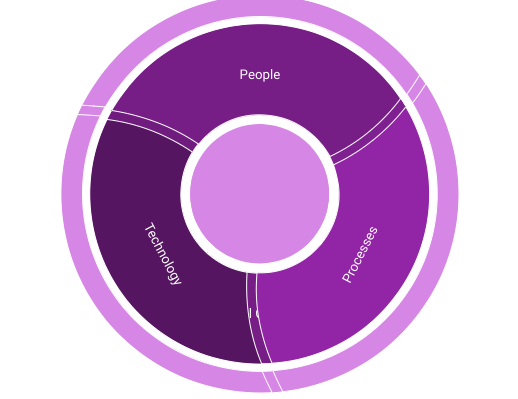
Component 1: People
Here, it is most important that the people are equipped with the right skills in order to have the ability to evaluate data with the appropriate tools. Also, the organization needs to ensure that it can recruit and then hopefully retain talents with these skills.
Component 2: Technology
As mentioned above, employees also need the right tools, and this is where a company needs to look at whether it also offers this infrastructure. Do you or your organization have the right tools, services and data platform architecture to provide the right people with the right data? A very modern and increasingly popular architecture is the Data Lakehouse. It combines Data Lake and Data Warehouse and offers Data Scientists, Data Analysts and simple employees the possibility to get data and also the right tools.
Component 3: Processes
The last component of process describes where the two previously mentioned components run together, so to speak. Here, the properly trained employees can then hopefully also draw the right results from the data using the right tools. The important thing here is that there is an organization in the company that makes it possible for data to be distributed or shared across departmental boundaries. Of course, it is important to have data governance that ensures that only the intended data is passed on to the respective employees. One approach is, for example, the so-called Data Mesh.
Benefits of a good Data Culture
The main goal and positive effects of a solid data culture are to enable all employees to actively use data. This not only makes their daily work easier, but also enables the company to fully exploit its potential. After all, active use of data makes decisions more comprehensible and often more successful.
The business model of a fully data-driven company is based on monetizing of the information. There are different approaches for companies to use data for their business cases. Besides the strategical usage of data, corporations can also make use of exploitative approaches such as generating new ideas or even evolutionary approaches for e.g. a Data Warehouse modernization or implement a self-service BI. No matter what approach a company may use for gaining insights from their data, the procedure is inevitable because only by understanding and analyzing data, a business can successfully fulfill the needs of their customers.
Summary
A Data Culture is created by various influencing factors such as the organizational structure, the technical architecture and of course the communication and decision-making by managers. The emergence of a Data Culture can be actively supported by roles like for example the one of the Chief Data Officer.
Sources and Further Readings
[1] Tableau, Data Culture (2022)
[2] Barc, Data Culture: Definition, Herausforderungen & Maßnahmen (2022)
[3] MILLAN, What Is Data Culture, and Why Do You Need It? (2022)