
What Is Bitcoin Backed By?
Hint: The correct answer is not ‘nothing’
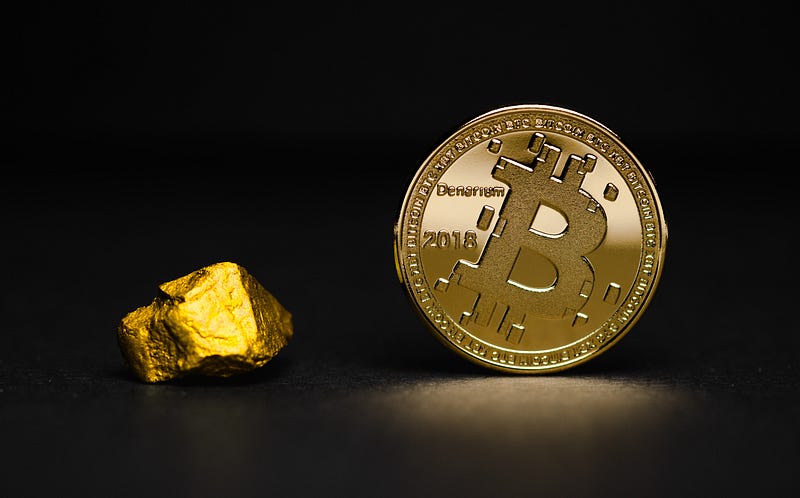
One of the most common comments made by people when I am presenting or writing about Bitcoin is the ‘but-it’s-backed-by-nothing’ position.
On the face of it, it seems like a fair comment. After all, there’s nothing physical about Bitcoin that we can point to and nothing that it is obviously linked or pegged to.
And, if I’m completely honest, I remember having the same thought myself when I began my own voyage of discovery into this new weird alternative money some years ago. It’s actually the part of Bitcoin that took me the longest to really understand.
But if Bitcoin is not backed by anything, what it is backed by?
Before we answer that question, there is an elephant in the room we must address first.
The myth of fiat currency
If you ask anyone in a roomful of people in the UK if they would accept a five-pound note in settlement of a debt that existed between you to the same value, the chances are that everyone would accept it without hesitation or suspicion. This is, of course, exactly what we do every day when we go to the shop or pay someone to do something.
But who says this five-pound note is worth five pounds? Most of us never really think about this because the system has worked this way for hundreds of years, especially in the UK which is currently enjoying the status of having the oldest currency in the world being established some 1,200 years ago.
Put simply, there isn’t anyone alive who can remember anything different.
If you examine carefully your five-pound note, you will find, in extremely small letters, the following words:
I promise to pay the bearer on demand the sum of five Pounds
Why is this there and what does this actually mean?
These days it simply means that if you take it to the central bank, in this case, the Bank Of England, they will happily exchange it for … another five-pound note. Or a combination of change that comes to the same total.
However, prior to 1931, a time when this message was considerably more prominent on the front of all currency notes, it was actually possible to exchange your five-pound note for the equivalent in gold. Yes, real, actual gold in the form of minted gold sovereigns that you could physically walk away with and take home. It’s difficult to imagine for those of us who walk the earth today.
Later on, our currency was still backed by gold, albeit slightly more indirectly, under the Bretton Woods agreement which pegged our currency to the US dollar beginning in 1944. In turn, the US guaranteed a gold standard for all forty-four members of the scheme by keeping physical gold reserves to the same level as dollars issued.
However, by 1971 this became unsustainable and in that year President Nixon closed the gold window, effectively converting all currencies on the planet to a form of fiat currency at a stroke.
The difference is subtle on the face of it, but actually important economically speaking.
A fiat currency has no psychical backing at all and is not pegged to any commodity except, basically, the confidence of the people. This means you can produce as much as you like of it without worrying about reserves as long as you maintain enough confidence in the people concerned.
That confidence, in turn, is essential to the system working and is directly affected by the actions of governments, banks and even, on occasion, individuals who have far too much power. It uses the trust of the people in those same bodies to manage and maintain our spending power, something that has, historically, been fraught with problems.
On the whole, however, the system works. We will happily accept that five-pound note in settlement of debt even though we know it’s only a piece of a paper with no inherent value whatsoever.
We will accept it knowing that we have no real way of knowing what it’s value will be tomorrow, except an idea, backed by experience, that it will only be slightly less than today as long as our elected official maintains the current inflation levels.
We accept it even though we know that unsustainable debt mountains are piling up around the world and we know, in our heart of hearts, that at some point we’re going to have to go through a lot of pain to fix these. Hopefully, we all think, not in our lifetimes.
The reality is that we accept it mainly because we have absolute confidence that someone else will accept it from us.
Of course, if you lived in Argentina in the 1980s, Zimbabwe in the 2010s or Venezuela today, you might disagree. Such is the disadvantage of the fiat system — when the curtain is pulled back, it simply won’t function.
But up until now, there has never really been a better alternative.
So what is Bitcoin actually backed by?
I took a few minutes to reiterate how our fiat currencies work to make it clear that even if it were the case that Bitcoin was backed by nothing, it wouldn’t actually matter anyway so long as certain conditions are met.
As we have seen (and experience every day), a global system can still work based only on confidence, albeit with the odd hiccup in the form of hyperinflation or a devaluation from time to time.
But if I were to go to that same room of people I offered the five-pound note to earlier and instead offered the equivalent amount of Bitcoin, how many would accept it this time? It’s likely to be a much lower number. Those who did accept it would no doubt be familiar with it, many would-be asking “what is Bitcoin?” and a few may even decline even though they know what it is.
So whilst confidence in Bitcoin is much lower than fiat for the time being (and is likely to remain this way for some time) Bitcoin has several advantages over fiat which are not immediately obvious. One, in particular, is quite relevant. It’s the fact that Bitcoin IS actually backed by something other than just confidence.
Bitcoin runs on a highly secure network, one that grows in security every day, which, in turn, is based on unbreakable, unchangeable, incorruptible mathematics. Even better, this system operates without our imperfect, entirely corruptible human selves involved. It is an entirely closed, self-checking system.
It cannot be influenced, changed or affected by any one individual, official, government or country at any time. It deals only in absolutes and is designed, at its very core, to be a very long term, deflationary store-of-value system. It’s complex and I don’t propose to go into it here, although this article covers it in detail if you want to find out more information about how this works.
Put simply, your transactions are backed by solid, immutable data on a scale of security that is hard to demonstrate in simple terms. That backing is also the reason why Bitcoin has never been hacked at any point in its entire history and, as each day goes by, the likelihood of it ever is diminishing steadily.
Compare that to fiat which is literally printed out of thin air and ascribed value based on traditional confidence and our central organizations assuring us that it does. Most of the time they are right, of course, and the system works pretty well, but Bitcoin is always right in that sense.
These are bold and almost unbelievable statements when you first hear them, but the fact is that Bitcoin will always work and will always be a solid basis of currency or transaction as long as the rules of mathematics continue to apply. In basic terms, as long as two plus two continues to equal four.
This is still not so easy for us humans to get our brains around. We can easily imagine ‘two’ or ‘three’ for example, but we can’t picture ‘eight million’ or ‘sixty thousand’ — our brains just don’t seem to be capable of doing that. Yet all these numbers are ‘real’ and form the basis of much of what we do.
To use a simplified analogy, when you buy a four-pack of tuna in the supermarket, that ‘four’ is a real, solid representation of something physical that is absolute. You don’t get three or five, you always get four. You have total confidence in what you’re getting and, of course, you can visually check it anyway. You have the same with Bitcoin both in terms of that mathematical confidence and the fact you can check the blockchain if you want to. After all, it’s a public ledger.
But this is still not easy for us to grasp because we’re so used to seeing something physical at the end of it. Even things we intrinsically know are backed by maths, such as architectural projects, aircraft, any form of engineering or, actually, most things that we’re familiar with in our day to day lives, still have some sort of psychical presence that make them ‘real.’
Bitcoin’s output, of mathematically perfect blocks of immaculately encrypted information that forms the basis of all our transactions, is always virtual and, like trying to imagine that eight million, that’s the step that seems to push our brains too far into the realms of incredulity.
Somehow we still have to check it out for ourselves, like insisting on touching something when the sign says ‘wet paint’ just to make sure. How do you that when it’s virtual?
Bitcoin's greatest strength is also its greatest weakness — understanding the complexity that underlies it and why any of us should have any confidence in it at all. Bitcoin is non-proprietary and entirely open for public scrutiny by anyone at any time and that, at least, makes that task a little easier. Reading, investigating and learning is the answer.
But at the same time, I always use this analogy: You can get in a car and drive it safely and with complete confidence, regardless of whether you actually know how that complex machine works. And if you want to learn, there’s nothing stopping you from taking the engine apart and finding out.
The takeaway
Our current currency system still works pretty well despite its obvious limitations in an increasingly digital world and the detachment of fiat from any sort of backing at all. Confidence remains high for now and you can always spend your pounds and dollars pretty much anywhere with no issue.
Bitcoin moves us to the next natural step in financial evolution AND provides a solid backing to do it, but for the time being it is no more than a niche project in terms of the global financial behemoth that surrounds it. Naturally, that means, for now, confidence is lower.
But in any case, as more and more of us drive that metaphorical car and security in the system continues to grow day by day, it’s entirely possible that sheer confidence alone will be enough to drive the transactions forward in future in any case, just like fiat.
And whilst that’s a wonderful place to be that’s already proven to work, I still personally find it reassuring that there’s a solid form of mathematical backing behind it AND a way of checking it for myself on a public, incorruptible ledger should I ever feel inclined to do so.
Y’know, like checking that paint is still wet, regardless of what the sign says.
If you enjoy reading stories like these and want to support me as a writer, consider signing up to become a Medium member. It’s $5 a month, giving you unlimited access to stories on Medium. If you sign up using my link, I’ll earn a small commission.
Want free access to articles, analysis, podcasts and training webinars? Why not subscribe to the ‘Bitcoin and Global Finance’ newsletter? Subscribers over 18, resident in Europe (see list on subscription page) & new to Bitcoin can claim £10’s worth of Bitcoin on joining! Unsubscribe at any time.
If you found this article helpful, you may also like these:
As each day goes by this becomes more important … and harder to do.
What will happen with Bitcoin over the next five years? Here’s some likely scenarios: (update: 4 and 7 have already happened! But what about the rest?)
We’d all like to know where Bitcoin’s price is going next — can we get some clues from ‘behind the scenes?’
Disclosure: The author of this opinion piece has been heavily involved with Bitcoin for several years and holds a substantial cryptocurrency portfolio, including Bitcoin. He also has a mining operation running the SHA 256 algorithm based in Siberia and is a published author on the subject of promoting the understanding of cryptocurrency.
Disclaimer: Investing in any cryptocurrency is extremely risky. The above should not be taken as financial advice, nor construed as so. Always do your own research before investing or consult with a professional financial planner.


