
avatarJJ Lim, PhD

Free AI web copilot to create summaries, insights and extended knowledge, download it at here

3031

Abstract

lains-ec473c474d1a">sustained high blood glucose damages our blood vessels in the long term</a>.</p><h2 id="d228">But, not all breakfast skippers eat more at lunch, what if they eat the same amount of lunch as breakfast regulars? [4]</h2><figure id="2c59"><img src="https://cdn-images-1.readmedium.com/v2/resize:fit:800/1*qgQ4FkO-r08mDMwu2sMLfA.png"><figcaption>Source: JJ Lim, BSc (Hons).</figcaption></figure><p id="21ee">This scenario is set in the case of <b>intermittent fasting</b>, where dieters conveniently restrict themselves from having breakfast in order to achieve a negative calorie balance to lose weight.</p><p id="4e8c">In another clinical trial, the researchers put the participants to <b>consume identical calories at lunch</b>, one day with breakfast, and another day without breakfast. I thought there is not going to have any difference as the calories were identical.</p><p id="e165" type="7">Surprisingly, despite identical calories were consumed at lunch, breakfast skipping still exhibited the pronounced post-lunch glucose spike!</p><p id="2194"><b>Not only the post-lunch blood glucose level was higher, but the overall 24-hour blood glucose level was also higher. </b>I was perplexed by this fact. Yet, fascinating!</p><h1 id="221a">How does breakfast skipping cause post-lunch glucose spike?</h1><p id="f0e7">When we wake up in the morning, our body is at a fasting mode. During fasting, two main biological events [<a href="https://www.ncbi.nlm.nih.gov/pmc/articles/PMC4050641/">5</a>, <a href="https://www.jlr.org/content/53/3/577.full">6</a>] happen:</p><ol><li><b>Liver releases stored glucose</b> to fuel our nerve cells (brain) and blood cells.</li><li><b>Body fat releases free fatty acids </b>as an alternative fuel for other body cells.</li></ol><p id="eeb0">When we perform work without breakfast, our body releases more free fatty acids need to cope with the energy demand to perform work. Eventually, the <b>concentration of free fatty acids in the blood peaks </b>just before lunch. Having fasted throughout the morning, when our body is refuelled with calories from food, insulin production is triggered to reverse the biological events that happened during fasting.</p><p id="d908">The <b>main problem </b>is the time lag in the reversal of fasting. After skipping breakfast, there is a <b>30-minute delay in insulin production</b> post-lunch [<a href="https://portlandpress.com/clinsci/article-abstract/117/3/119/77701/The-second-meal-phenomenon-is-associated-with?redirectedFrom=fulltext">7</a>, <a href="https://www.ncbi.nlm.nih.gov/pubmed/26220945">8</a>]. Furthermore, <b>our cells prioritise to clear the free fatty acids from the blood</b> before the cells use the glucose from the blood [<a href="https://www.ncbi.nlm.nih.gov/pubmed/12784183">9</a>]. Therefore, glucose stays in the blood longer when we skipped breakfast.</p><p id="6f99">Collectively, this phenomenon constitutes a classic <b>symptom of insulin resistance. </b>In other words, a symptom similar to Type-2 Diabet

Options

es, whereby the body fails to clear the incoming glucose timely.</p><h1 id="4fe8">How to eat after you skipped breakfast?</h1><p id="e653">A group of Italian scientists reviewed many clinical trials and published their findings on a universal scientifically proven way to lower post-lunch glucose spike [<a href="https://www.frontiersin.org/articles/10.3389/fendo.2019.00144/full">10</a>].</p><h2 id="8788">Have a low-carb snack 30 minutes before your lunch meal.</h2><p id="0c59">Here is how you do it. A snack that contains protein and fat will prepare your body to go into accepting main meals, by ramping up insulin sensitivity and clearing the free fatty acids from the blood. Good pre-lunch snacks are protein bar, yoghurt, full-fat milk, cheese and eggs.</p><p id="a6c6">To date, I cannot find any recommendations on how to avoid the overall 24-hour glucose elevation after breakfast skipping. A universally accepted tip is not to have a high carbohydrate meal, but include more vegetables (fibre) in your meal, as well as make sure you have enough protein and fat at lunch and dinner. <b>If this worries you, then have your breakfast</b>. Please refer to the following story in regards to breakfast eating:</p><div id="d624" class="link-block"> <a href="https://readmedium.com/why-not-moving-some-protein-from-dinner-to-breakfast-science-explains-74ff8545cbe5"> <div> <div> <h2>Why Not Move Some Protein From Dinner To Breakfast? Science Explains.</h2> <div><h3>Too much protein at dinner, if you do not use it, you lose it.</h3></div> <div><p>medium.com</p></div> </div> <div> <div style="background-image: url(https://miro.readmedium.com/v2/resize:fit:320/0*bt3uWAgWzAQORcDK)"></div> </div> </div> </a> </div><h1 id="ce87">Three take-home messages</h1><p id="8da1">1. If you think skipping breakfast is “healthy”, but you are having <b>a high-carbohydrate lunch</b>, then you are doing “intermittent fasting” wrongly.</p><p id="6b50" type="7">The modern Asian-style of eating, characterized by big portion of refined rice, noodles or starchy bread ( the Indian Roti) are not fit for lunch for breakfast skippers.</p><p id="f61f">2. Practice eating the right food before practice timely eating. Don’t attempt to micro-tune before you learn to macro-tune.</p><p id="4ad5">3. Since post-lunch blood glucose is more elevated after skipping breakfast, <b>skipping breakfast is not likely to help with glucose management among the diabetics.</b></p><p id="b1f6"><i>Final Tip: If you feel foggy-headed and hard to concentrate, then it is likely that your blood glucose is too high after lunch [<a href="https://www.webmd.com/diabetes/how-manage-blood-sugar-spikes-after-meal#1">11</a>].</i></p><figure id="bd37"><img src="https://cdn-images-1.readmedium.com/v2/resize:fit:800/1*oK_6-IoNOGdkyc1t0Uv2QQ.png"><figcaption></figcaption></figure></article></body>

Photo by Brooke Cagle on Unsplash

What Is A Healthier Lunch After Skipping Breakfast? Science Explains.

Skipping breakfast elevates post-lunch glucose level. Alleviate it by having a healthier lunch.

During the search of how skipping breakfast might cause weight gain, I discovered that skipping breakfast exhibits a “second-meal phenomenon” [1, 2], which is largely ignored by many people in support of skipping breakfast as a convenient method to achieve intermittent fasting. The second-meal phenomenon states that skipping breakfast leads to a post-lunch blood glucose (sugar) spike.

So, I turned to ask if I skip my breakfast, what constitutes a healthier lunch meal to alleviate post-lunch blood glucose spike. This article will explain:

  1. The fact that skipping breakfast increases post-lunch blood glucose.
  2. Why skipping breakfast increases post-lunch blood glucose?
  3. What is a healthy lunch to alleviate this negative side-effect of skipping breakfast?

Skipping breakfast increases post-lunch blood glucose

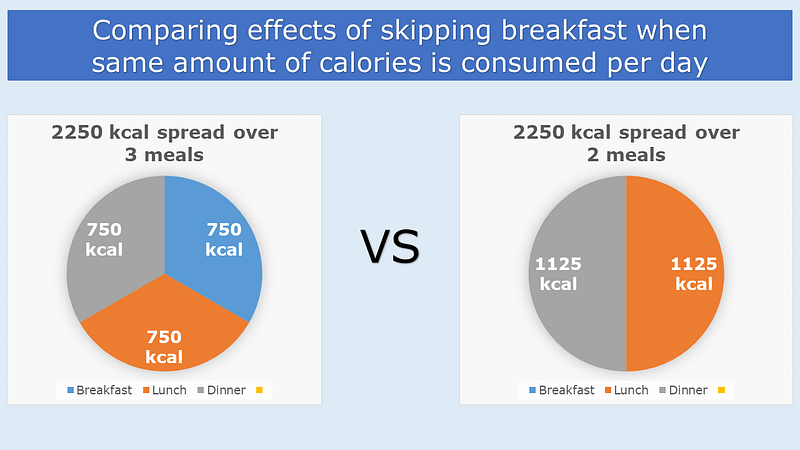
Breakfast skippers consume more calories at lunch [3]
Source: JJ Lim, BSc (Hons).

When a Japanese clinical trial put a group of participants to consume 100% of calories spread across two meals (each lunch and dinner provided 50% calories) as opposed to three meals (each breakfast, lunch and dinner provided 33% calories), their post-lunch glucose level was higher.

The same trial tested the same participants again after 6 consecutive days of skipping breakfast. Having accustomised to the lifestyle of skipping breakfast, will their body able to normalise the blood glucose? Yes, the post-lunch glucose spike was alleviated. However, the average blood glucose level over 24 hours was still significantly higher.

After consecutive days of skipping breakfast, the elevation of blood glucose level occurred in the late afternoon and early evening, without any sign of high fasting blood glucose in the morning. Consequently, a single fasting blood test routinely carried out in the morning cannot detect how well our body manages blood glucose over 24 hours. Certainly, we don’t want our glucose to spike as sustained high blood glucose damages our blood vessels in the long term.

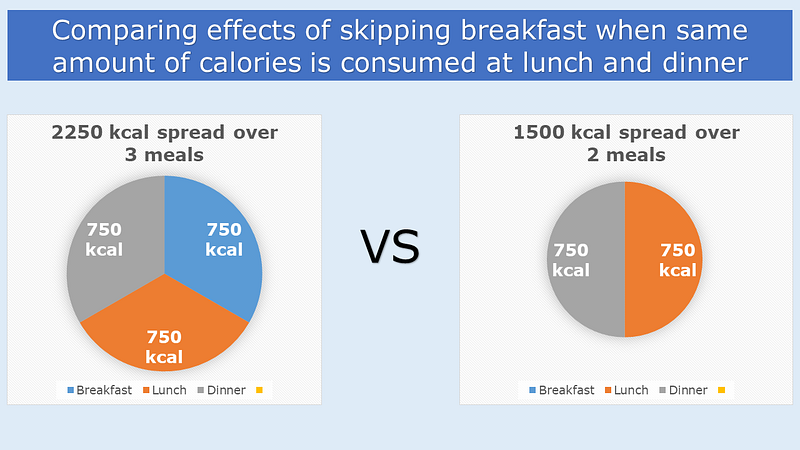
But, not all breakfast skippers eat more at lunch, what if they eat the same amount of lunch as breakfast regulars? [4]
Source: JJ Lim, BSc (Hons).

This scenario is set in the case of intermittent fasting, where dieters conveniently restrict themselves from having breakfast in order to achieve a negative calorie balance to lose weight.

In another clinical trial, the researchers put the participants to consume identical calories at lunch, one day with breakfast, and another day without breakfast. I thought there is not going to have any difference as the calories were identical.

Surprisingly, despite identical calories were consumed at lunch, breakfast skipping still exhibited the pronounced post-lunch glucose spike!

Not only the post-lunch blood glucose level was higher, but the overall 24-hour blood glucose level was also higher. I was perplexed by this fact. Yet, fascinating!

How does breakfast skipping cause post-lunch glucose spike?

When we wake up in the morning, our body is at a fasting mode. During fasting, two main biological events [5, 6] happen:

  1. Liver releases stored glucose to fuel our nerve cells (brain) and blood cells.
  2. Body fat releases free fatty acids as an alternative fuel for other body cells.

When we perform work without breakfast, our body releases more free fatty acids need to cope with the energy demand to perform work. Eventually, the concentration of free fatty acids in the blood peaks just before lunch. Having fasted throughout the morning, when our body is refuelled with calories from food, insulin production is triggered to reverse the biological events that happened during fasting.

The main problem is the time lag in the reversal of fasting. After skipping breakfast, there is a 30-minute delay in insulin production post-lunch [7, 8]. Furthermore, our cells prioritise to clear the free fatty acids from the blood before the cells use the glucose from the blood [9]. Therefore, glucose stays in the blood longer when we skipped breakfast.

Collectively, this phenomenon constitutes a classic symptom of insulin resistance. In other words, a symptom similar to Type-2 Diabetes, whereby the body fails to clear the incoming glucose timely.

How to eat after you skipped breakfast?

A group of Italian scientists reviewed many clinical trials and published their findings on a universal scientifically proven way to lower post-lunch glucose spike [10].

Have a low-carb snack 30 minutes before your lunch meal.

Here is how you do it. A snack that contains protein and fat will prepare your body to go into accepting main meals, by ramping up insulin sensitivity and clearing the free fatty acids from the blood. Good pre-lunch snacks are protein bar, yoghurt, full-fat milk, cheese and eggs.

To date, I cannot find any recommendations on how to avoid the overall 24-hour glucose elevation after breakfast skipping. A universally accepted tip is not to have a high carbohydrate meal, but include more vegetables (fibre) in your meal, as well as make sure you have enough protein and fat at lunch and dinner. If this worries you, then have your breakfast. Please refer to the following story in regards to breakfast eating:

Three take-home messages

1. If you think skipping breakfast is “healthy”, but you are having a high-carbohydrate lunch, then you are doing “intermittent fasting” wrongly.

The modern Asian-style of eating, characterized by big portion of refined rice, noodles or starchy bread ( the Indian Roti) are not fit for lunch for breakfast skippers.

2. Practice eating the right food before practice timely eating. Don’t attempt to micro-tune before you learn to macro-tune.

3. Since post-lunch blood glucose is more elevated after skipping breakfast, skipping breakfast is not likely to help with glucose management among the diabetics.

Final Tip: If you feel foggy-headed and hard to concentrate, then it is likely that your blood glucose is too high after lunch [11].

Food
Nutrition
Health
Lifestyle
Science
Recommended from ReadMedium