

Why Is Diabetes Causing Complications From Head To Foot? Science Explains.
Understanding how eye damage, cardiovascular disease, kidney damage and nerve damage is related to one another in diabetes.
Diabetes is associated with a variety of complications if the patient’s blood glucose level is not controlled to the near-healthy range. Diabetes is characterised by having too much glucose in your blood, irrespective to the underlying genetic or dietary causes. You can test your blood glucose using a finger-prick glucometer at home:
- a fasting blood glucose higher than 5.6mmol/L is the first sign of pre-diabetes
- a fasting blood glucose higher than 7.0mmol/L is a symptom of diabetes.
Indeed, a lot of clinical tests must be done before confirmation of diagnosis. Still, it is crucial to monitor blood glucose as about 1 out of 3 adults in the US have pre-diabetes, 90% of them don’t know they have it[1]! I shared tips on health monitoring in my previous story:
The common complications of diabetes from head to foot include:
- Eye damage (retinopathy): Loss of sight
- Kidney damage (nephropathy): Lead to failure of kidney’s filtration units, also known as chronic kidney disease (CKD), whereby its final-stage requires dialysis or kidney transplant to sustain life.
- Cardiovascular disease: Chest pain, heart attack, stroke.
- Nerve damage (neuropathy): Loss of sensation in the extremities. Numbness begins from the foot and slowly spread towards the upper body. Consequently, patients may not feel pain from injuries/bruises/cuts on their foot. The untreated wound leads to foot infections. If poorly healed, amputation is necessary to prevent the spread of infection to the upper body.
Blood vessels are bathed in hyperglycaemic blood
General Mechanisms
Hyperglycaemia (Hyper- refers to high; Gly- refers to glucose; -aemia refers to blood) means an excess concentration of glucose in the blood. Glucose disrupts the blood vessels function by damaging the endothelial cells (cells that line the interior surface of blood vessels) via a single unifying biological mechanism.
In a very simplified view, when excess glucose diffuses into the endothelial cells:
- Endothelial cells attempt to “get rid” of the excess glucose by metabolising them.
- Before long, glucose metabolism becomes overloaded, and glucose cannot be completely metabolized.
- This leads to the accumulation of molecules that can alter the integrity of endothelial cells. For example, the vascular becomes leaky, narrow or harden. This often followed by an inadequate supply of oxygenated blood to the cells around the affected region.
- Finally, the compromised endothelial cells give rise to all vascular-related complications we see in diabetes [2].
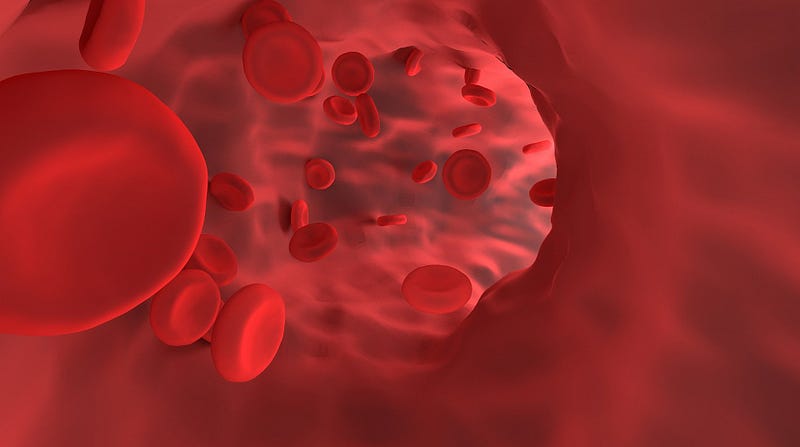
Damage to the fine blood vessels, known as the microvascular, in the eyes and kidneys causes the microvascular to become leaky. Then, blood constituents (glucose, protein or fatty acids) leak out of the microvascular. Later, the damaged microvascular impairs oxygen supply to the cells around the region. When cells experience oxygen shortage (hypoxia), they die off. Ultimately, the organ begins to lose its function [3].
Eye damage (retinopathy)
During retinopathy, patients begin to notice greyish spots in the vision as blood constituents leak out for the eyes’ microvascular. At a later stage, when light-sensing cells in the eyes do not receive enough oxygen supply, they slowly die, progressing towards the loss of vision. When diabetes is coupled with high blood pressure, microvascular in the blood may burst, causing serious internal bleeding that results in blindness [4, 5].
Kidney damage (nephropathy)
Similarly, in kidneys, blood filtration becomes suboptimal as the microvascular becomes leaky. The accumulation of glucose, protein and fatty acids which leak from the microvascular impedes normal kidney function. In a later stage, the low supply of oxygenated blood to the nephron cells (cells that form the kidney’s filtration unit) is causing cell death and the loss of filtration function [4, 5].
Since the kidney also regulates blood pressure, its dysfunction increases the blood pressure, in turn, increases the risk of other macrovascular complications (problems associated with larger blood vessels), such as cardiovascular diseases.
Cardiovascular disease
Indeed, the narrowing and hardening of arteries require LDL (bad cholesterol), but high blood sugar exaggerates the problem as the function of the endothelial cells becomes suboptimal. Furthermore, diabetic patients suffer from hypercoagulation of blood, that means their blood can clot easily in the vessels [4, 5]. High blood glucose, coupled with high blood LDL and high blood pressure, is a dangerous combination that associates with cardiovascular death.
When blood clot occurs in the brain, it results in stroke; whereas when blood clot occurs in the heart, it results in heart attack.
Nerve damage (Neuropathy)
Neuropathy is the most common complication in diabetes but how high blood sugar damages nerve cells is not clearly understood yet.
Since nerve cell is one of the very few cell types that does not rely on insulin to absorb blood glucose, nerve cell can be overloaded by glucose easily. As a result, a “metabolism traffic jam” happens in the nerve cell, quite similar to how it occurs in the endothelial cells. The inability to completely metabolise the glucose timely leads to accumulation of molecules that are toxic to the nerve cell. Alternatively, an inadequate supply of oxygenated blood to the nerve cells is another plausible explanation [6].
The most extended sensory nerve cells, that is the nerve to the foot, is most susceptible to the damage, for unknown reasons. Patients with numb foot have low awareness when their foot is actually hurt or bruised, it can easily lead to the development of infection on the untreated wound. When coupled with poor blood supply due to the narrowing of macrovascular and microvascular, the wound is poorly healed. If the infection cannot be healed entirely, an amputation is the last resort to stop the infection from spreading.
Conclusion: How To Prevent Complications among Type-2 Diabetes Patients?
Whenever there are blood vessels, high blood glucose has an effect on those regions, with some organs more susceptible to damage than others. Successful diabetes management requires stabilization of blood glucose, either via:
- Increasing insulin sensitivity, so that the blood glucose can be effectively cleared from the blood vessels into muscle and fat.
- Reducing carbohydrate consumption, to avoid dietary glucose from raising the blood glucose level.
The top strategy to stabilize blood glucose may be weight control [7], as it works by both increasing insulin sensitivity and reducing carbohydrate consumption.
High blood glucose can cause more problems than what was mentioned in this article. This is just an example to show one unifying mechanism that can explain the many complications resulted from diabetes.



