

Why Not Move Some Protein From Dinner To Breakfast? Science Explains.
Too much protein at dinner, if you do not use it, you lose it.
Today, most Americans are consuming about 100g protein per day [1], equivalent to about 1.1g protein per kg body weight. Hence, most Americans exceed the RDA protein requirement (0.8g protein per kg body weight). This story is not to discuss whether we should promote a high-protein diet as Markham Heid has nicely discussed the protein debate in the Heated.
Instead, let’s think about how to make the most use out of the amount of protein we consume daily. The US RDA [2] and the distinguished European Food Safety Authority (EFSA) [3] recommend us to consume 0.8g protein per body weight every day, an average American man who weighs 90kg [4] is then recommended to consume 72g protein in a day.
Most Americans consume about 100g of protein, similar to New Zealanders [6] and French [7], but is slightly lower in the Italian [8] and British [9], at about 80g protein per day. As such, most individuals achieved the RDA target. Many of us are so obsessed with daily protein intake, that we almost forgot to think about how much protein should we consume in a meal and whether it matters.
However, we rarely being told how much protein to consume per meal. The guideline does not make it crystal clear.
The typical daily protein consumption pattern
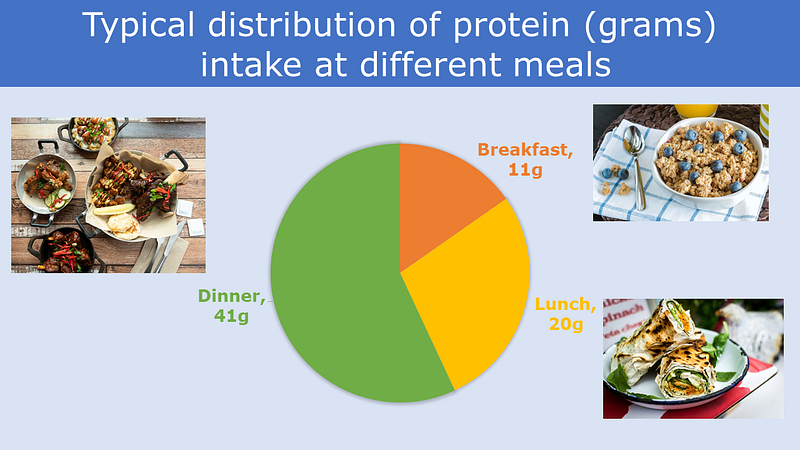
The current data shows that we consume most protein at dinner [5]. Least amount of protein is consumed as breakfast, characterized by the consumption of milk, toast and eggs, with many people nowadays even skip breakfast. The protein consumption at lunch is typically characterized by the meat in sandwiches. Lastly, protein consumption at dinner is more variable and typically contains approximately a palm-size of meat or more, in addition to other sources of protein, such as legumes.
The distribution of protein intake in the figure below assumes a person who consumes a 72g protein per day. It is believed that even if total protein consumption is higher in any individuals, the trend remains the same, with the least amount of protein consumed at lunch, the greatest amount of protein consumed at dinner.
Can our body absorb all the protein that we consume at dinner?
An average person probably consumes 40g or more protein at dinner if you include at least a palm-size meat, along with other sides which often comes with some protein too.
Our body is a wonderful self-regulatory biological machine that has an array of hormones serve as biological signals, and a plethora of mini structural ‘machines’ made up of protein trying to perform actions such as chemical digestion and mechanical transport in response to biological signals.
When we consume a mixed solid meal, our stomach holds the food for approximately 30 minutes to allow mechanical and chemical digestion before releasing food into our intestine. This holding time is longer if the meal is structurally more complex or heavier in load. A typical mixed meal is then emptied at an average rate of 1–4 kcal/min, and require 3–4 hours to completely emptied from the stomach [6].
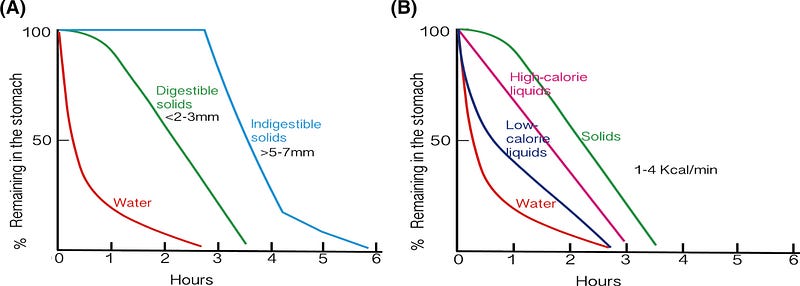
In the intestine, further digestion takes place. This is also where the absorption of protein occurs. Since whey protein is frequently used as a model protein, let us have a look at the absorption rate of whey protein. First of all, whey protein beverage is a low-calorie liquid, so it empties very quickly from the stomach and can be absorbed at a rate of 10g per hour [7]. Hence, whey protein is commonly known as fast protein. The absorption rate of other protein is relatively lower. Nevertheless, the more protein we ingest, the intestinal movement will slow down, aided by the increase in transporters on the surface of the intestine to maximise the chance of all digested protein can be absorbed by the body.
To sum up, under normal circumstances, most of the digested protein can be absorbed by the body.
Can our body use all absorbed protein?
Protein is digested into amino acids and it is used for muscle synthesis. Our muscle is constantly undergoing degradation and repair even though we are not working out at the gym. Certainly, the process is sped up if you hit the gym.
There is a limit whereby our muscle can only use the a certain amount of amino acids at a certain time point if we consume fast (whey) protein.
The optimum consumption of fast protein for maximum muscle synthesis is about 20g protein per meal for young endurance-trained adults. Notably, there is a minimal threshold of protein requirement to trigger muscle synthesis. As such, consuming protein lower than the threshold simply has no significant effect on muscle synthesis. Since seniors have a higher threshold, muscle synthesis becomes less efficient. Research suggests that seniors require 30g protein per meal to achieve similar maximum muscle synthesis as young endurance-trained adults [8].
On the other hand, our body can probably use a decent amount of absorbed protein for muscle synthesis if we ingest protein in a mixed meal.
When digested protein is slowly channelled into your body from the intestine, it probably won’t exceed the maximum limit for muscle synthesis at any time points. Considering that 30g of whey protein requires 3 hours to be completely absorbed and hit the muscle synthesis limit, 30g of protein from a mixed meal may require about 5 to 6 hours to be completely absorbed, hence giving the muscle to have its sweet time for muscle synthesis. Nevertheless, slowly absorbed protein is not favourable for competitive muscle building as the overall efficiency in muscle protein accrual is higher with fast protein.
What happens to the rest of the protein if the intake exceeds the optimum threshold? There is a famous saying called “use it, or lose it”. This is also applicable for protein. If the absorbed protein cannot be used for muscle synthesis or replenishing the free-floating amino acids pool in our body, the excess will be degraded. It is this degradation that provides us with calories, ironically this degradation also increases our calorie expenditure as the degradation process itself consumes calories, as well as associated with the feelings of satiety [8].
Why Not Moving Some Protein From Dinner To Breakfast?
Although we are very likely to absorb most protein from dinner and possibly use them, it appears that it is probably better to reduce protein at dinner and increase protein at breakfast due to the following two reasons:
- High-protein breakfast is more likely to produce sustained satiety than high-protein dinner [9, 10]. Feelings of fullness in the morning may be beneficial for some people to avoid snacking of empty calories food (a term that refers to calories that provide no other micronutrients), or eventually increase daily calories intake. The feelings of satiety after breakfast tends to sustain throughout the day and afternoon. Since consuming 30g protein per meal is associated with satiety [8], why not increase the protein intake at breakfast to enjoy the benefit of a high-protein meal? Notably, the feelings of satiety can be very variable from person to person as not everybody experiences a similar degree of satiety after a high-protein breakfast.
- 30g protein is the threshold for muscle synthesis for the seniors. After a meal, muscle protein synthesis is ramp up and peaks between 60–90 minutes post-meal, then muscle synthesis drops 3 hours postmeal [11]. During fasting or without sufficient protein intake in the morning, there is no muscle protein synthesis, but muscle protein breakdown can occur. It is this tiny breakdown that we probably want to prevent. Research has shown that even distribution of daily protein consumption is beneficial for seniors to preserve their muscle strength [12], whereby preventing muscle degradation is the utmost priority for their functional health.

Take-home message
In fact, the recommendation to consume 30g protein is originally applicable for competitive muscle builders who consume whey protein [13]. But, Dr. Heather Leidy and Prof. Phillips Stuart have been trying to investigate if there is any potential benefit in following a diet with an evenly-distributed protein consumption for the benefit of satiety and muscle preservation in seniors.
Although there is nothing wrong with consuming a larger amount of protein at dinner, some evidence suggests that we may be getting more benefit by consuming more protein at breakfast. It is worth trying to consume 30g protein at each breakfast, lunch, and dinner for a week to see what it does to our body. Since my body weight is low, I accepted the challenge by just having 20g protein breakfast for almost every day now, and I found it is really helpful to curb my appetite. If your BMI is lower than 23, I personally think a 20g protein breakfast would suffice.
20g breakfast is very achievable without much effort, this is how it looks like:
Otherwise, this is how a 30g protein breakfast looks like:
If you would like to enjoy another protein story:



