
What is a Data Mart and Why Does Your Business Need One + Example
Data Mart 101: The Key to Streamlined Data Analysis

In today’s world, businesses are generating a vast amount of data every day. To harness the insights from this data, companies need to store, process, and analyze the data efficiently. This is where the concept of a data mart comes in.
A data mart is a subset of a data warehouse that focuses on a specific department, business unit, or functional area within an organization. It is designed to provide easy access to relevant data for a particular group of users, allowing them to quickly analyze and make informed decisions based on that data.
TLDR; Don’t have time to read? Here’s a video to help you understand the difference between data mart vs database vs data warehouse vs data lake in detail.
The main advantage of using a data mart is that it allows companies to organize their data in a way that is tailored to their specific needs. Let’s take an example to understand it better.
Data Mart Example
Let’s take a real-life example to understand the importance of a data mart. Imagine a retail company that operates in multiple regions and sells a variety of products. The company has a lot of data on its sales, inventory, and customer behavior, which is stored in a central data warehouse. However, the company’s sales team needs to access this data quickly and easily to analyze sales trends and make informed decisions.
To address this need, the company creates a sales data mart. This data mart is designed to provide easy access to sales data for the sales team. It includes data on sales by region, product, customer demographics, and other relevant metrics. By focusing on sales data, the sales team can quickly access the information they need and make informed decisions on pricing, promotions, and inventory management.
Now, imagine what could’ve gone wrong if the company did not employ a data mart. The sales team would have to spend a lot of time and effort sifting through large amounts of data to find the information they need. This would lead to delays in decision-making and could result in missed opportunities or incorrect decisions.
Furthermore, without a data mart, the company would have to give access to the entire data warehouse to the sales team, which could lead to security issues and potential data breaches. By employing a data mart, the company can ensure that the sales team has access only to the data they need, while the rest of the data remains secure.

Benefits of a Data Mart
By focusing on specific areas of the business, a data mart can help users quickly find the data they need and analyze it in a way that is most relevant to their business. Here are some of the benefits of a data mart:
1. Faster access to data
A data mart is designed to provide easy and quick access to relevant data. By focusing on a specific area of the business, data marts can reduce the time and effort required to find the information needed to make informed decisions.
2. Improved decision-making
Data marts can provide users with access to the data they need in a format that is most relevant to their business needs. This enables them to analyze the data more effectively and make better decisions based on that data.
3. Increased efficiency
By providing users with easy access to relevant data, data marts can help reduce the time and resources required to perform data analysis. This can help businesses operate more efficiently and make better use of their resources.
4. Better data quality
Data marts can be designed to focus on a specific area of the business, which can help ensure that the data is more accurate and reliable. By reducing the amount of irrelevant data, data marts can improve the quality of the data being used for decision-making.
5. Enhanced security
By limiting access to specific data sets, data marts can help improve data security. This can help reduce the risk of data breaches or unauthorized access to sensitive data.

6. Lower costs
By focusing on a specific area of the business, data marts can reduce the storage and processing costs associated with storing large amounts of data. This can help businesses save money on their IT infrastructure costs.
7. Improved collaboration
Data marts can be designed to provide access to relevant data to multiple users within a specific business unit or department. This can help improve collaboration and communication between different teams within the organization.
Types of Data Marts
There are three main types of data marts: dependent data marts, independent data marts, and hybrid data marts. Each type of data mart has its own unique characteristics and is designed to serve specific business needs.
1. Dependent Data Mart
A dependent data mart is created by extracting data from a larger data warehouse. The data warehouse serves as the primary source of data, and the dependent data mart is created to provide a specific set of users with access to a subset of the data warehouse.
This type of data mart is often used in large organizations that have a centralized data warehouse and need to provide specific teams or departments with access to relevant data.
2. Independent Data Mart
An independent data mart is created to serve the needs of a specific department or business unit without relying on a larger data warehouse. This type of data mart is often created by individual departments within an organization to provide quick and easy access to relevant data.
Independent data marts are usually smaller and less complex than dependent data marts since they do not rely on a central data warehouse for their data.
3. Hybrid Data Mart
A hybrid data mart combines elements of both dependent and independent data marts. It is created by extracting data from a larger data warehouse, but it also includes additional data that is not available in the data warehouse.
This type of data mart is often used in organizations where there is a need for both centralized data management and departmental autonomy. Hybrid data marts can provide users with access to a broader range of data while still maintaining a centralized data management system.
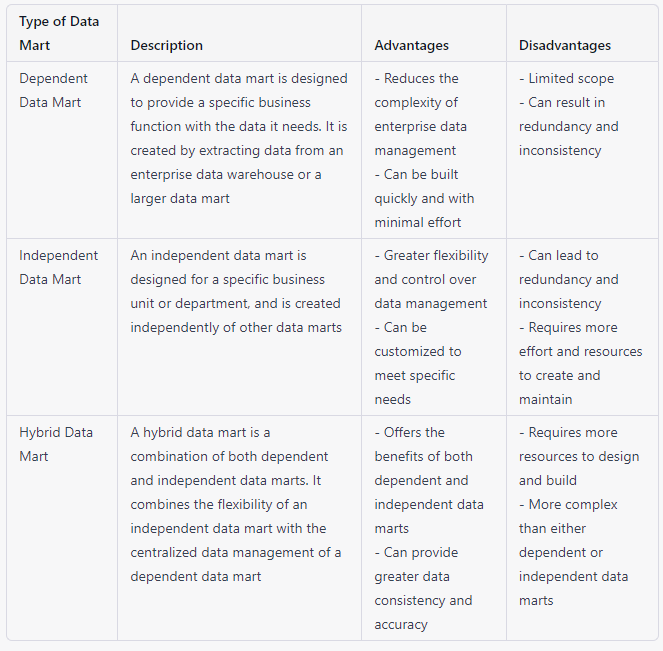
In addition to these three main types of data marts, there are also other types of data marts that are used for specific purposes. These include:
4. Virtual Data Mart
A virtual data mart is a type of data mart that is created on-the-fly by querying a data warehouse. This type of data mart does not require any data to be extracted from the data warehouse, making it a quick and easy way to access data for ad-hoc analysis.
5. Standalone Data Mart
A standalone data mart is created to serve the needs of a single user or a small group of users. This type of data mart is often used by individuals who need to access specific data for their work, but do not require access to the broader data sets available in a larger data warehouse.
Structure of a Data Mart
The structure of a data mart is a crucial aspect of its design as it affects how data is stored, organized, and accessed. Here are the main components that make up the structure of a data mart:
1. Dimension tables
Dimension tables contain descriptive information about the data in the data mart. This information is used to categorize or group data, making it easier to analyze. For example, a dimension table for sales data might include information about the date of the sale, the location of the sale, and the product sold.
2. Fact tables
Fact tables contain numerical or quantitative data, such as sales revenue, that is related to the dimension tables. Fact tables are used to store the detailed data that is used for analysis and reporting.
3. ETL processes
ETL (Extract, Transform, Load) processes are used to extract data from the source systems, transform it into the required format, and load it into the data mart. ETL processes are used to ensure that the data in the data mart is accurate and consistent.
4. Data modeling
Data modeling is the process of designing the structure of the data mart. This includes defining the relationships between the fact tables and dimension tables, as well as defining the attributes and hierarchies of the dimension tables.
5. Data access tools
Data access tools are used to query and analyze the data in the data mart. These tools can include SQL-based query tools, reporting tools, and data visualization tools.
6. Metadata
Metadata is information about the data in the data mart, such as the data source, data lineage, and data quality. Metadata is used to ensure that the data in the data mart is accurate, consistent, and up-to-date.
In addition to these main components, the structure of a data mart can also include other components, such as security and access controls, data governance processes, and backup and recovery processes.
Conclusion
In conclusion, a data mart is an essential tool for any organization that wants to harness the insights from its data efficiently. By focusing on specific areas of the business, a data mart can help users quickly find the data they need and analyze it in a way that is most relevant to their business.
Without a data mart, businesses risk spending valuable time and resources sifting through large amounts of data and potentially making incorrect decisions.
You may also like,


