
What Is a Calorie Deficit and Why Do We Need One to Lose Fat?
Because of thermodynamics. Duh!
To lose weight, we must be in a calorie deficit.
There’s no “But, what if I eat this food?”. Or, “Oh, but what if I don’t eat carbs after 6 pm?”. No, “How about Keto, can I eat as much as I like?”.
All of the random weight loss hacks recommended to us in fitness magazines or by random influencers are completely irrelevant unless…
We’re in a calorie deficit. It’s that black and white.
What is a Calorie Deficit?
A calorie deficit (or caloric deficit) is when a person consumes fewer calories than they expend (burn). If a person is in a calorie surplus, it means they are consuming more calories than they burn and therefore, gain weight.
“The traditional approach to weight reduction has been the prescription of diets that provide an energy intake below that of energy expenditure, i.e., an energy (calorie) deficit.” — Finer, 2001
A calorie is how we measure the energy content of food.
Calories are made up of macronutrients — fat, carbohydrates, and protein. One other “nutrient” that contains calories is alcohol.
By consuming less energy than it takes to sustain your current weight, our body is forced to use its fat stores as energy.
Why must we be in a calorie deficit to lose weight?
Our weight is controlled by our food consumption (or anything else with calories) and our activity levels. Calories in versus calories out.
We burn calories through exercise, but ultimately, what matters is how many calories we consume in the first place. This calorie intake dictates whether we’re in an energy surplus or deficit.
The law of thermodynamics dictates that energy doesn’t disappear but is instead transformed from one form to another. In the case of food, our body metabolises the energy and transfers it from the food to the person (or animal) consuming it.
Therefore, food adds potential energy to our bodies. Depending on the person, we have a maintenance level of calories, governed by current size, our energy intake, and activity level.
The more calories we consume, the more activity is required to burn off the excess energy. Otherwise, our body stores this energy as body fat for later use.
When we burn body fat, our body is using stored energy because we’re not providing enough calories.
If we continually reduce the calories in our diet, we’ll keep losing weight.
How do we calculate a calorie deficit?
So how do we know how many calories we should be eating to be in an energy deficit?
Each person’s maintenance level of calories depends on genetics, activity level, and current body weight.
It could be 2000 calories, or it could be 3500 calories.
Use a calorie deficit calculator to give an estimate of your maintenance level of calories and accordingly, your calorie intake to lose fat.
Using apps such as MyFitnessPal can also make it a lot easier to count your calories. They have a huge database of foods and their calories. You can also use Google to find out how many calories are in different foods.
Over the day, input everything you consume — from sauces to drinks like coffee and juice or beer. At the end of the day, you’ll be left with your total calorie intake.
Each day, aim to eat around 200 to 500 calories under maintenance.
Try not to get caught up on your day-to-day scale weight.
If you overeat one day, you won’t gain a pound of fat overnight, despite what the scale tells you. Water weight fluctuates daily but your calorie intake is averaged out over time.
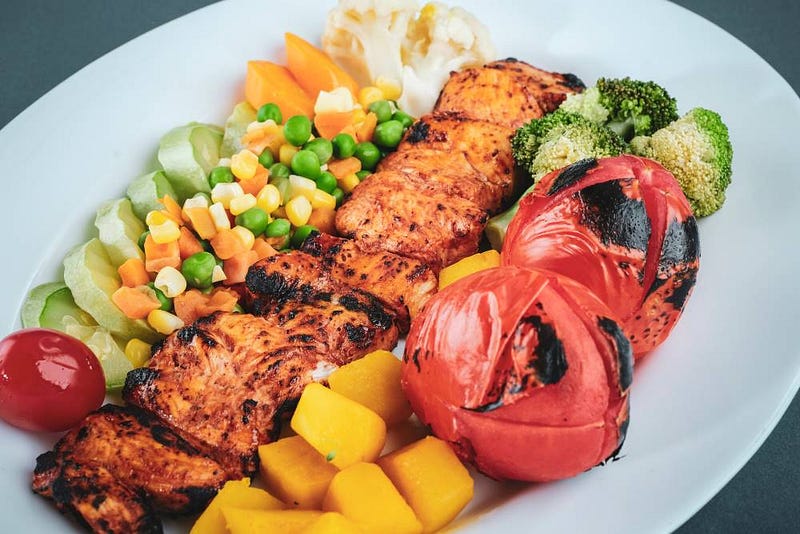
Foods to Eat to Reduce Your Caloric Intake
Does eating healthy food automatically mean you lose weight? Nope.
However, as healthy foods are lower in calories than most processed foods, eating healthy does mean it’s easier to consume fewer calories to lose body fat.
However, unless you’re in a caloric deficit, you can still gain weight by eating healthy foods. If fat loss is your goal, portion control is key.
Some general advice to take on board to help lose body fat is
Per meal:
- Moderate to high protein (10+ grams per 100 gram serve)
- Low to moderate carbs (<40g)
- Low to moderate fat (<10g)
Does it really matter exactly what we eat?
A 2013 systematic review and meta-analyses found that replacing sugar in a person’s diet with another food source with equal calories didn’t affect a person’s weight. Their findings concluded that how much a person eats dictates whether they’re overweight.
Studies show there is little difference in the fat loss/gain between people on a low-fat diet or those on a low carb diet. Therefore, it doesn’t matter so much what we’re eating — our body doesn’t discriminate between 500 calories made up of mostly carbs or 500 calories made up of mostly fat.
What matters is the total number of calories we consume.
Therefore, it doesn’t really matter what you eat, but how much you eat.
Sure, it makes sense to consume mostly low-calorie foods, such as fruit and vegetables. As well as containing plenty of micronutrients (vitamins and minerals) and fibre for our overall health, we can eat more of these low-calorie foods.
We should also aim to eat foods that are high in protein, as they’re more filling, reducing your hunger. Why? Because protein is the most satiating macronutrient.
“Protein is the most effective food macronutrient providing a satiating effect. Thus, formulating foods with increased protein contents can help to modulate food intake, promoting body weight loss and body weight maintenance thereafter.” — Morell, 2017

Ten foods that I regularly eat to help control my weight are:
- Chicken breast — High in protein, low in calories
- Whitefish fillets — High in protein, low in calories
- Eggs — High in protein, low in calories
- Oats — Good energy source (complex carbs), only a small serving required
- Egg noodles — Low in calories and high protein
- Brocolli — Low in calories and nutritious
- Carrots — Low in calories and nutritious
- Kiwifruit — Low in calories and nutritious
- Bananas— Low in calories and nutritious
- Wholegrain bread — Complex carbs, high in fibre and a good protein source
I’m not saying that these are the best foods for you to eat. But, they’re great options that I enjoy eating, and you might too.
In Conclusion
Eat more calories to gain weight and eat fewer calories to lose weight. Calories in vs calories out.
It’s that simple!
In this article, we’ve explored why we need to be in a calorie deficit to lose weight.
There is energy in food, which we call calories. This energy is transferred to the individual consuming it. If we need more energy than we need, our body stores it as body fat for later use. If you consistently eat fewer calories than it takes to sustain your body weight, your body will use this stored body weight as energy.
I have recommended ten foods that I love that help me to manage my calorie consumption and therefore weight.
Thank you for reading.
I hope you found the information useful.
If you enjoyed the content, you might be interested in this article about five common cardio mistakes to avoid to improve your fat loss.
Read More Medium Articles
Non-Medium members can only read 3 articles a month — become a Medium Member for unlimited access.
If you would like to read more articles like this one, sign up to become a Medium member for only $5 a month.
Subscribe to be notified when I publish new content.


