
What I Learned about Writing Watching Painting Time Lapses
The magic happens after you’re 80% done
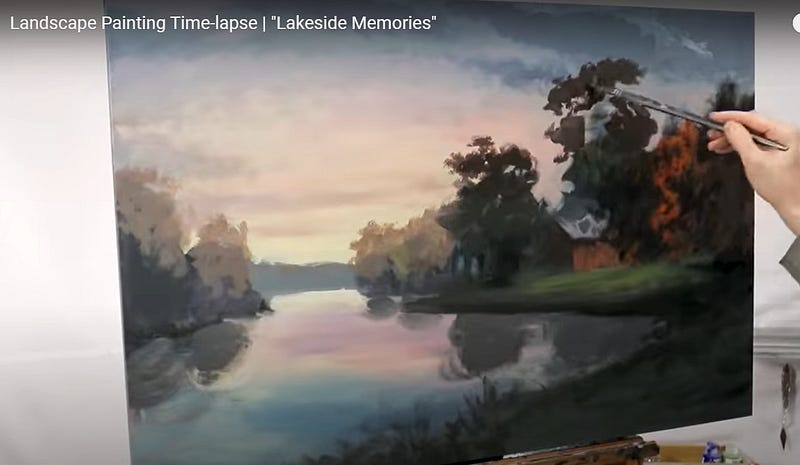
In addition to cookie decorating videos, one of my serotonin pleasures (as opposed to guilty pleasures) is watching painting time lapses. The one we’ll talk about here has a gorgeous preview image. There’s a cabin on the shore of a lake, a dock with two people sitting on it, fall foliage and a sunset in the background, all of it reflected in the still water of the lake. It was stunning. I couldn’t wait to see how it was made.
But as the video starts, the artist, Chuck Black, talks in a voiceover about how much of a struggle this piece was, and how nothing was going right.
The Foundation
Thirty seconds into the video, things look good to my eye, if different than the preview. There’s a cabin sketched out, a bunch of trees, and a stream down the left side. But the voiceover talks about his dissatisfaction with the composition. Almost immediately, he paints right over the cabin, changes the sky, and changes the stream to something closer to a lake.
Then he puts in a huge block of near-black paint on the left: a blob of a rectangle with lines spidering away from it. It wasn’t pretty. But he kept going, still trying things out, covering the canvas and not afraid to make a mess of it all. In fact, when he decides against the tree/dirt road composition, he takes a brush and paints through it in pieces, not so much erasing it as making it clear to Future Him it isn’t working and needs addressed.
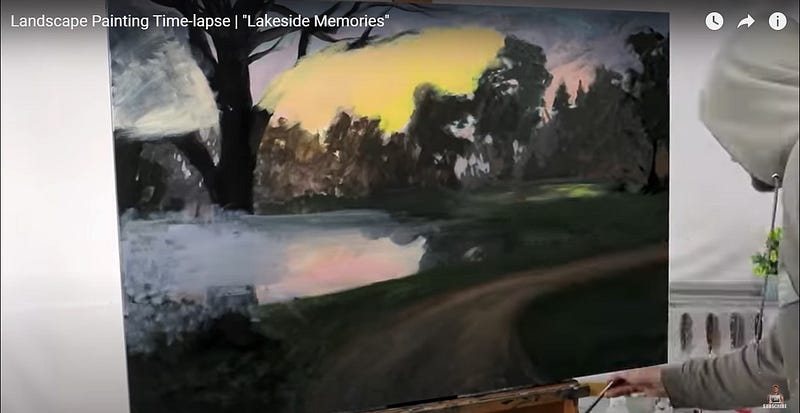
In this moment, the painting looks worse than it did a few minutes earlier in the video. The trees in the background are nothing more than suggestions, and the foreground tree is Schrodinger’s, both there and not: part floating tree, part lake, part sky.
But he’s not done. He’s not scared to work in broad strokes, finding what works and what doesn’t, and letting the layers underneath support the composition as it changes again. And again. And again.
The first three minutes of this 11:36 video — a full 25% of the total time — are spent with what ends up being the wrong composition. It’s only just past the three-minute mark that Black settles on a composition and starts to work on colors, lighting, and details.
This feels a lot like writing to me.
So much of our initial time and effort needs to go into a Zero Draft. We need to determine what goes where, how the story hangs together, what the focus is. This takes time. We might get down some details — snippets of dialogue, a bit of a scene, a character trait — in this early planning stage that makes it to the end, but we have to hold onto it with a loose pen.
First drafts are the base layer of a canvas. We need them for practice, they pave the way to the final piece, and they’re not visible in the final.
Part of what it means to lay a decent foundation is to not be afraid to save the details for later. If details are in the foundation, they’ll need to be painted around — which is difficult and doesn’t look quite right in the end — or painted over to create the background and then redone later. There’s no point in details at this point.
There are two key takeaways for our writing from the changing composition that comprises the first quarter of Black’s video:
- A full quarter of the work is deciding on the basic foundation.
- Once you have this foundation, you still have 75% more work to do.
That is, I think it’s a balancing act: we need to spend time on the base layer to be sure we’re happy with it, but we must remember it’s only the beginning. Outlines and Draft Zeros are necessary, important work. But they aren’t the end.
Some Thoughts on Middles
I’m mostly going to gloss over the middle part of the video, the bulk of the “writing your book” part of writing your book, to get to the end. But I want to take a stop along the way to look at iterations.
See, within about three more minutes of Black’s video, the painting looks pretty close to done to me, outside of the cabin. Then right at the six-minute mark, he runs his brush through an already finished tree and completely remakes it.
Not all pieces of a painting are the same age, if you will. Some have been reworked six or seven or a dozen times. Some have been there from the beginning and only get refined. Still others get scrapped near the end and need replaced. By necessity, these newer elements will be worked over fewer times.
The same thing happens in writing. Some scenes will be there from the very first idea. Others will need scrapped and redone, potentially even when the rest of the book feels complete. When you look at that scene in conjunction with the rest, it no longer fits. So you redo it. It can be tough at first to see the first draft of a scene wedged between two polished ones, but if it’s the right scene, it’s worth it to redo.
Finishing Touches
By about the 7:45 mark of the video, the whole painting looks done to me. I would have stopped. But the last 20% of the video ends up being as vital as the first 25% was in finding the right composition.
While for the first quarter Black worked in broad strokes with big brushes, by the end he’s pulling out small — even tiny — brushes and oil paints, adding in details as fragile as a fishing line, or reeds along a shore, or birds in a finished sky.
Of course, it makes no sense to add birds to the sky until you’re happy with how the sky looks, or even put a dock over the water until the reflections from the trees are in place. Earlier work will get covered over, but it’s evident in the final nonetheless.
The last 20% is where the magic happens. It takes a great painting into a photorealistic one, and it takes words from a decent story to a cathartic one, a resonant one. The last 20% is where you ensure that all the lines of a story are connected, where themes and motifs get run throughout, where contradictions disappear and timelines firm up.
Writing a book — the putting words on a page in order part — is less than half of the job. So much of what makes a story work is in the foundation, and in the slow, hardly noticeable alone, details that bring it to life at the end.

If you like my work and would like to read more of it, consider joining Medium with my referral link to get full access to every article on Medium. Using my referral link doesn’t cost you anything, but half of the fee goes directly to supporting me each month.