
You Should Outline Your Book (But Outlining Might Not Mean What You Think)
Lessons from visual art to apply to writing a novel
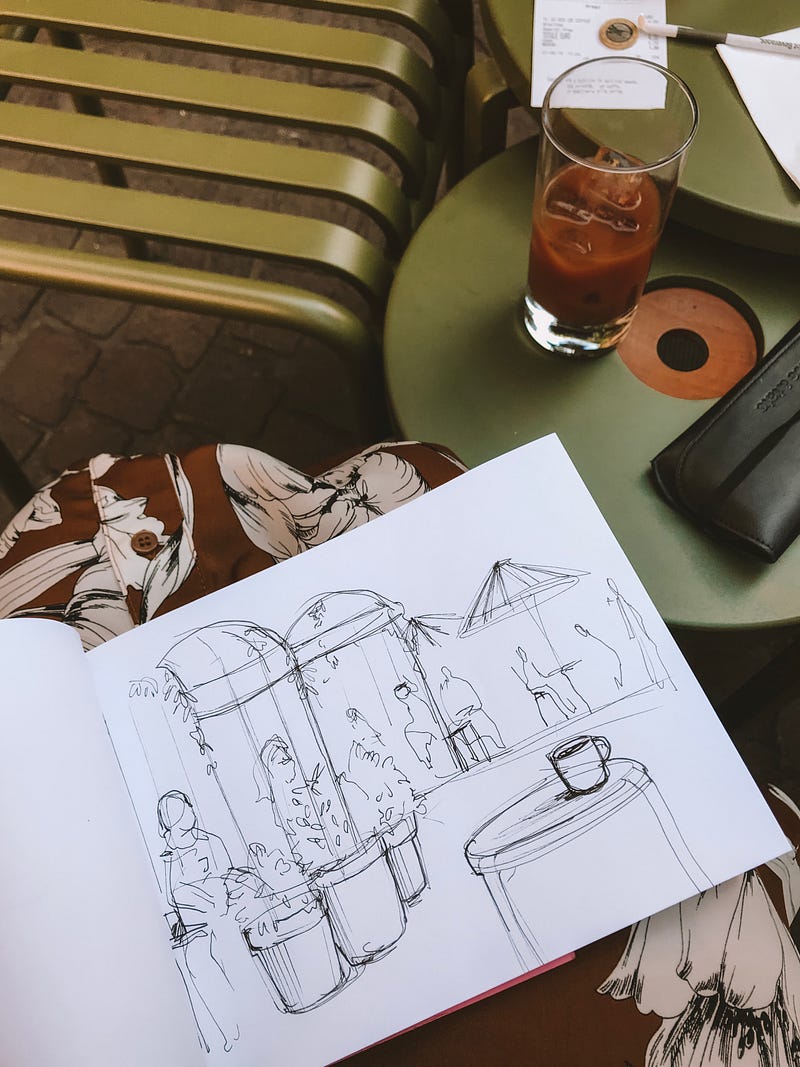
Not all artists work from a separate sketch, but most artists who work in realism do. Initial sketches help a visual artist determine what to include, what to leave out, where to put things on the page, and a general idea of the proportions. Like I mentioned, it’s like looking at the landscape of your starting point vs your destination to figure out which way to go.
In a road trip, this is the map with a planned route. In visual art, it’s the initial sketch. In writing, of course, it’s the outline.
I know a lot of people get terrified of the idea of writing an outline for their book. Complaints about it stifling creativity, ruining the idea, or just being a plain boring way to look at story come up often. Many associate outlines with a rigid, Roman-numeral-dominated list that then can’t be messed with. But the best outlines aren’t lists. Instead of seeing them as the only path forward, viewing the planning stage like it’s an initial sketch can provide a huge benefit to the final story.
Think of this step this way: instead of immediately laying down oil paints on an intimidating piece of 20x30 canvas, you start on a piece of paper with a pencil, sketching things out. You try a hundred variations. Find a perspective you like. Play with some ideas. From this place, you can see the work in miniature and start to draw connections.
Will X be a mirror of Y? Where will the focus of the piece be? What do we build around? What background will be most effective? Can we play with pattern or motion here? You can scrap it and try again. You could draw three different branch locations coming off the tree in the foreground and save the decision-making for later. It all works; it’s just a reference for you, so it can look however you want it to.
The same goes with outlining: it’s your reference. Write an outline your way, however makes sense! Below are some methods of outlining that aren’t strict Roman Numeral Outlining, from least structure to most. This is only a sample, too, of myriad ways to outline.
A quick note that these methods focus on plot and character, not worldbuilding. Worldbuilding, especially, but not only, for a fantasy, is imperative and should be done before or in conjunction with these steps that lead to story, no matter which outline method you choose. Without further ado, ways you can outline a book:
- A list of scenes, characters, and things that have you excited about the project.
- A document with characters’ complex backstories and the inciting incident.
- A filled out “beat sheet” discussing the turning points of the novel.
- Truby’s 22 plot steps.
- A scene-by-scene, chapter-by-chapter breakdown of the book.
Let’s explain each of these down a little further.
A List of What Excites You
“What excites me” could be a character trait, a scene you can’t wait to write, a dynamic to explore, a thematic motif, a line of banter — anything that comes to mind. Include connections between things and notes for ideas you could go deeper with if it interests you. Let your list contradict itself if you want to. Don’t put it in any kind of order if order intimidates you. This is more a catalogue of ideas than an outline, but it’s worth having to mine from, especially if you prefer to “pants” your way through the story-writing itself.
Helpful equipment here could be as simple as a notebook dedicated to the project, but programs like Scapple and Evernote are built for this kind of outlining and brainstorming, with the added benefit of being searchable.
Character Backstories + The Inciting Incident
This method of outline focuses on character-building and is great for working toward a character-driven plot. Its focus is on characters, their backstories, their relationships, their “ghosts,” what you want them to learn, parallels in different characters’ lives you could juxtapose, etc. With fully fleshed-out characters, a paragraph (or even a sentence) about the premise itself — the situation you want the characters to be reacting to — is enough for some authors to get ready to write a full draft.
In addition to something like Scapple or Evernote, character questionnaires (either downloadable or as part of software) are helpful if this method of preparation appeals to you.
A filled out “beat sheet” discussing the turning points of the novel. This idea of a Beat Sheet is used by several authors who discuss plotting. One of the most familiar is Save the Cat (by Blake Snyder and updated by Jessica Brody). Another is K.M. Weiland and James Scott Bell’s work with plot points and pinch points. There’s the three-act structure, the hero’s journey, and the heroine’s journey, too, just to name a few. A plot alone may not be enough, so some form of character work should supplement this.
Beat sheet templates can be found all over the place and for pretty much any method of plotting there is. Some people prefer spreadsheets, and others do this planning work directly in a program like Scrivener or Plottr.
John Truby’s 22 steps. A much more complicated system of plotting, John Truby’s The Anatomy of Story includes a 22-step beat sheet that hits every point he believes all good stories have. They’re far more specific in function, but less specific in when, precisely, they should fall, than the beats mentioned earlier. His book is helpful for those looking to dive deeper into story, and involves checklists in every chapter to help you as you plan to write a novel.
A Scene-by-Scene Breakdown of the Book
Some authors need far more details, building up from premise to a full summary of every scene in the book. This method of outlining can’t work without pre-writing about characters and the world, then making sure all the pieces fit into the puzzle of a chapter outline. It’s the culmination of what, for some authors, can be a pre-writing file even longer than the novel ends up being.
The Snowflake Method of writing works toward this level of detail in the outlining stage, but it can be a step beyond a beat sheet as well. Most people who work this way keep detailed, organized notes in a notebook, a program like Scrivener, or both.
No matter how you choose to do the initial work, getting from idea to a finished novel requires a sketch of some kind. Pantsers might argue this point, but hear me out. If you choose to work entirely as a pantser, starting with a blank page and nothing else, and moving straight into “writing a book” in scene form, it’s imperative to understand that even if your completed document has 70,000 words, description, action, and dialogue, it needs to be treated as a study, not as a final piece ready for tweaking. Stories, like paintings, cannot be made in one layer. For the sake of your time and the finished product, I highly recommend finding a way to sketch out a plan first.
If you like my work and would like to read more of it, consider joining Medium with my referral link to get full access to every article on Medium. Using my referral link doesn’t cost you anything, but half of the fee goes directly to supporting me each month.


