
When Planning a Story, Knowing Your Starting Point Is as Vital as Your Destination
It’s less spontaneous, but you’ll end up where you want to go
I’ve talked about it before, but it’s my mantra and we’re going to talk about it again:
Plans are useless, but planning is essential.
That’s a Dwight Eisenhower quote, and it’s my approach to all aspects of writing — but especially pre-writing. As you might have noticed by the name of this publication, I firmly believe that books aren’t written in order, but built, one layer at a time, like a canvas of fine art. We’ll be talking about that more in the following weeks.
For now, one of the keys to working in layers when you’re writing is knowing where your starting point is.
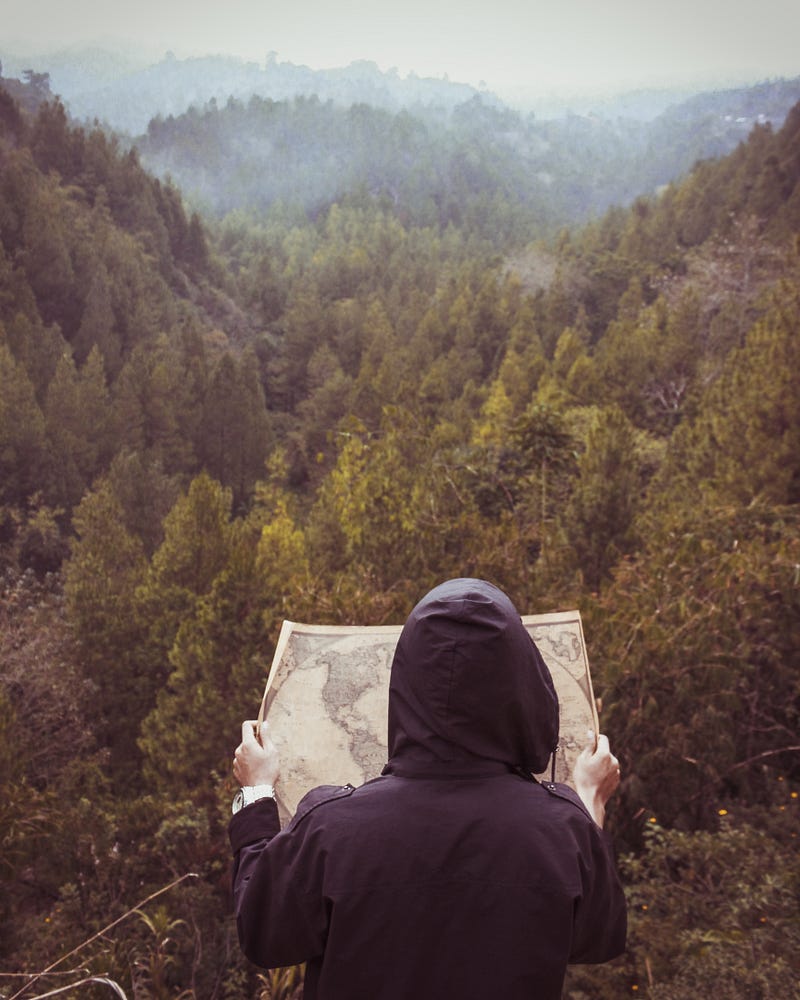
Say you’re going on a vacation. Maybe you know you want to end up in Disneyland, but if you don’t know if you’re in Hawaii or Washington right now, how do you know which way to go? If you try to drive to Disneyland from Maui, you are going to end up with issues, to say the least. Driving east from Washington is more possible than driving to Disneyland from Maui, but you still won’t end up where you need to go. Your starting point is as crucial to planning your trip as your destination.
Likewise in writing.
In art, you find your starting place by choosing an idea, concept, place, or person you want to capture in the final piece. While literal road trips can show you the landscape in Google Maps once you provide your destination, in art and writing alike, you’ve got to draw the destination yourself. I’m a firm believer that it’s better to get something — anything — down before you leave, rather than trying to draw the road and drive on it at the same time.
More about that in the coming weeks. First, let’s turn back to choosing an idea and figuring out where you’re starting from.
Choosing a Topic
Before you can set out to create a piece of art, you need to know something about what you want it to be. In modern and abstract art, the initial idea usually isn’t what, exactly, would make it onto the final canvas, but the principles that the artwork explored. “This painting,” they might say, “will be about loneliness.” Landscape artists look for a scene that inspires them. Portrait artists usually want to capture a person’s likeness not only in how they look, but their spirit.
Writers, meanwhile, come upon their ideas in a number of ways. Vivid dreams, a scene the author couldn’t wait to write, a theme to explore, a character, a voice. For the vast majority of writers, coming up with an idea isn’t the problem; the problem is evaluating which idea is the best one to work on right now.
Here’s an incomplete list of starting questions to ask, to help you decide which of your several amazing ideas to pursue first.
- Is this something I’m passionate about?
- What has me excited to explore this story?
- What would the challenges be about telling this story?
- Am I the right person to tell this story?
- What’s the age category and genre this story would work best in? Is that a style I’m comfortable in or want to learn more about?
- Where do I see this going? Can I build from that initial spark into a combination of plot, character, and theme that makes sense to me and excites me even more?
- Can any of my separate ideas be combined into a single story — can they be connected by character or theme so the book I write has more nuance?
- Is there anything problematic about this plot/theme/dynamic that I should address? Is it too problematic in the lesson it teaches to pursue?
But maybe you aren’t the kind of writer who could have (or actually has) a spreadsheet with your myriad ideas. Maybe ideas come to you in a trickle, one at a time, and back to back only if you’re lucky. Honestly? This is me. I’ve never had too many ideas at once. In fact, when I start wrapping up a project, I inevitably have an existential crisis about what I’m going to write next. About if I’m going to write next. What if this was my last good idea? I can’t think of anything else. This book is do or die now, because this is it.
And, invariably, it hasn’t been. But if you’re a writer like me, it can be harder to choose a topic because it isn’t evaluating all the good ideas you already have, but finding one at all that will land on you like a butterfly. Be patient. You’ll find another good idea, even if you have to manufacture your way to it.
Finding Inspiration
I’ve written seven novels so far, and I’m in the midst of coaxing a butterfly onto my shoulder for an eighth. Each of them have had different starting places, and I know these have worked for other authors as well.
- Inspiration from a derivative source. Love the worldbuilding in The Hunger Games but want to set it in 12th century Argentina? Go for it. Winnie-the-Pooh but with aliens? I’d be curious. Taking a derivative source, combining it with something else, and then making it your own is a fairly common place to start a book’s idea.
- Retelling a public domain story. You don’t need a huge twist to retell stories in the public domain as far as copyright is concerned, but it’s often a good idea to twist something and make it your own. What’s your favorite fairy tale? How would it look if it were a contemporary? A high fantasy in a world you build? What if you gender-swapped it, or told the story before the story, or the one after the happily ever after?
- A philosophical concept. What if everyone knew the day they would die? What if no one saw in color until they met their soulmate? Starting from a philosophical “what if” can lead to a premise worth exploring.
- Revitalizing a shelved WIP of your own. Maybe the book you wrote about magical ponies living in rural Tennessee when you were twelve isn’t quite fully formed (or maybe that’s just me?), but there is likely something in your old work that can inspire something new. Maybe a side character is more interesting than the character you initially wrote about. Maybe the world is fun, but you need different characters entirely. Save your work and reread it when you need an idea.
- An aesthetic. Despite often wishing it were true, the creation of an aesthetic does not a novel make. But for a lot of visual learners, they’re not only a fun procrastination tool, but a healthy way to mine for ideas. A picture can inspire an entire story, or clarify the characters, or give you an idea for a motif that will carry the plot.
- Something that happened in your own life. What if you’d said yes to the boy who asked you out in seventh grade, right before the earthquake? What if you took that high school story that seems too unbelievable to be true and made it believable fiction?
I want to leave a quick note about this last one. When I first began writing books, I tried to stay as far removed from my own experience as I could. I figured my life was boring and not worth writing about.
I was wrong. The Definitely Not Me stories I wrote were hard to relate to because there wasn’t enough of me in them. The personal is universal. Just look at Taylor Swift (or Olivia Rodrigo) lyrics. It was only when I started drawing from my own well — my experiences, my insecurities, my struggles, not just the themes that interested me — when I started getting compliments about my work being relatable.
It’s terrifying. It’s right. When you’re looking for ideas, look for things that are personal. Look for what scares you. And be sure it’s your story to tell. Those are the stories people use as mirrors and windows. Those are the stories that resonate.
If you like my work and would like to read more of it, consider joining Medium with my referral link to get full access to every article on Medium. Using my referral link doesn’t cost you anything, but half of the fee goes directly to supporting me each month.