
What Genuine Human Touch Can Do to Help Others Get Their Strength Back
You can do tiny things to improve your and other people’s lives.
His barely noticeable smile always lights up the place.
Most of the time, Mr. M. sits at the table in the living room. In a wheelchair with his eyes closed. If he has his eyes open, he scans the curtains or kitchen while he’s lost in thought.
Sometimes he opts for the lazy chair in front of the TV. He doesn’t get much of what is said on TV, it’s more the idea. All his muscles move slowly, even when he yawns.
When he tries to get up his arms shake intensely. These days, he’s re-learning to get up and walk on his own, and he barely speaks. I help him eat during dinner time — this can take up to an hour.
He hasn’t always been in this state.
Two months prior, he was walking back and forth down the hall on the 3rd floor. And at times being aggressive towards furniture.
Now I can’t imagine where he’d get that energy from. He’s mid-50’s.
The difference between then and now is Covid-19.
The 3rd Floor
I work on the 3rd floor of a residential care center. The floor has rooms for nine residents.
Two residents died from the recent Covid-19 outbreak. One resident was in the hospital until last Monday. Three of them are recovering, like Mr. M.
They lost a lot of weight and strength.
This makes it extraordinarily quiet on the 3rd floor. The few residents that are there now, are relatively at ease. That’s changing slowly because one resident came back from the hospital and a new resident moved in.
It’s only my third week working here, so for me, it was a ‘good’ time to start. The place is full of interesting stories. People. Lives. (I’m looking forward to sharing more about them with you in later posts.)
There was all the time of the world to get to know the place, Mr. M. and his fellow residents.
During the outbreak, it was a different story.
My colleagues were wearing medical suits from the tip of their toes to the crown of their heads. And yes, it’s a place where primarily old people live, so the heating is turned high. That means sweating like crazy in your full-body suit. They did their ‘normal job’, combined with lots of extra care for the residents, having colleagues in quarantine, while being in those suits.
The residents with Covid-19 who didn’t go to the hospital got isolated and taken care of each in their own room.
Wow, I have lots of praise for them. For both the residents and my colleagues.
Despite all efforts and care, two of the residents died. We’re now helping the remaining residents get their strength back and let life get back to normal.
Getting Strength Back
Helping Mr. M. and the other residents to get their strength back shows me how tough recovery can be.
But, it mostly confirms to me how beautiful it is to give to others. That perhaps sounds like an outdated quote, but it’s so accurate.
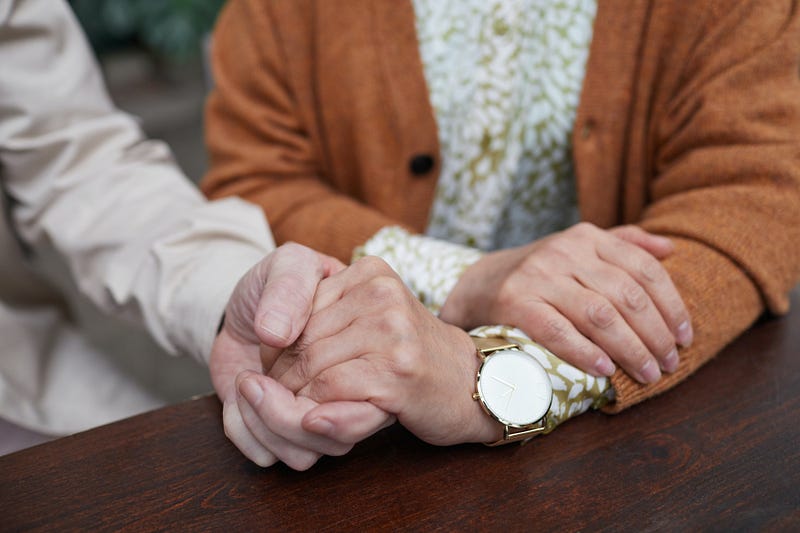
When I hold a resident’s hand, he becomes calm. When I patiently help with dinner, he shows a small smile (while he kindly reminds me after half an hour that the food cooled off).
Not only does food count as an energy resource; human attention and touch do as well.
Let’s dive into the importance of touch a bit. This is an excerpt of The Guardian’s article titled “Lost touch: how a year without hugs affects our mental health” on the 24th of January, 2021:
“Touch is a modulator that can temper the effects of stress and pain, physical and emotional. We have seen in our research that a lack of touch is associated with greater anxiety,” says Fotopoulou. “In times of high stress — the loss of a job, or a bereavement, for example — having more touch from others helps us cope better, particularly in calming the effects of [the stress hormone] cortisol.” Even if we’re used to not being touched a lot, after a while the need can feel very physical — sometimes described as “skin hunger” or “touch hunger”. — Eleanor Morgan at The Guardian.
During the past three weeks, I’ve probably held more hands than the last year combined. The residents show immediate relaxation when caressing their shoulder or holding their hands takes place.
Writing this makes me think of my partner and me. We live 6000 kilometers apart. Of course, we take care of ourselves food-wise and we’re ‘fine’ by most standards, but the first hug at the airport after not having seen each other for three months is magical. It gives both of us a boost. A well-needed boost.
The Small Things in Life
It’s true — the small things in life are the ones that count.
As adults, we may not comprehend the importance of touch even when it disappears. “We might begin to realise that something is missing, but we won’t always know that it’s touch,” says Prof Francis McGlone, a neuroscientist based at Liverpool John Moores University and a leader in the field of affective touch. “But when we talk about the problem of loneliness, we often ignore the obvious: what lonely people aren’t getting is touch.” — Eleanor Morgan at The Guardian.
With tiny actions, we can do a lot to make each other’s lives a bit brighter every day. Heck, isn’t that a beautiful feature of life?
I’m truly honored that I — together with fantastic colleagues — can do this for Mr. M. and his neighbors.
I’d now like to ask you: how are you doing? Is there something you’re up for? A hug? Just being together and relaxing on the couch? How are your relatives, friends, and family doing?
If you get the chance, take your time to give them a hug. And/or let them know you can use a hug. Recharge your and the other person’s body and let stress wash away. Even if it’s just for a minute.
We’re all people living in a still somewhat strange world where the human touch is rarer than it was before. At the same time, we’re still as wired to need touch as we did before.
This piece is a reminder for me, too, to keep an eye on loved ones. To keep asking them how they do and share plenty of hugs whenever I can. To keep expressing it when I’m up for a hug. It feeds both of us.
Let’s not take the human touch for granted.
You receive when you give ♥
Thank you so much for reading!
Here I like to put a story by Emily Forman in the spotlight. She wrote a striking piece about appreciating the processes we go through in life by translating her own progress — and how she tracks it — with Lyme disease. Thank you, Emily!
Two more stories to continue reading:
If you like this piece, give a few claps and follow me for more! If you want to have full access to Medium: become a member. Via that link, it also only costs $5 and I receive a small commission. That’s a win-win! ♥
Your support means a lot☺


