
What Everyone Forgets About F. Scott Fitzgerald
Why his impact on literature goes far beyond ‘The Great Gatsby’
What would you say if someone asked you — just off the top of your head — to describe F. Scott Fitzgerald in a few words? You might say “author of The Great Gatsby,” “one of America’s best short story writers” or — if you have a literary turn of mind — “apostle of the Jazz Age.”
The last word that might occur to you is “historian.”
But you can’t separate The Great Gatsby or “Babylon Revisited” or Jazz Age fiction from one of Fitzgerald’s supreme gifts: He was a superb historian of his era. His work gives you a well-rounded picture of his time and place in matters large and small: You always know where you are in time and space.
That gift helps to explain why Fitzgerald is more closely linked to the Jazz Age than Ernest Hemingway, who also wrote about the 1920s, particularly in his novel The Sun Also Rises and his memoir A Moveable Feast. Hemingway favored what he called the “iceberg theory” of writing, which hints at his themes. Fitzgerald brings his to the fore.
You can see something of their different approaches in two stories that deal with the aftermath of a disaster, each among the finest by its author.
Hemingway’s protagonist in “The Big Two-Hearted River,” Nick Adams, has returned emotionally wounded from World War I and finds a measure of solace in the vitality of the fish on a river in on Michigan’s Upper Peninsula — but Hemingway doesn’t name the war and the story might have worked as well if set in another region with a similar landscape.
Fitzgerald’s main character “Babylon Revisited,” Charlie Wales, returns to Paris after losing almost everything, including his money and family, in the stock market crash of 1929 — and this is not only explicit but essential to the story. Hemingway’s tale might hold more interest for psychologists, but Fitzgerald’s would have more for historians.
Here’s how John Cheever describes Fitzgerald’s gift:
“Great writers are profoundly immersed in their time and he was a peerless historian. In Fitzgerald there is a thrilling sense of knowing exactly where one is — in the city, the resort, the hotel, the decade and the time of day. His greatest innovation was to use social custom, clothing, overheard music, not as history but as an expression of his acute awareness of the meaning of time. All those girls in their short skirts and all those German tangos and the hot nights belong to history, but their finer purpose is to evoke the excitement of being alive. He gives one vividly the sense that the Crash and the Jazz Age were without precedent, but one sees that while this is a part of his art and that while Amory, Dick, Gatsby, Anson — all of them — lived in a temporal crisis of nostalgia and change they were deeply involved in the universality of love and suffering.”
John Cheever in his essay, “F. Scott Fitzgerald,” in Atlantic Brief Lives: A Biographical Companion to the Arts (Atlantic Monthly Press, 1971).
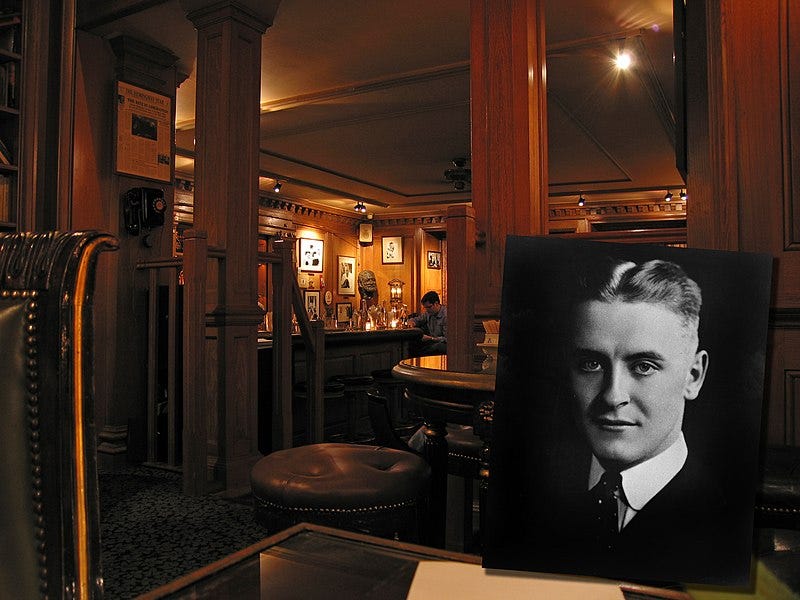
A note about the header image for this story: Don’t miss bust of Hemingway in the rear corner of the photo of the bar.
You might also enjoy my stories on three other literary titans:


