
What Can We Learn from Reconciliation: Healing the Inner Child
Mindfulness teachings from Reconciliation: Healing Your Inner Child by Zen Master Thich Naht Hanh
Reconciliation: Healing the Inner Child by Zen Master Thich Nhat Hanh was third down in my to-read list but I decided to honour his recent passing by jumping to it right away. While there are many books on inner child by psychologists, I was particularly drawn to reading his. I wanted to find out what a monk’s perspective on inner child healing is like and how he relates it to the practice of mindfulness.
To begin with, I’ve always enjoyed Thich Nhat Hanh’s other books and reading this book on Reconciliation is no different. I tapped into immense peace while turning the pages. His book offered me many points for reflection, which I will share some as follows.
Connecting with The Energy of Mindfulness
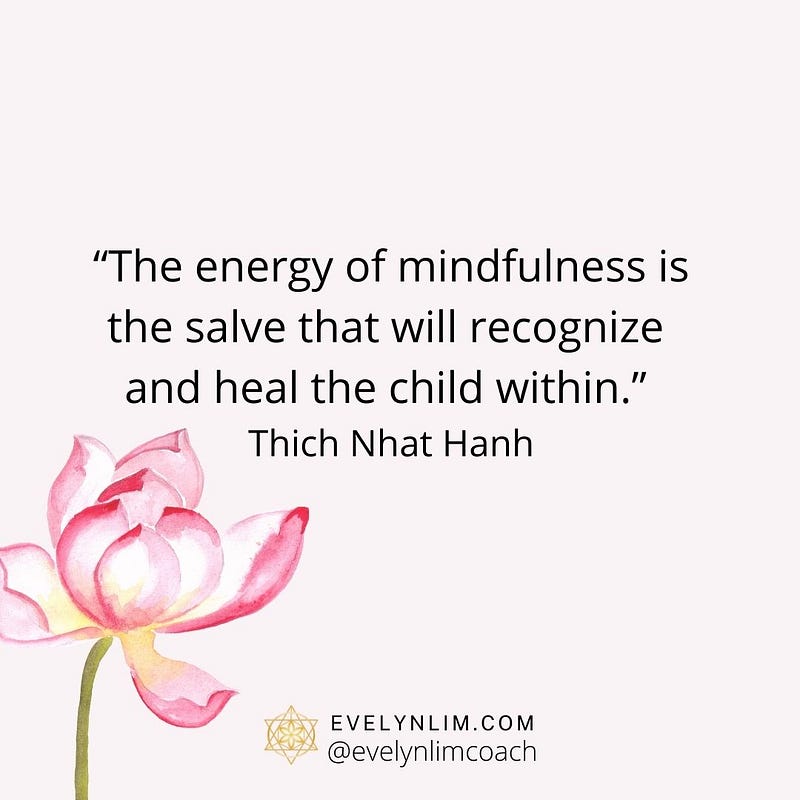
“The energy of mindfulness is the salve that will recognize and heal the child within.” Zen Master Thich Nhat Hanh
In Buddhist psychology, there are two parts to consciousness, the mind consciousness and the store consciousness. Mind consciousness is our active awareness for everyday living while store consciousness is often referred to as the “unconscious mind” where our past experiences are stored. In some situations, we go through life without engaging our mind consciousness. For example, when we drive without actively thinking, we are using our store consciousness.
What I found insightful is when Thich Naht Hanh describes consciousness as a house in which the living room is our mind consciousness and the basement is our store consciousness. We store anger, sorrow and joy as seeds in our basement. These seeds stay there until we call them into the living room of mind consciousness.
So when a seed, such as anger, comes up, it serves us to invite in mindfulness too. Mindfulness is another mental formation in the living room. In this case, mindfulness is mindfulness of anger. It helps to know that anger is not an enemy because both mental formations are part of ourselves. Mindfulness does not fight the anger but embraces it.
Our blocks of sadness, anger and sorrow stay in the basement but they want our attention. But what happens is that we would often try to block their way. We want them to stay inside the basement. In fact, we prefer other guests in our living room such as our TV or drugs, so that we can keep ourselves occupied. However, there is no way that we can avoid fear and anger for too long.
If we don’t cultivate mindfulness, things can get ugly when these seeds come up. However, if we bring in the energy of mindfulness, we can invite these seeds up and embrace them every day. Once they are embraced, they are not as strong as before and they go back to the basement. The blocks of pain become lighter when we do this on a daily basis.
“Every time we need the energy of mindfulness, we just touch the seed within our mindful breathing, mindful walking, smiling and then we have the energy ready to do the work of recognising, embracing, and later on looking deeply and transforming.”
If we’ve not realised, our inner child is lying in our basement too. She is holding on to fear and anger, causing us to feel sick and unwell. Instead of avoidance, we need to invite her and the energy of mindfulness into the living room. However, before doing so, we need to ensure that we are ready. Otherwise, it will be disastrous. We are ready when the lamp of mindfulness is lit and its light is steady and strong.
“The energy of mindfulness enables us to look deeply and gain the insight we need so that transformation is possible.”
The Path to Reconciliation with Mindfulness
To get ready is to cultivate a practice of mindfulness.
One way to practice mindfulness is to do it through our breath. Mindful breathing helps us to cultivate a sense of connectedness and find reconciliation. With each breath, we start by reminding ourselves that we are alive. We also practice being in touch with our bodies.
Thich Nhat Hanh prompts us to look at how interconnected we all are. No one can be by himself or herself alone. Unfortunately, when we see ourselves as separate from others, we build resentment and anger. For transcendence, we have to inter-be — in connection with everyone and everything else.
Thich Naht Hanh defines reconciliation as follows…
“Reconciliation means leaving behind our dualistic view and our tendency to want to punish the other person. Reconciliation opposes all forms of ambition, but reconciliation doesn’t take sides. Most of us want to take sides in a conflict. We distinguish right from wrong based on partial evidence or hearsay. We think we need indignation in order to act. But even legitimate, righteous indignation isn’t enough. Our world doesn’t lack people who are willing to throw themselves into action! What we need are people who are capable of loving and not taking sides so that they can embrace the whole of reality.”
As we look at ourselves deeply, we are reminded that all past and future generations are in us. We breathe in a way that all generations of ancestors and descendants are breathing with us. Not forgetting, there is a child in us who is breathing together at the same time. If we are to reconcile with others, we have to start to reconcile from within. And this includes reconciling with our inner child.
Reconciliation with Our Inner Child
Thich Nhat Hanh outlines how we can connect with our inner child through meditation.
Say, you are seeing your 5-year old. As you breathe in, say the following…
“Breathing in, I see myself as a five year-old child. Breathing out, I smile with compassion to the five year-old child in me.”
You’ve already learnt that child within you is not just you. So there is your dad’s and mum’s 5-year old in you too. You can go on to say…
“Breathing in, I see my father as a five year-old child. Breathing out, I smile to my father as a five year-old child.”
You do the same for your mother too.
If we experience old wounding, he advises us to speak to the child within and say,
‘”Darling, I am here for you. I will take good care of you. I know that you suffer so much. I have been so busy. I have neglected you, and now I have learned a way to come back to you.”
In terms of reaching out, Thich Nhat Hanh offers four ways on how we can connect with our inner child: talk, walk, write, and invite.
- We get into a conversation with our inner child — even out loud.
- We practice walking meditation with the child within. With each step, we walk with our five-year old for instance.
- We listen and write down what our inner child has to say. We may even choose to write a letter to our inner five-year-old.
- We invite our inner child into the present moment, so that she can experience the here and now where it is safe.
Thich Naht Hanh encourages us to speak to our inner child several times a day. It’s how we can get to know what her old fears are by listening. Through having a conversation, we are able to make peace with the traumas of our past. Just as we know that a lotus cannot grow without mud, we learn to embrace pain and suffering. We are able to tell our five-year old that things have changed in the present.
Reconciliation is possible when we do it with understanding, compassion and love. Mindfulness helps us not to run away but to hold our pain, sorrow and fear. Applying mindfulness, we are to realise that we are safe now and we have the capacity to enjoy the wonders of life in the present moment.
The Powerful Message of Reconciliation
All in, Thich Nhat Hanh encourages us to find the reconciliation from within. Once we are able to do so, we are better able to reconcile with others. Mindfulness is the path towards reconciliation.
With the insight of inter-being, we know that just as a kernel of corn is in a corn stalk, our mother is alive in us. Hence, when we reconcile with our inner child, we are also healing our ancestors. If we are already parents, he suggests that it is not too late to do healing even if we may have passed down past wounds to our kids. In fact, it would be imperative that we heal the little child in us and to also help our son and daughter heal the wounded part that we have transmitted to them.
We are a continuum of the stream in life. By undertaking responsibility, we not only heal from the past inside us but we also free our children and the generations after us. When the relationship we have change from within, we also change the relationship we have with others. Through inter-being, we lift all of humanity.
As you can probably tell by now, I recommend reading his book. Reconciliation: Healing the Inner Child is a wonderful guide to embracing our inner child and on how we can find reconciliation with our parents and ancestors. My Learning: If we are to transmute pain and suffering at its root, lighting the lamp of mindfulness and inviting our inner child into our living rooms is the way to go.
Subscribe for more of Evelyn’s writings on emotional healing.