
LEADERSHIP
What Are the Fundamentals of Leadership?
A discussion about basic leadership concepts

Every organization is filled with problems. Most problems derive from the same source — people — that occurs as a result of poor leadership.
All organizations have a relentless drive to increase profits and decrease costs. Most challenges are the same, process challenges, which occur as a result of poor management.
Not taking any prisoners here.
Yet, most organizations are vastly over-managed, under-resourced, and quite frankly, desperately led.
This article will discuss the fundamental concepts of leadership.
Leadership
A leader, manager, or supervisor has a far greater influence on employee satisfaction than any other factor— fact.
According to Torrington, “People leave managers not organizations.”
Leadership is the process by which an individual, in a group, influences others to voluntarily contribute towards the achievement of group tasks for a given goal or objective.
Connection and motivation
Leadership is a dynamic process. The role of the leader is to direct a group of individuals towards group goals.
A leader determines the goals, the tasks to be performed, role responsibility, rewards, value of each person’s contribution, and influences the relationships within the group.
All of these factors impact motivation.
Henri Fayol asserted that management is the ability “to forecast and plan, to organize, to command, to coordinate, and to control.”
In essence, command, and coordination is the human relations aspect of leadership that inspires motivation. If deployed effectively it connects people and a purpose.

What is leadership?
Richard Daft, a Professor of Management at Vanderbilt University said that leadership is “the ability to influence people toward the attainment of organizational goals”.
“Leadership is the art of getting someone else to do something you want done because he wants to do it.”
— Dwight D. Eisenhower, 34th US President (1953–1961)
Dwight, Richard … I disagree. Leadership is about the evolution, enrichment, and development of others.
First and foremost.
By doing this they will follow the leader and from there, command, and coordination is a collective purpose.
It’s complex. For example, if a follower arrives at the conclusion that they want to do their own thing, and leave an organization as a result to start their own company, this can indicate either poor or great leadership.
Leadership schools of thought
Allow me to summarize four:
- Trait theories — Focused on identifying the personality traits that differentiate leaders from followers.
- Behavior Styles theories — Attempt to uncover the various leader behaviors that lead to higher follower performance.
- Situational Leadership theories — Propose that effective leadership behavior is situation dependent. Situational theories, therefore, reject the idea of a universal one best style of leadership.
- Charismatic Leadership theories — Rather than focusing on the interpersonal interactions between the leader and followers, charismatic leaders use self-confidence, moral conviction, and inspiring charisma to influence followers.
№1 — Trait theory
Early traditional views of trait theorists were that leaders are born, not made.
Muahahaha — Ooops, apologies for that outburst of laughter, it was unprofessional.
Anyway, before my rude interruption, people were thought to possess inborn skills, social and physical characteristics that made them successful leaders.
Teheheh … tears are running down my cheeks here folks!
Some traits were said to include:
- A high level of general intelligence — Really, IQ, CQ, or EQ?
- A dominating personality — From experience, dominating personalities are either narcissists, sociopaths, or psychopaths. Or worse, all three, members of the Dark-triad club of toxicity.
- Self-confidence with high self-awareness and self-regulation — I concur.
Numbers 1 and 2 are complete Cra … I mean ineffective, yes, leadership defects, so please ignore. While there is potential in 1, only number 3 is valid on merit.
№2 — Behavioral styles theories
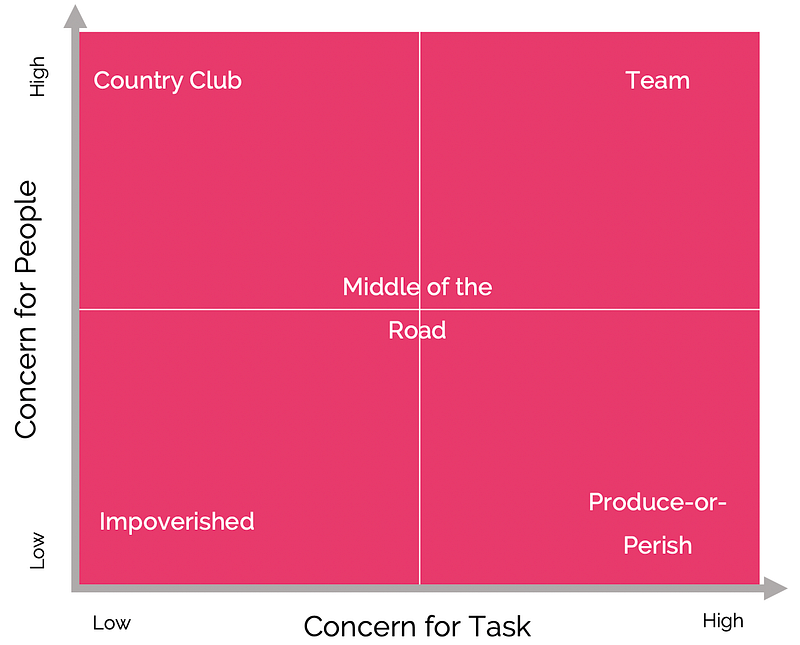
This proposed that a leader’s behaviors, not traits, determined their effectiveness. Ohio State University studies identified two orientation dimensions of leadership:
- Task — The degree to which a leader focuses on the task by structuring followers’ roles to accomplish the same
- People — The degree to which a leader addresses the needs of individual followers
Blake and Mouton developed a Grid, a leadership matrix that proposed five different leadership styles:
- Impoverished leadership
- Middle-of-the-Road leadership
- Country Club leadership
- Authority-Compliance leadership
- Team leadership
Indeed.com discusses the application of this model.
Douglas McGregor described two mutually exclusive classifications of the intrinsic human nature of motivation, namely X and Y.
- X-leaders assume that people are intrinsically lazy, extrinsically motivated, incapable of self-discipline or self-control, want security, and take no responsibility in their job.
- Y-leaders assume that people do not inherently dislike work, are intrinsically motivated, exert self-control, and seek responsibility.
№3 — Situational Leadership Theory
Hersey and Blanchard further related McGregors’ two dimensions to a life cycle, matching a leader’s style to the readiness of their followers.
The life cycle has four stages:
- Telling — the leader guides directs, establishes guidelines, provides specific instructions, and closely supervises performance.
- Selling — the leader explains decisions, clarifies them, and persuades the followers to follow them.
- Participation — the leader shifts significant responsibilities to the followers, encouraging them to participate in decision-making, and facilitates collaboration and commitment.
- Delegating — the leader only observes and monitors followers’ performances, after giving them ownership of decisions and implementation.

Tannenbaum and Schmidt built on the aforementioned theories presenting a behavioral continuum in leadership styles.
Also, contingency theories combine trait and behavioral styles theories with a further dimension, which is the consideration of context, or the situation in which leaders find themselves.
Fiedler developed a situational contingency model of leadership on the basis that the degree to which the situation gives the leader control and influence is determined by the leaders-follower relationship, the task structure, and the position power of the leader.
This model promoted the contingency nature of leadership, reinforcing the notion that “there is no one best style of leadership”.
Leaders should alter their task and relationship orientation to fit the demands of the situation at hand.
№4 — Charismatic Leadership
Charisma is a Greek word meaning “divinely inspired gift” such as the ability to perform miracles or predict future events.
Weber (1947) used the term to describe a form of influence, not based on tradition or formal authority but rather on follower perceptions that the leader is endowed with exceptional qualities. It addresses leader attributes and behaviors at a symbolic, emotional level rather than a physical level.
House and Shamir (1993) assert that certain leader behaviors, particularly “visionary, empowering, role modeling, image building, and risk-taking behaviors, constitute the charismatic leadership syndrome.”
Final Thoughts
Charisma is more likely to be attributed to leaders who advocate a vision. A picture of the future. A compelling proposition that can be highly divergent from the status quo but within the latitude of acceptance by followers, by the masses.
Charisma is more likely to be attributed to leaders that use innovative strategies that appear successful.
Leaders are viewed as charismatic if they make self-sacrifices, take personal risks, and incur high costs to achieve the vision they espouse.
Trust, confidence, and enthusiasm are important components of charisma.
Followers who believe that the leader knows how to attain a shared objective will work harder, thereby increasing the likelihood of success.
That said, charismatic leadership is not without risk.
Likewise, some theories outlined above are outdated.


