Welcome to Wisconistan
The governor thought teachers would be an easy target; he ended up diminishing public education in the Dairy State
Greetings from the front in Wisconistan, the name adopted by tens of thousands of protesters a decade ago who converged on the capitol building in Madison, Wisconsin in the wake of the new governor’s plan to slash salaries and benefits for public servants statewide — including teachers.
Governor Scott Walker — who wouldn’t know a good education if it went up to him and bit him on the nose, as my Nana used to say — claimed budget problems in the state were the fault of the labor movement. Wisconsin just happens to be the 1959 birthplace of public sector unions. Walker intended to eliminate union bargaining rights, resulting in less coverage — from salaries to health care to working conditions — for police, firefighters, teachers, nurses, prison guards and other public service employees. He decided to make teachers the center of his crusade to break the back of organized labor.
To put a face on an insulting and ridiculous plan, the newly elected governor wanted to balance the state budget on the back of public education in Wisconsin. Just like a man. Try to beat up on a predominantly female profession — and expect them to take it.
I won’t get into the monetary details except to say that Wisconsin 10 years ago was in the same shape as most of its 49 brethren. Not enough cash coming in, too much going out. When Walker took office, we were not far removed from the Great Recession of 2007–2009. You may have heard that the federal government’s coffers were about bled dry, too.
In response, public school teachers led the fight against Walker and what was known as “Act 10”, which he termed a “modest” change in state law designed to help strengthen the Wisconsin bottom line. Tens of thousands of citizens started flooding the streets around Capitol Square in February 2011. And they didn’t quit until they believed they’d been heard, good and loud, four months later.
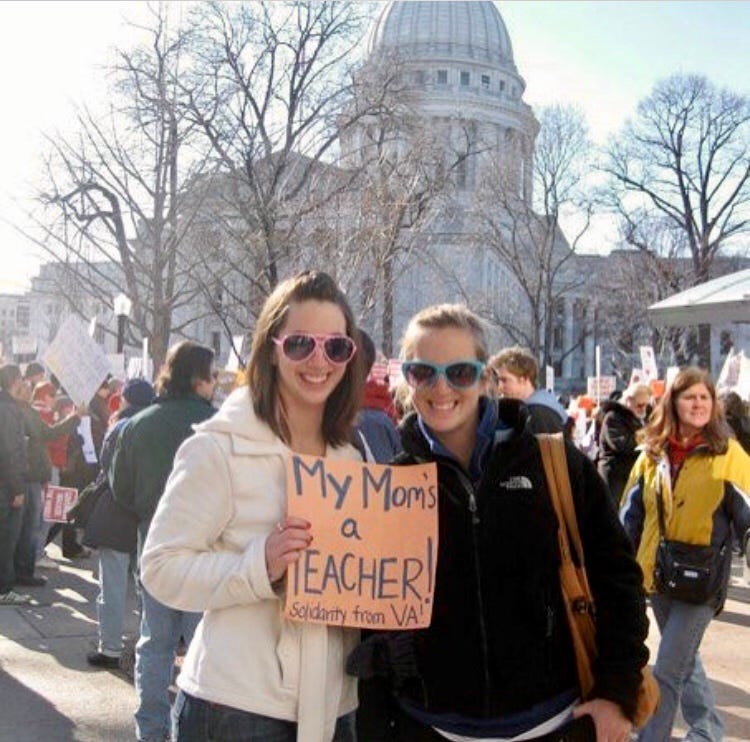
My kids joined the throng when they could, demonstrating on behalf of all teachers, including their Mom, who was back home in suburban D.C. holding down the fort in Room 215. Both girls, who went to college in the Dairy State, saw it as not only a way to show support for the cause, but as their first chance to exercise their First Amendment rights on behalf of something that was larger than their little world.
In a way, this fight was personal. Both had spent the better part of their lives watching their Mom justify the books she was teaching her high school English classes; stand up to goofy administrators who had no clue how to run a school, much less cram oodles of knowledge into the craniums of their charges; suffer ridiculous “professional development days” that left teachers bewildered and angry at the time-wasting activities (yes, one all-hands-on-deck “inservice”, as they were known in my district, featured higher-ups teaching 160 “real” teachers how to draw a ladybug — don’t ask me; I think it had something to do with lesson planning), and watching me grade endless stacks of essays late into the night, at swim meets, on vacation, and even in those dumb ladybug-like meetings, knowing that I was being paid diddly-squat to do so. No public service unions in Virginia, you see.
So my girls turned out, mostly on the weekends (college classes, you know), from February through June, sometimes bringing friends along. And when they skipped class to demonstrate, I fully supported them —we all know that there are some real-life experiences that will impart more knowledge in an afternoon than sitting on one’s bum in a sterile classroom an entire semester.
Not to give away the ending, but Walker won this fight. And Wisconsin is poorer for it. In the past decade, teachers in the state have ditched the profession; fewer students are studying education these days; Wisconsin suffers from a dire teacher shortage, and those who have remained in the teaching trenches have found their salaries reduced.
It took a good long while for Wisconsin to wake up from the Walker years. He served one term, then survived a recall; was reelected, but then (finally) booted from his job in 2018. His replacement as governor? Wisconsin Superintendent of Public Instruction Tony Evers, a professional educator. The irony sometimes doesn’t fall far from the tree, does it?
Oh, and Walker was one of those eighty gazillion idiots who ran for president in the contest that the “former guy” won. But Scottie didn’t do so well on the national stage, dropping out in September 2015, before the contest really got started. He left the race with the support of less than one-half of one percent. Oh, and he ended up endorsing the junior senator from Texas, “Fled” Cruz.
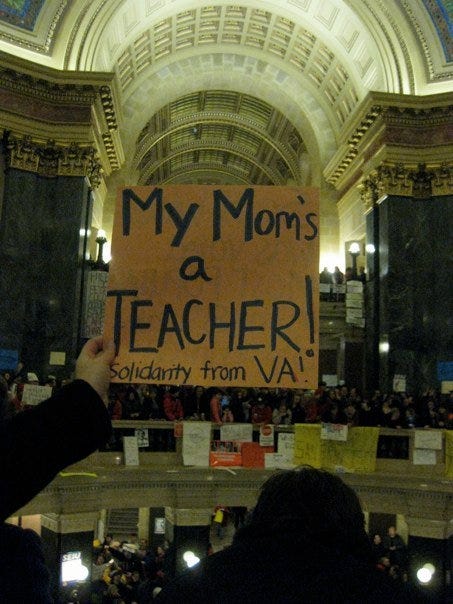
I think my girls felt like they lost the skirmish, but definitely won the war during the Battle of Wisconistan in the Spring of 2011. One afternoon, while walking down State Street on their way to the Capitol, they encountered a Tea Party type. She leered (according to eyewitness accounts) at the sign the girls were holding, pictured above — and below.
“She can be replaced, you know,” sneered the Tea Partier.
“By whom,” my eldest countered. “You?”
The budget crisis was real, I’m sure. But why start with the teachers? They’re traditionally overworked and underpaid across the country. Walker was so determined he threatened to call out the National Guard to do the jobs of those public service employees — including educators — who walked off the job in protest. I may be biased, but I’d like to see one of those camo-clad warriors in a place like Room 215.
“Well, your classes wouldn’t have any discipline problems, that’s for sure,” said one of my cherubs at the time, who hails from an Army family. “And we’d all be really, really organized.”
But would the kids learn anything? Only, I suppose, that the governor tried to balance the budget on the backs of those who, for a lack of a better cliché, might figure in shaping their futures.