avatarSean Youra

Free AI web copilot to create summaries, insights and extended knowledge, download it at here

4435

Abstract

broken down by economic sectors (Source: <a href="https://www.epa.gov/ghgemissions/global-greenhouse-gas-emissions-data">EPA</a>)</figcaption></figure><p id="7c9a">It can be concluded that electricity and heat production, agriculture and other land use, and industry represent 70 percent of global GHG emissions. Thus, out of all the various energy-intensive activities that produce emissions, a small number of economic sectors account for the majority of said emissions.</p><p id="f0f6">If we were to use the 80/20 rule and apply it to GHG emissions, then focusing the majority of our efforts on these three sectors would produce the most effective results in terms of reducing global emissions.</p><p id="8c4d">One of the important takeaways from this analysis is that if we focus on all factors of global emissions equally rather than analyzing those contributing the most to emissions, then our efforts will be spent less productively. As a result, we will be farther away from achieving our country-specific <a href="https://www.carbonbrief.org/paris-2015-tracking-country-climate-pledges">climate pledges that were agreed to after the Paris Agreement</a>.</p><p id="6da0">The 80/20 rule also applies if we look at corporate contributions to GHG emissions. As <a href="https://www.theguardian.com/sustainable-business/2017/jul/10/100-fossil-fuel-companies-investors-responsible-71-global-emissions-cdp-study-climate-change">reported by The Guardian</a>, 71% of global emissions have been produced by just 100 companies out of the millions that exist around the world. Therefore, it makes sense to focus on those small number of companies and determine what actions they can take to reduce their emissions.</p><p id="c330">Granted, a majority of these 100 companies are fossil fuel producers, but efforts could still be made by these companies to diversify their product portfolios into more low-carbon energy sources and begin transitioning out of fossil fuels, or else risk filing for bankruptcy as <a href="https://www.newsweek.com/eight-coal-companies-have-filed-bankruptcy-since-trump-took-office-1468734">many coal companies have already started to do</a>.</p><p id="ebe8">In terms of individual country contributions to GHG emissions, the Pareto principle again shows itself, as we can see in the pie chart below.</p><figure id="0b8c"><img src="https://cdn-images-1.readmedium.com/v2/resize:fit:800/0*XzS05qe00VE523cd.png"><figcaption>2014 global GHG emissions by country or region (Source: <a href="https://www.epa.gov/ghgemissions/global-greenhouse-gas-emissions-data">EPA</a>)</figcaption></figure><p id="ab78">China, the US, EU, India, Russia, and Japan account for 70 percent of global emissions out of the 193 countries that are represented in the United Nations. Therefore, mitigation efforts would be most productive if applied in these countries and regions in terms of reducing global GHG emissions rapidly.</p><p id="ef5b">The 80/20 rule when applied to country-specific emissions echoes the <a href="https://www.theguardian.com/environment/2015/nov/23/paris-climate-talks-developed-countries-must-do-more-than-reduce-emissions">arguments made by developing countries during the Paris climate talks</a> that developed nations like the U.S. need to take on more of the responsibility and burden in reducing emissions, as they are the biggest contributors to climate change and have already used a majority of the carbon budget that must be shared among all countries.</p><p id="aa53">Most importantly, the 80/20 rule can be applied to specific climate solutions and actions that can help reduce global emissions. In a new <a href="https://www.pnas.org/content/early/2020/01/14/1900577117">research article</a> from the Proceedings of the National Academy of Sciences, the authors lay out six social tipping interventions (STIs) that are most likely to lead to the development of carbon-neutral societies by 2050, which include:</p><ol><li>Removing fossil fuel subsidies and incentivizing decentralized energy generation</li><li>Building carbon-neutral cities</li><li>Divesting from assets linked to fossil fuels</li><li>Revealing the moral implications of fossil fuels</li><li>Strengthening climate education and engagement</li><li>Disclosing information on GHG emissions</li></ol><p id="7b6f">If a consensus could be reached among climate scientists and experts that these few interventions would provide the gre

Options

atest returns in terms of rapid emissions reductions out of the thousands of potential solutions, then it would make sense to focus a majority of collective and individual efforts on these interventions.</p><p id="27c9">Indeed, several solutions have been proposed by scientists, political leaders, nonprofit organizations, and others, but what is needed now is a prioritization of these solutions based on which ones are expected to be the most successful in meeting the <a href="https://ec.europa.eu/clima/policies/international/negotiations/paris_en">Paris climate goals</a> to avoid catastrophic warming. By applying the Pareto principle, we can do exactly that.</p><p id="fdd7">References:</p><p id="2728">[1] Richard Koch. (2017). <i>The 80/20 Principle: The Secret to Achieving More with Less</i> (3rd ed.). Nicholas Brealey Publishing.</p><p id="3cd5">If you want to read about how some of these social tipping interventions can actually be applied, check out the below stories:</p><div id="19a1" class="link-block"> <a href="https://readmedium.com/radical-caring-can-save-the-world-7552d7da66fe"> <div> <div> <h2>Radical Caring Can Save the World</h2> <div><h3>But a major shift in our mindset is required</h3></div> <div><p>medium.com</p></div> </div> <div> <div style="background-image: url(https://miro.readmedium.com/v2/resize:fit:320/0*SjAK_YOZ1QmjBEkZ)"></div> </div> </div> </a> </div><div id="b8a8" class="link-block"> <a href="https://readmedium.com/building-climate-momentum-f9a81a5bfa41"> <div> <div> <h2>Building Climate Momentum</h2> <div><h3>Unleashing our collective potential to drive change</h3></div> <div><p>medium.com</p></div> </div> <div> <div style="background-image: url(https://miro.readmedium.com/v2/resize:fit:320/0*nGZgqmE3xtRcdllY)"></div> </div> </div> </a> </div><div id="b3e7" class="link-block"> <a href="https://readmedium.com/the-complete-guide-to-divestment-a97955537a22"> <div> <div> <h2>The Complete Guide to Divestment</h2> <div><h3>Hitting the big banks and fossil fuel companies where it hurts.</h3></div> <div><p>medium.com</p></div> </div> <div> <div style="background-image: url(https://miro.readmedium.com/v2/resize:fit:320/1*KP7V2wWhO3N9sJuDY4rc_A.jpeg)"></div> </div> </div> </a> </div><div id="634a" class="link-block"> <a href="https://readmedium.com/climate-literacy-fosters-effective-climate-action-3f5d2448ac5b"> <div> <div> <h2>Climate Literacy Fosters Effective Climate Action</h2> <div><h3>Ensuring people adequately understand climate change solutions is as important as the solutions themselves</h3></div> <div><p>medium.com</p></div> </div> <div> <div style="background-image: url(https://miro.readmedium.com/v2/resize:fit:320/0*KSXkqNtAK-qHBkcH)"></div> </div> </div> </a> </div><div id="9e67" class="link-block"> <a href="https://readmedium.com/climate-action-planning-at-the-local-level-2d02991c8513"> <div> <div> <h2>Climate Action Planning at the Local Level</h2> <div><h3>An interview with the City of San Rafael’s Sustainability Program Manager</h3></div> <div><p>medium.com</p></div> </div> <div> <div style="background-image: url(https://miro.readmedium.com/v2/resize:fit:320/0*unGVo-xA4gRRt6hN)"></div> </div> </div> </a> </div><p id="354e">To address the crises we face, we all need to work together and contribute our knowledge, ideas, and skills. If you share my vision of building a <b>better future together</b>, then please consider subscribing <a href="https://sean-youra.medium.com/subscribe"><b>here</b></a> to stay connected and be notified when I publish a new story.</p></article></body>

We Need to Pareto Our Way Out of Climate Disaster

Utilizing the Pareto principle can help the world achieve emissions reductions faster

Photo by NASA on Unsplash

The Pareto principle

“Eighty percent of the results come from 20 percent of the causes. A few things are important; most are not.” — Richard Koch, The 80/20 Principle: The Secret to Achieving More with Less¹

There are thousands of potential solutions to the climate crisis, but only a vital few will be truly effective at reducing the majority of global greenhouse gas (GHG) emissions — and in a timely manner. In order to understand why this is, we first need to discuss where the Pareto principle comes from and how it is applied in real-world scenarios.

The Pareto principle is named after the Italian economist, Vilfredo Pareto, who first observed the principle in action when studying wealth distribution back in 1897. Even back then, as is the case still today, he noticed a predictable imbalance in wealth distribution in England, in which a majority of the wealth was concentrated in a minority of households. He also noticed this same phenomenon played out in other countries and across time.

Over 50 years later, Joseph Juran, an American engineer, popularized this phenomenon and named it the “Pareto principle” after the late Italian economist. Juran realized that this phenomenon could be applied to many facets of life, not just for analyzing wealth distribution.

As discussed in Richard Koch’s book, The 80/20 Principle: The Secret to Achieving More with Less, there are several real-world examples where the 80/20 principle applies, such as 20 percent of customers accounting for 80 percent of a company’s sales, or that 20 percent of motorists account for 80 percent of all automobile accidents¹.

What’s important to focus on with these examples is not the exact percentages themselves, but rather the fact that there is a natural imbalance in inputs vs. outputs or causes and effects, which runs counter to how we normally view the world.

In the medical device industry (where I work in) and in other industries, the Pareto principle is commonly applied in the form of a Pareto chart like shown below. Basically, the primary issues or causes of a particular defect are plotted on the x-axis while the defect frequency and cumulative percentage of the total defects are plotted on the y-axis. What usually results is a chart showing that a small number of causes (20 percent) are responsible for a majority of the defects (80 percent), hence the 80/20 rule.
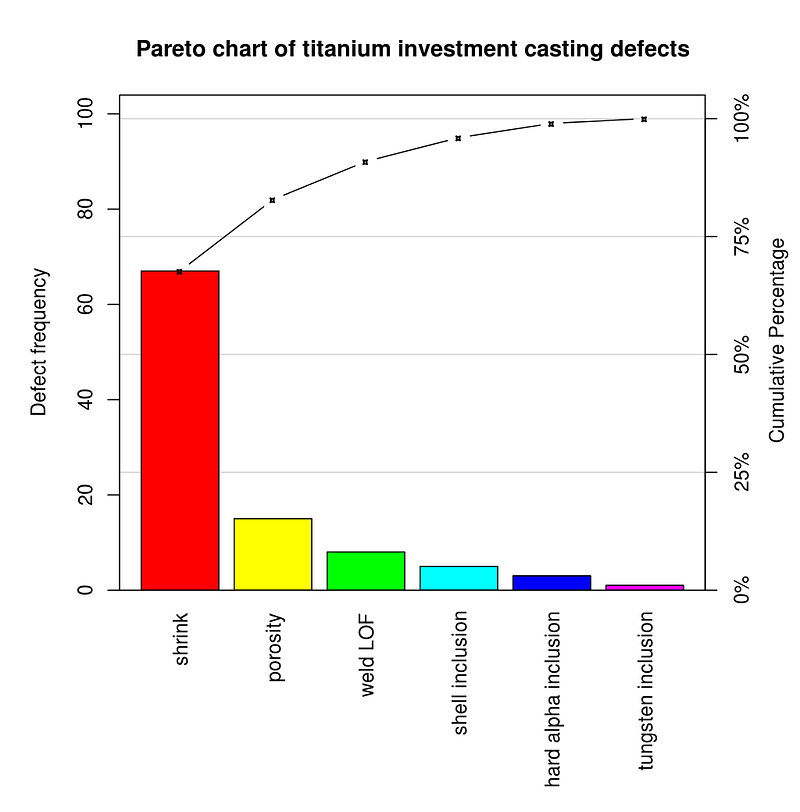
Example of a Pareto chart showing that a majority of defects are caused by a minority of issues (Source: Daniel Penfield, Wikipedia)

Juran realized the power of the 80/20 rule and would utilize it to help Japanese companies make superior quality products, and later help U.S. companies do the same¹. This would lead to a “quality revolution” in which companies could produce cheaper, higher quality products that were more reliable.

Applying the 80/20 rule to climate solutions and efforts

So, what does the Pareto principle have to do with climate change you ask?

Well, let’s start by looking at global GHG emissions data synthesized by the EPA from the IPCC’s Fifth Assessment Report (AR5). In the pie chart below, each economic sector and its corresponding percentage contribution to global GHG emissions is shown.
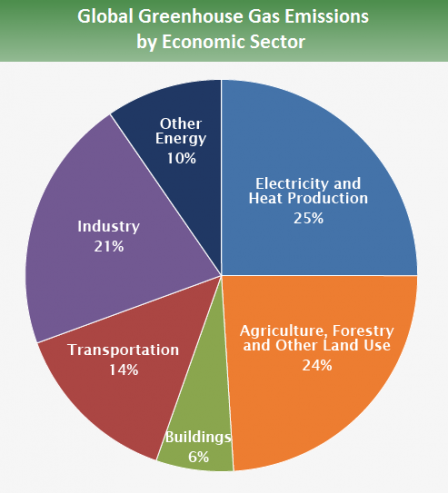
Global GHG emissions broken down by economic sectors (Source: EPA)

It can be concluded that electricity and heat production, agriculture and other land use, and industry represent 70 percent of global GHG emissions. Thus, out of all the various energy-intensive activities that produce emissions, a small number of economic sectors account for the majority of said emissions.

If we were to use the 80/20 rule and apply it to GHG emissions, then focusing the majority of our efforts on these three sectors would produce the most effective results in terms of reducing global emissions.

One of the important takeaways from this analysis is that if we focus on all factors of global emissions equally rather than analyzing those contributing the most to emissions, then our efforts will be spent less productively. As a result, we will be farther away from achieving our country-specific climate pledges that were agreed to after the Paris Agreement.

The 80/20 rule also applies if we look at corporate contributions to GHG emissions. As reported by The Guardian, 71% of global emissions have been produced by just 100 companies out of the millions that exist around the world. Therefore, it makes sense to focus on those small number of companies and determine what actions they can take to reduce their emissions.

Granted, a majority of these 100 companies are fossil fuel producers, but efforts could still be made by these companies to diversify their product portfolios into more low-carbon energy sources and begin transitioning out of fossil fuels, or else risk filing for bankruptcy as many coal companies have already started to do.

In terms of individual country contributions to GHG emissions, the Pareto principle again shows itself, as we can see in the pie chart below.
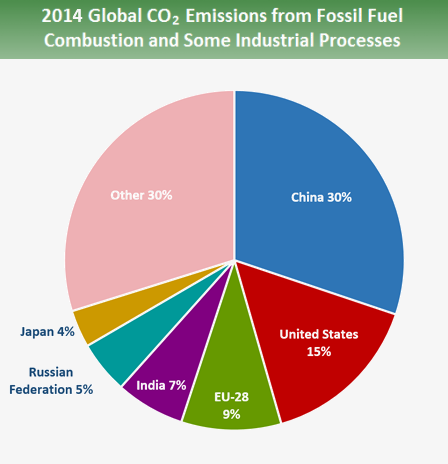
2014 global GHG emissions by country or region (Source: EPA)

China, the US, EU, India, Russia, and Japan account for 70 percent of global emissions out of the 193 countries that are represented in the United Nations. Therefore, mitigation efforts would be most productive if applied in these countries and regions in terms of reducing global GHG emissions rapidly.

The 80/20 rule when applied to country-specific emissions echoes the arguments made by developing countries during the Paris climate talks that developed nations like the U.S. need to take on more of the responsibility and burden in reducing emissions, as they are the biggest contributors to climate change and have already used a majority of the carbon budget that must be shared among all countries.

Most importantly, the 80/20 rule can be applied to specific climate solutions and actions that can help reduce global emissions. In a new research article from the Proceedings of the National Academy of Sciences, the authors lay out six social tipping interventions (STIs) that are most likely to lead to the development of carbon-neutral societies by 2050, which include:

  1. Removing fossil fuel subsidies and incentivizing decentralized energy generation
  2. Building carbon-neutral cities
  3. Divesting from assets linked to fossil fuels
  4. Revealing the moral implications of fossil fuels
  5. Strengthening climate education and engagement
  6. Disclosing information on GHG emissions

If a consensus could be reached among climate scientists and experts that these few interventions would provide the greatest returns in terms of rapid emissions reductions out of the thousands of potential solutions, then it would make sense to focus a majority of collective and individual efforts on these interventions.

Indeed, several solutions have been proposed by scientists, political leaders, nonprofit organizations, and others, but what is needed now is a prioritization of these solutions based on which ones are expected to be the most successful in meeting the Paris climate goals to avoid catastrophic warming. By applying the Pareto principle, we can do exactly that.

References:

[1] Richard Koch. (2017). The 80/20 Principle: The Secret to Achieving More with Less (3rd ed.). Nicholas Brealey Publishing.

If you want to read about how some of these social tipping interventions can actually be applied, check out the below stories:

To address the crises we face, we all need to work together and contribute our knowledge, ideas, and skills. If you share my vision of building a better future together, then please consider subscribing here to stay connected and be notified when I publish a new story.

Climate Change
Policy
Climate Action
Pareto Principle
Environment
Recommended from ReadMedium
avatarTodd B Harrington
The Climate…

Has no monetary system

2 min read