avatarSean Youra

Free AI web copilot to create summaries, insights and extended knowledge, download it at here

5027

Abstract

lthough I’m still technically with Ally (but closed my credit card with them), I decided to research if there were any other banks out there who did not finance fossil fuels in any way (including through their partners) and, to my surprise, there were!</p><p id="74b3">After much research, I decided to open an account with Aspiration Bank. What really drew me to use them was that they were very honest and transparent about not providing funding for fossil fuel projects, but still had comparable services and interest rates as Ally. I also like that they have an Aspiration Impact Measurement (AIM) that lets you track your personal impact on people and the planet. And they’re by no means the only bank that is trying to be socially and environmentally responsible; you can find a whole list of alternatives <a href="https://www.greenamerica.org/find-a-better-bank-by-address?field_listing_type_target_id%5B1023%5D=1023">here</a> and <a href="https://www.yesmagazine.org/people-power/is-your-bank-funding-dapl-heres-how-to-find-one-that-isnt-20161201">here</a>.</p><figure id="57ce"><img src="https://cdn-images-1.readmedium.com/v2/resize:fit:800/1*6kMlxneUcfaaLJBo91V6yA.jpeg"><figcaption>Photo by <a href="https://unsplash.com/@twopaddles?utm_source=unsplash&amp;utm_medium=referral&amp;utm_content=creditCopyText">Two Paddles Axe and Leatherwork</a> on <a href="https://unsplash.com/search/photos/credit-card?utm_source=unsplash&amp;utm_medium=referral&amp;utm_content=creditCopyText">Unsplash</a>.</figcaption></figure><p id="328c">However, as with most things related to climate change, it’s never that simple. It’s not just our banks that we have to worry about as far as fossil fuel funding; there are also the credit cards we use, our retirement plans, and investment portfolios that may be contributing to the problem.</p><p id="a8c4">Let’s deal with credit cards first. Whichever bank issued the credit card will make money off you in terms of the interest payments you make on the card, which they can, in turn, use to fund fossil fuel projects. In this case, you basically have two options: leave the card open and don’t use it, or close the account. There is much debate over which is better as far as not negatively affecting your credit score, but this <a href="https://www.fool.com/the-ascent/credit-cards/articles/should-you-close-an-unused-credit-card-the-answer/">article</a> does a good job of laying out the pros and cons of each.</p><p id="8ad5">In general, if the credit card is new, has a low credit limit, and your overall credit utilization is low, then closing the card shouldn’t affect your credit score too much, and could even increase it. If you must use the card, then make sure to always try to pay any balance off before interest is accrued to ensure the bank doesn’t make as much money. Just like with banks, there are credit card issuers and organizations that offer more environmentally responsible cards, such as the ones listed <a href="https://www.greenamerica.org/responsible-credit-cards">here</a>.</p><blockquote id="2f1f"><p>“When you use a mega-bank’s card, you’re bolstering all the things the bank’s loans support, from clearcutting forests to new coal-fired power plants to predatory loans.” — Fran Teplitz, Green America’s director of social investing programs</p></blockquote><p id="40c0">When’s the last time you looked at the funds in your 401k, IRA, or investment portfolio? Well, according to a Prudential Investment <a href="https://www.marketwatch.com/story/40-of-americans-dont-know-how-their-investments-are-allocated-heres-help-2016-11-30">survey</a> from 2016, 42% of investors don’t know how their investments are allocated in their portfolios (i.e. they have no idea what their money is being invested into). Most likely, a decent chunk of your portfolio is invested in fossil fuels, so it’s worth a look.</p><p id="3f31">You can start by checking if any of the banks or fossil fuel companies listed in the <a href="http://priceofoil.org/content/uploads/2019/03/Banking-on-Climate-Change-2019-final.pdf">report</a> are in your investment portfolios. If they are, try to change the allocations and put your hard earned money towards supporting renewable energy companies, for example. However, there may be limitations on how much you can change the allocations and what funds you can invest in, especially with a 401k managed by your employer. If so, you can always try pressuring your employer to provide more investment options, and if that doesn’t work, then you can at least try to offset those investments with more sustainable investments like the ones offered by Aspiration Bank and <a href="https://www.sustainableinvest.com/category/investment-products/">others</a>.</p><h1 id="75df">Join the Divestment Movement</h1><p id="1f10">The importance of divestment cannot be understated. Not only is continuing to invest in fossil fuels a losing investment strategy as renewables begin to make up a <a href="https://www.ucsusa.org/clean_energy/smart-energy-s

Options

olutions/increase-renewables/renewable-energy-80-percent-us-electricity.html">greater portion of the energy mix</a> and dominate on an <a href="https://www.forbes.com/sites/jeffmcmahon/2019/07/01/new-solar--battery-price-crushes-fossil-fuels-buries-nuclear/?utm_source=FACEBOOK&amp;utm_medium=social&amp;utm_term=Valerie%2F&amp;fbclid=IwAR2UUsTfQMcR2RDlJMMCK6Vdj3DHmWUE7RK4jWVkoDq6bXJ_dJ0JQAsg5aw#76616c657269">economic front</a>, but continuing to do so will put us on a path to exceeding the carbon budget. Thus, we have a moral imperative to do our part to try to prevent this.</p><p id="ba0d">Divestment is one of the most surefire ways to hit the big banks and fossil fuel companies where it hurts, and arguably one of the most important individual actions we can take — besides voting for politicians who will support aggressive climate legislation — to help address the climate crisis. And the divestment movement is growing at a phenomenal rate, as shown in the figure below.</p><figure id="2833"><img src="https://cdn-images-1.readmedium.com/v2/resize:fit:800/1*aT-LaFz0-cOT7V5BALC9ZA.jpeg"><figcaption>The growth in divestments from fossil fuels since 2013. Source: <a href="https://www.arabellaadvisors.com/wp-content/uploads/2018/09/Global-Divestment-Report-2018.pdf">Arabella Advisors, The Global Fossil Fuel Divestment and Clean Energy Investment Movement 2018 Report</a></figcaption></figure><p id="e7c9">If mass amounts of people and organizations begin to switch their banks and credit cards over to ones that don’t invest in or benefit fossil fuels, eventually the big banks will listen and follow suit. If those same people and organizations also divest their portfolios away from fossil fuels, then the fossil fuel industry will become much less powerful in their ability to control our politics and push their agenda.</p><p id="bfd4">I hope you join me, and the millions of others, in divesting from fossil fuels. It’s easy for us to feel helpless when we’re up against one of the most powerful industries in human history, but we’re far more powerful than we give ourselves credit for, and the fossil fuel industry is <i>banking</i> on us continuing to feel helpless and not do anything to stop them. Let’s prove them wrong.</p><p id="d721"><i>Disclosure: Climate Conscious, and the author, are not endorsed or affiliated with Aspiration Bank, or any of the other banks mentioned, in any way. All opinions expressed in the article are the author’s own. The content provided is for informational purposes only and should not be construed as financial advice.</i></p><p id="7ec3">If you enjoyed this story, then you might also enjoy reading:</p><div id="a5ec" class="link-block"> <a href="https://readmedium.com/galvanizing-climate-action-in-the-face-of-environmental-catastrophes-ea4e6caaad35"> <div> <div> <h2>Galvanizing Climate Action in the Face of Environmental Catastrophes</h2> <div><h3>People should be protesting in the streets every time there is an environmental catastrophe like the oil spill in…</h3></div> <div><p>medium.com</p></div> </div> <div> <div style="background-image: url(https://miro.readmedium.com/v2/resize:fit:320/0*KkHuYa2eKfd2jWZZ.jpg)"></div> </div> </div> </a> </div><div id="8d68" class="link-block"> <a href="https://readmedium.com/breaking-the-cultural-addiction-to-consumerism-45c76d8014c1"> <div> <div> <h2>Breaking the Cultural Addiction to Consumerism</h2> <div><h3>And giving minimalism a much-needed makeover</h3></div> <div><p>medium.com</p></div> </div> <div> <div style="background-image: url(https://miro.readmedium.com/v2/resize:fit:320/0*TdFUBM_RQ_gF6_wc)"></div> </div> </div> </a> </div><div id="5e51" class="link-block"> <a href="https://readmedium.com/we-need-to-pareto-our-way-out-of-climate-disaster-266f6b219388"> <div> <div> <h2>We Need to Pareto Our Way Out of Climate Disaster</h2> <div><h3>Utilizing the Pareto principle can help the world achieve emissions reductions faster</h3></div> <div><p>medium.com</p></div> </div> <div> <div style="background-image: url(https://miro.readmedium.com/v2/resize:fit:320/0*oikjlSkNm0P-DLQA)"></div> </div> </div> </a> </div><p id="75fc">To address the crises we face, we all need to work together and contribute our knowledge, ideas, and skills. If you share my vision of building a <b>better future together</b>, then please consider subscribing <a href="https://sean-youra.medium.com/subscribe"><b>here</b></a> to stay connected and be notified when I publish a new story.</p></article></body>

The Complete Guide to Divestment

Hitting the big banks and fossil fuel companies where it hurts.

Photo by Pogonici on iStock.

Fossil Fuel Investments Need to End. Now.

Since the Paris Agreement was signed on December 12, 2015, banks around the world have helped to finance fossil fuel projects to the tune of $1.9 trillion according to a new joint report from several environmental non-profit groups. Not surprisingly, the top four banks with the largest fossil fuel investments happen to be headquartered in the United States, as shown in the table below.
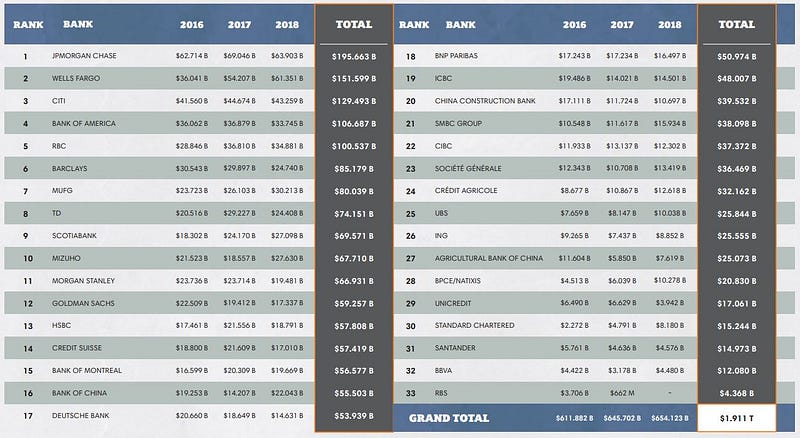
Bank financing for fossil fuels from 2016 to 2018. Source: Banking on Climate Change 2019 — Fossil Fuel Finance Report Card.

JP Morgan Chase leads the pack substantially by as much as 29% for global fossil fuel financing with nearly $196 billion invested in just the short span since the Paris Agreement was signed. Ironically, prior to the signing of the agreement, Bank of America, Citi, Goldman Sachs, JP Morgan Chase, Morgan Stanley, and Wells Fargo released a joint statement about the importance of a strong climate agreement and stated that they have “the business opportunity to build a more sustainable, low-carbon economy and the ability to help manage and mitigate these climate-related risks.”

Despite these promising words, each year since the Paris Agreement was signed, fossil fuel financing by these large banks has only increased as illustrated in the report.

Talk about a missed opportunity for these companies…

Instead of being the drivers of a low-carbon, and eventually carbon-free economy, they have decided to continue to perpetuate the growth of a carbon-intensive economy — and much worse than that, they’ve been helping to accelerate it.

These banks might try to defend themselves by saying how they’ve restricted some financing of coal, tar sands oil, fracking, and liquified natural gas (LNG) projects, but that is clearly not enough to stop their fossil fuel investments from increasing year-over-year and is woefully insufficient if we want to begin winding down fossil fuel infrastructure that will be replaced by renewable energy and other low-carbon sources.

Perhaps one of the scariest findings in the report is that the amount of carbon held within existing fossil fuel project reserves could push us beyond the limits established in the Paris Agreement. Therefore, any further expansion of fossil fuels puts us on a course that would exceed the 2°C carbon budget.

Clearly, these big banks don’t see the danger that they’re subjecting the world to by continuing to invest in fossil fuels — or they’re knowingly doing so in the pursuit of greater profits. Either way, it’s time we all sent them a message that this kind of reckless financing is unacceptable.

Utilizing the Power of Your Pocketbook for Doing Good

It’s not just our banks that we have to worry about as far as fossil fuel funding; there are also the credit cards we use, our retirement plans, and investment portfolios that may be contributing to the problem.

For many years, I banked with Wells Fargo but eventually transitioned my finances over to Ally Bank after hearing about the many scandals that Wells Fargo had gotten themselves into and realizing they were paying me an abysmal interest rate to store my money with them. Since then, I’ve enjoyed banking with Ally and they’ve been able to meet my needs consistently.

However, up until just recently (June 17, 2019), Ally was partnered with TD Bank, who happens to be the 8th largest financier of fossil fuel projects and the 2nd largest financier of tar sands projects according to the report. I reached out to an Ally Bank spokesperson who stated that they do not provide funding for fossil fuels, but the fact that they had partnered with TD Bank for their credit cards meant that they were still indirectly funding such projects.

Although I’m still technically with Ally (but closed my credit card with them), I decided to research if there were any other banks out there who did not finance fossil fuels in any way (including through their partners) and, to my surprise, there were!

After much research, I decided to open an account with Aspiration Bank. What really drew me to use them was that they were very honest and transparent about not providing funding for fossil fuel projects, but still had comparable services and interest rates as Ally. I also like that they have an Aspiration Impact Measurement (AIM) that lets you track your personal impact on people and the planet. And they’re by no means the only bank that is trying to be socially and environmentally responsible; you can find a whole list of alternatives here and here.

Photo by Two Paddles Axe and Leatherwork on Unsplash.

However, as with most things related to climate change, it’s never that simple. It’s not just our banks that we have to worry about as far as fossil fuel funding; there are also the credit cards we use, our retirement plans, and investment portfolios that may be contributing to the problem.

Let’s deal with credit cards first. Whichever bank issued the credit card will make money off you in terms of the interest payments you make on the card, which they can, in turn, use to fund fossil fuel projects. In this case, you basically have two options: leave the card open and don’t use it, or close the account. There is much debate over which is better as far as not negatively affecting your credit score, but this article does a good job of laying out the pros and cons of each.

In general, if the credit card is new, has a low credit limit, and your overall credit utilization is low, then closing the card shouldn’t affect your credit score too much, and could even increase it. If you must use the card, then make sure to always try to pay any balance off before interest is accrued to ensure the bank doesn’t make as much money. Just like with banks, there are credit card issuers and organizations that offer more environmentally responsible cards, such as the ones listed here.

“When you use a mega-bank’s card, you’re bolstering all the things the bank’s loans support, from clearcutting forests to new coal-fired power plants to predatory loans.” — Fran Teplitz, Green America’s director of social investing programs

When’s the last time you looked at the funds in your 401k, IRA, or investment portfolio? Well, according to a Prudential Investment survey from 2016, 42% of investors don’t know how their investments are allocated in their portfolios (i.e. they have no idea what their money is being invested into). Most likely, a decent chunk of your portfolio is invested in fossil fuels, so it’s worth a look.

You can start by checking if any of the banks or fossil fuel companies listed in the report are in your investment portfolios. If they are, try to change the allocations and put your hard earned money towards supporting renewable energy companies, for example. However, there may be limitations on how much you can change the allocations and what funds you can invest in, especially with a 401k managed by your employer. If so, you can always try pressuring your employer to provide more investment options, and if that doesn’t work, then you can at least try to offset those investments with more sustainable investments like the ones offered by Aspiration Bank and others.

Join the Divestment Movement

The importance of divestment cannot be understated. Not only is continuing to invest in fossil fuels a losing investment strategy as renewables begin to make up a greater portion of the energy mix and dominate on an economic front, but continuing to do so will put us on a path to exceeding the carbon budget. Thus, we have a moral imperative to do our part to try to prevent this.

Divestment is one of the most surefire ways to hit the big banks and fossil fuel companies where it hurts, and arguably one of the most important individual actions we can take — besides voting for politicians who will support aggressive climate legislation — to help address the climate crisis. And the divestment movement is growing at a phenomenal rate, as shown in the figure below.
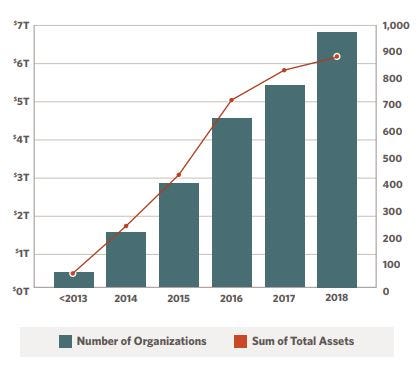
The growth in divestments from fossil fuels since 2013. Source: Arabella Advisors, The Global Fossil Fuel Divestment and Clean Energy Investment Movement 2018 Report

If mass amounts of people and organizations begin to switch their banks and credit cards over to ones that don’t invest in or benefit fossil fuels, eventually the big banks will listen and follow suit. If those same people and organizations also divest their portfolios away from fossil fuels, then the fossil fuel industry will become much less powerful in their ability to control our politics and push their agenda.

I hope you join me, and the millions of others, in divesting from fossil fuels. It’s easy for us to feel helpless when we’re up against one of the most powerful industries in human history, but we’re far more powerful than we give ourselves credit for, and the fossil fuel industry is banking on us continuing to feel helpless and not do anything to stop them. Let’s prove them wrong.

Disclosure: Climate Conscious, and the author, are not endorsed or affiliated with Aspiration Bank, or any of the other banks mentioned, in any way. All opinions expressed in the article are the author’s own. The content provided is for informational purposes only and should not be construed as financial advice.

If you enjoyed this story, then you might also enjoy reading:

To address the crises we face, we all need to work together and contribute our knowledge, ideas, and skills. If you share my vision of building a better future together, then please consider subscribing here to stay connected and be notified when I publish a new story.

Climate Crisis
Divestment
Fossil Fuels
Environment
Climate Action
Recommended from ReadMedium