
Climate Literacy Fosters Effective Climate Action
Ensuring people adequately understand climate change solutions is as important as the solutions themselves
The slow progress of education and obstacles to improving climate literacy
For all the talk of climate solutions, they won’t be nearly as effective or implemented on the large scales necessary to avert global warming of 1.5°C and adapt to future climate change scenarios if people don’t understand the solutions and why they’re necessary. Yet, the idea of climate education receives almost no attention in the media or from politicians.
Before delving into the importance of improving climate literacy here in the United States and abroad, we first need to understand why climate education isn’t already a core topic in K-12 education and the obstacles that must be overcome for it to become part of mainstream education curricula.
Ever since the New England colonies were first established in the 17th century, we’ve had a public education system in the US. Since then, the public education system has undergone a number of reforms to its structure, inclusiveness, requirements, standards, and emphasis on what skills and knowledge should be taught. Despite such reforms, public education in the US still lags behind many other nations in terms of learning outcomes, as shown in the chart below.
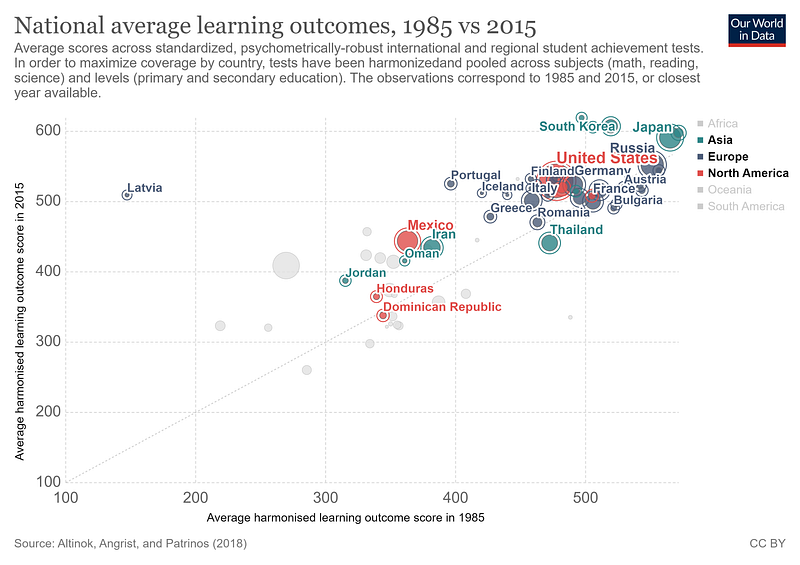
Not only are our learning outcomes not as great as other developed nations like Japan and South Korea, but we also spend far more (approximately $5,500 more, on average, per student) than these countries for worse educational outcomes.
Although we spend more per student than any other country, education spending is also one of the first areas to be cut when federal budgets are proposed to Congress each year, especially during the current Trump Administration which has proposed an 8 percent cut to education this year. While other countries are increasing their spending on education, the US is moving in the opposite direction.
The takeaway is not that education spending doesn’t improve learning outcomes, but rather that the money needs to go to the right places and be used in effective ways. Data compiled by the Organisation for Economic Co-operation and Development (OECD) from several countries show that training teachers and increasing their wages leads to better student performance, which is just one way that federal spending can be better directed to achieve improved outcomes for students.
The other related issue of why student performance in the US still lags behind other countries is that students simply aren’t being taught everything they need to know in our rapidly evolving society because state education curricula are not keeping pace with these changes to our society.
As our technology and scientific knowledge have improved at breakneck pace, our education systems have fallen severely behind and students are not prepared for the harsh reality they face once they graduate.
Zach Sims, co-founder and CEO of Codecademy, wrote in Forbes that “students deserve a relevant, modern, customized education that helps them acquire 21st century skills.” Not only do students need to be taught digital skills like computer science to succeed in the digital age we live in, they need to be taught many other skills and knowledge that have largely been missing from most classrooms, including knowledge related to climate change.
As our technology and scientific knowledge have improved at breakneck pace, our education systems have fallen severely behind and students are not prepared for the harsh reality they face once they graduate.
Besides misappropriated education funding and outdated curricula, most K-12 teachers are also not prepared to teach complex subjects like climate change. A 2016 study in Science found that despite the overwhelming consensus among climate scientists that climate change is predominantly caused by human activity, only 30 percent of middle school teachers and 45 percent of high school teachers fully understand the extent of this consensus. These numbers are not far off from polling of US adults by Pew Research that show only 27 percent believe the scientific consensus on climate change.
Most elementary, middle school, and high school teachers are woefully unprepared to teach climate science, much less climate mitigation and adaptation solutions that are incredibly important for current and future generations to understand.
Even if teachers were properly qualified to teach climate-related concepts, there would still be the problem of state science education standards not adequately including this information.
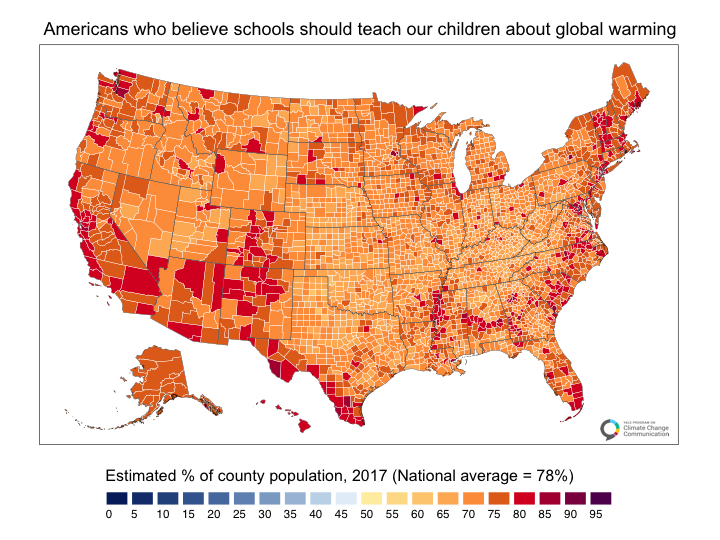
Despite widespread support from the American public in virtually every state to teach kids about global warming, several states with fossil-fuel backed Republican legislators such as Idaho, New Mexico, Texas, Wyoming, Nebraska, and others have actively tried to remove what little global warming information might already be in their state science standards or prevent such information from being added to the standards, causing significant disagreement with the communities they’re supposed to represent.
Such anti-environmental efforts by Republican-controlled states are further emboldened by the Trump Administration which has cast a skeptical eye towards climate science and done everything in its power to prevent climate change policies from being enacted and climate change information from being disseminated to the public, including forcing the EPA to remove climate change information from its website.
Thus, the obstacles to integrate climate change into state curricula are numerous with powerful interests actively trying to prevent our public education system from teaching kids this vital information, because these powerful interests know all too well what a future educated electorate that fully understands the causes, consequences, and solutions to climate change would mean to their bottom lines.
The importance of climate education
Millions of students graduate each year from US schools equipped with knowledge, beliefs, and skills that will have important influences over their success in their careers and in life in general. However, many of them currently are not prepared for the stark reality that faces them once leaving school; a reality that says quite clearly that we’re running out of time to address the climate crisis in a meaningful way.
Younger generations will increasingly have to grapple with a warming planet that will pose a significant risk to their livelihoods, and they need to have the skills and knowledge necessary to understand what’s happening, why, and what they can do about it to better adapt and mitigate future warming to maintain a habitable planet.
The climate scientists — along with their dire warnings of what will happen if we continue along our business as usual path of increasing emissions — have also stated in no uncertain terms that we do have the solutions to this problem if we have the willpower, open-mindedness, and know-how to implement them.
Paul Hawken’s book, Drawdown, covers 80 solutions that can significantly reduce our emissions and potentially help us achieve carbon neutrality³. There’s also The Solutions Project, which has detailed interactive maps for every US state for how they can achieve 100 percent renewable energy along with how many jobs would be created, the positive health impacts, the reductions in energy costs, and other information that shows that these solutions aren’t just viable, they’re necessary for saving lives and could boost the economy substantially.
However, all these solutions aren’t particularly effective if people don’t understand them and advocate for them to be implemented. Furthermore, a recent study published in the Proceedings of the National Academy of Sciences found that one of the most effective ways to achieve carbon-neutral societies by 2050 is by “strengthening climate education and engagement.”
In addition to climate mitigation solutions, climate adaptation will be needed to reduce vulnerabilities and manage climate risks. In a 2013 study that looked at the importance of education in building adaptive capacity to natural disasters in 125 countries, the researchers found that “education (and in particular female education) is the single most important social and economic factor associated with a reduction in vulnerability to natural disasters.” Integrating climate adaptation information into school curricula can help kids understand how to adapt to climate risks and reduce their vulnerabilities.
Efforts to develop climate change curriculum
Despite the many obstacles that prevent climate change from being taught in classes in the US, there has been progress made in many states to develop state science standards and curricula that include climate change information.
One such effort has been the Next Generation Science Standards (NGSS), which has been adopted by 20 states and the District of Colombia (representing 36 percent of students), and includes climate change science in the curricula. However, its implementation is currently optional for states.
Congressional representatives and Senators who understand the importance of improving youth climate literacy have also introduced bills like H.R. 2349 (known as the Climate Change Education Act) to foster climate change education from K-12.
The bill, if enacted into law, would require the National Oceanic and Atmospheric Administration (NOAA) to establish a climate change education program. As part of this program, NOAA would provide grants to states that develop curricula and academic standards for K-12 education that include climate change topics within core classes and prepare students for “green collar” jobs (i.e., jobs that help produce goods or services that are environmentally beneficial or promote conservation). States would also be required to provide the necessary training to teachers so that they can effectively teach the new climate change curricula.
The climate change curricula developed by states would be more comprehensive than the NGSS, since it would need to ensure that students are taught about “climate adaptation and mitigation; climate resilience; and the effects of climate change on the environment, energy sources, and social and economic systems.”
Although the legislation has little chance of passing under the current Administration and Republican-controlled Senate, it is still promising to see such legislation being proposed due to the urgency of the climate crisis and, if enacted, would be an important step towards ensuring the youth are sufficiently educated about possibly the most important topic of their lifetimes.
Advocating for climate literacy will strengthen the climate movement
Even without climate change integrated into state education curricula, it is encouraging to see younger generations understand the gravity of our current situation based on youth climate protests around the world led by young leaders like Greta Thunberg.
Without sufficient and comprehensive climate change education in every state and country, the climate movement may lack the collective strength needed to overcome institutional power that prefers the status quo.
However, environmental activists need to understand that advocating for improved climate literacy is just as important as solutions to the climate crisis. Without sufficient and comprehensive climate change education in every state and country, the climate movement may lack the collective strength needed to overcome institutional power that prefers the status quo. The movement may also become misdirected if those leading it do not adequately understand what adaptation and mitigation solutions must be pursued to ensure a livable and prosperous future for all of us.
“Education is the most powerful weapon which you can use to change the world.” — Nelson Mandela
In Mandela’s words, we must use education to build an unstoppable climate movement that has the knowledge and skills necessary to transform our extractive society into one that harmonizes human progress with environmental protection and conservation.
References:
[1] Max Roser, Mohamed Nagdy and Esteban Ortiz-Ospina (2020) — “Quality of Education”. Published online at OurWorldInData.org. Retrieved from: ‘https://ourworldindata.org/quality-of-education' [Online Resource]
[2] Cheskis, A., Marlon, A., Wang, X., Leiserowitz, A. (2018). Americans Support Teaching Children about Global Warming. Yale University. New Haven, CT: Yale Program on Climate Change Communication.
[3] Paul Hawken. (2017). Drawdown: The Most Comprehensive Plan Ever Proposed to Reverse Global Warming. Penguin Random House LLC.
If you enjoyed this story, then you might also like:
To address the crises we face, we all need to work together and contribute our knowledge, ideas, and skills. If you share my vision of building a better future together, then please consider subscribing here to stay connected and be notified when I publish a new story.