
We Are Asking The Police To Handle Things They Shouldn’t
And allowing them to do things that are unnecessarily dangerous
A few years back two of my next-door neighbor’s dogs got out due to a faulty gate latch. One of them chased a jogger and nipped her shoe. The police were called and as I watched in horror from my front door, one of the officers came into my yard to try to apprehend the dogs, one of whom made a slight defensive charging motion in his direction, but didn’t actually come after him. Rather than retreating to the other side of his cruiser or getting back in it, and asking for assistance from say, Animal Control, he tased the 50-pound dog from about 15 feet away, delivering 50,000-volts that are intended to take down a 250-pound man. The dog writhed on it’s back in pain and then ran off. I was horrified!
When my husband heard the commotion, he came running and calmly stepped out into the fray. James approached the remaining dog gently, rather than aggressively, and was able to easily hook her collar with his finger and guide her back into her yard where she belonged.
“C’mon sweetie,” he said as loudly as he could, hoping to shame the taser-happy cop. “Let’s get you home.”
Unfortunately, the other dog who had been tased was never seen again and probably went off somewhere to die. A brief search of the internet says you should never use a taser on a dog because it’s incredibly dangerous for them. The officer, who clearly didn’t know how to handle the situation, not only failed to contain the dogs but probably made the situation worse by driving one of them off from the immediate vicinity of its home where it had been for the past 30 minutes out into the larger neighborhood where it could have become a much bigger menace now that it was even more scared and in pain.
The officer should have never attempted to deal with that situation in the first place. He wasn’t trained for it, and for that reason, a minor incident became a more major one. He should have found a neighbor (like me) that knew how to contact the dog’s owners to come and get them in, or he should have called someone specifically trained in how to handle dogs. My neighbor, who loves animals and already had some mental health issues before this happened, deteriorated significantly afterward because she was so distraught. The whole street was in an uproar, taking sides about whether or not the officer was “just doing his job” or had acted inappropriately. In my opinion, he had botched the entire thing. He did not contain the dog who was already sticking close to home at that juncture and hadn’t actually hurt anyone. Instead, he made the whole situation much worse all around.
When we ask the police to do things for which they are not adequately trained, people get hurt, including sometimes, the officers themselves. But more often than not, it is a person (or a dog) who is a part of the situation they were intending to “help” with because they weren’t actually equipped to do that. The police should not have to be experts in a wide variety of subject areas just to do their jobs, and we shouldn’t be assuming that they are, depending on them to handle situations they aren’t trained for.
In 2016, the black therapist of an autistic adult who had wandered away from his group home was shot while laying on the ground with his hands in the air while the young man he was trying to apprehend sat nearby playing with a toy car.
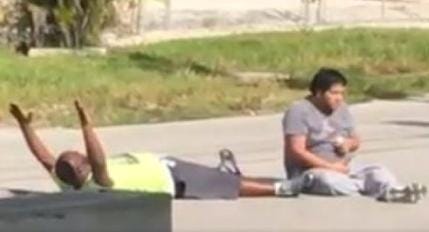
The therapist, Charles Kinsey, was professionally trained to handle that situation, but instead of being allowed to do so, the police swooped in and made a mess of it. The officer who shot Kinsey in the thigh claimed that he believed the autistic man had a gun and was threatening Kinsey. He said he actually had intended to shoot him. So, not only was an unarmed therapist lying on the ground with his hands in the air needlessly shot but a person with developmental disabilities who was holding a toy car nearly got shot as well. They should have talked to Kinsey and then supported him in doing his job.
More and more police departments are offering training on how to deal with people with disabilities who might not immediately comply with their orders, but still too often a failure to comply is perceived as defiance and escalates to violence. According to an article in The Guardian, “The Massachusetts-based disability rights non-profit organization the Ruderman Family Foundation has published an eye-opening paper in which it estimates that a third to half of all people killed by police in the US have a disability.”
“For example, if a person’s ability to communicate is significantly impaired, be it by psychosis, autism or dementia, and responding officers are ill-equipped to identify or adequately engage with and protect those individuals, the outcomes can be disastrous,” it went on to say.
As the mother of a young adult son who is autistic and non-verbal, this scares the hell out of me. I don’t foresee a time when my son will ever drive, or even be out and about on his own, but failure to comply is a specialty of his, particularly with someone that he doesn’t know. If Hugh ever got separated from us or a caregiver it could lead to real danger for him from the very people that we should be able to rely on to help keep him safe. He is registered with the police department in our city, but in a fast-moving situation, they might not get far enough to check their database.
Only about 5% of arrests are for violent crimes. The rest are for low-level offenses that quite possibly could be handled better by other types of professions such as social workers or drug counselors; in conjunction with those other professions; or by techniques that don’t involve force. Calls to defund the police aim to address this by reducing police budgets and diverting that money elsewhere — to education, health care, and other social services. This would allow municipalities to no longer ask officers to do so many of the jobs they often don’t want to be doing anyway such as resolving family and school disputes, moving homeless people into shelters, etc.
There’s a growing understanding that the problems of policing are not limited to a few high-profile deaths but are the result of a broader problem of over-policing,” said Alex Vitale, a sociology professor at Brooklyn College and author of a book that argues for alternatives to policing rather than police reform. “The solution to this is not making police arrests friendlier or more professional. It’s to quit relying on arrests to solve any problem under the sun.
POLICE MAKE MORE THAN 10 MILLION ARRESTS A YEAR, BUT THAT DOESN’T MEAN THEY’RE SOLVING CRIMES
In the wake of the shocking death of George Floyd, the Minneapolis City Council is exploring ways to dismantle the existing police force entirely and to instead create an entirely different kind of public safety system from the ground up. The city of Camden, NJ did the same thing in 2013 and has seen not only vastly improved relationships between the community and the police but also a dramatic drop in violent crime. Shifting the emphasis back to Serve and Protect by increasing the instances of non-crisis interactions with the public has taken Camden from one of the deadliest cities in America to one where the violent crime rate has dropped by 42% in the past seven years. The other day the police chief and 21 other officers walked alongside protesters in a peaceful march. Meanwhile, at the same time, across the river in Philadelphia police were using tear gas and rubber bullets to try to subdue angry protesters.
“This television-inspired myth-making that police are out there all day solving serious crimes is just completely erroneous,” said Vitale. “We have this myth that if we didn’t have the police, crime would be out of control, when the reality is very little crime is reported to the police, and even less is solved by the police. There’s just no reason to equate police with public safety in this way.”
“But part of the problem is also that police are the go-to solution for all kinds of complaints in communities with no meaningful alternatives. ‘The vast majority of police work is in response to 911 calls for service,’ said Neusteter. “I think that the major component of the large number of arrests for low-level offenses has to do with the fact that police are being called as the default responders for these quality-of-life issues.”
Too many municipalities have also allowed their police forces to become militarized and this too contributes to unnecessary injury and death. Off-duty EMT Breonna Taylor was shot and killed in her own home recently when police executed a no-knock warrant. Battering down someone’s door in the middle of the night and charging into their home unannounced with guns at the ready should be reserved for only the most dangerous and unique of situations, but too often it is used for more minor non-violent offenses. A few years ago a Georgia toddler had to be put into a medically induced coma after a flash-bang grenade was thrown into his crib during the serving of a no-knock warrant. This is police militarization gone out of hand.
Law enforcement consultant Melvin Tucker, who’s been a police chief in four cities in the U.S. South, said the element of surprise afforded by no-knock warrants isn’t always justified.
“If you’re going in on a drug case where the quantity is so small that they could dispose of it by flushing it down the toilet, you probably shouldn’t be there with a search warrant in the first place. It’s not worthwhile,” said Tucker, who has been an expert witness in dozens of court cases.
The same goes for high-speed chases. Unless someone is being kidnapped or their life otherwise threatened, there is no excuse for endangering the public with them. USA Today reports that “At least 11,506 people, including 6,300 fleeing suspects, were killed in police chases from 1979 through 2013, most recent year for which NHTSA records are available. That’s an average of 329 a year — nearly one person a day.”
The Justice Department has urged restraint in the use of high-speed chases, calling them the most dangerous thing that is a part of routine policing, but many police departments still leave them up to the complete discretion of the officer. Even in instances of low-level crimes such as shoplifting, police can be overcome with a “need to prevail and make the arrest mentality” where they don’t want to allow any perpetrator to potentially go free. Research indicates, however, that in most cases, the person being chased has committed a minor offense and then made the bad decision to flee.
Instead of endangering lives with a chase that may be a disproportionate reaction to the crime, why not use investigative techniques in conjunction with community support to find and charge the perpetrator at another time? Endangering innocent bystanders, some of whom are children, in order to make an arrest for a minor offense doesn’t seem like a very good trade-off for the community as a whole.
No unarmed person should ever die as the result of a traffic stop, even if they are belligerent, even if they are resisting arrest. De-escalation tactics ought to be the first order of business in nearly all instances and in at least some of them, somebody else entirely with more expertise should be called to the scene to help handle it. When the police are dealing with a hostage situation, they call in someone who has specific training in how to handle that, because choosing force as the first option usually leads to a lot of needless death.
Former FBI hostage negotiator, Chris Voss, says that you should never look at the hostage-taker as an enemy, but as a person who has the same problem as you, but who is looking at it from another perspective. When the hostage negotiator seeks to understand the other party instead of just trying to dominate him, they can better find ways to a peaceful resolution. When done correctly, you get what you want and the other side believes that it was actually their idea. That outlook could be applied more widely, even if there aren’t innocent bystander's lives to consider.
Calls for reforms in police departments related to racism and police brutality have been underway for decades around the US, and although some changes have been made for the good in certain pockets of the country, such as in Camden, NJ, it’s clear that this is insufficient. Policing itself needs to be completely re-evaluated and perhaps rebuilt from the ground up, as the city of Minneapolis is seeking to do.
The culture of “the thin blue line” envisions the police as the force that holds back chaos and provides a safe and civil society, but too often this creates an Us vs. Them mentality that does not actually serve the community. It leads to the police being tasked with jobs that they are not trained for or well equipped to do and it encourages domineering and dangerous behavior. A more community-centered type of policing has made things better in Camden, but there are still things that need to improve, say many community leaders.
“We can’t police our way out of social issues, unemployment, disproportionate health issues, economic challenges — these are things that drive crime,” (Nyeema) Watson said. Watson is the associate chancellor for civic engagement at Rutgers University — Camden, and although she thinks the restructuring has had a largely positive impact, it alone is not the answer. Public safety needs to be a holistic effort brought about by improvements in a variety of areas. Finding the right mix and making it all work will surely be a big challenge, but it’s one that it’s clear we can no longer afford to ignore.


