
Santorini, Greece
Visiting the Place of a Massive Volcanic Eruption in the Middle of the Mediterranean
Own photographs accompanied by what science has so far unveiled about this place and what popular culture has imagined. Plus, I recommend you the best tour and guide to visit this all.
You see the shape of the caldera clearly from above. The islands that make up Santorini were once the rim of a volcano that surfaced in what’s today the heart of the Greek Mediterranean. In a massive eruption, the rim cracked, got split into several islands, and seawater filled the caldera:
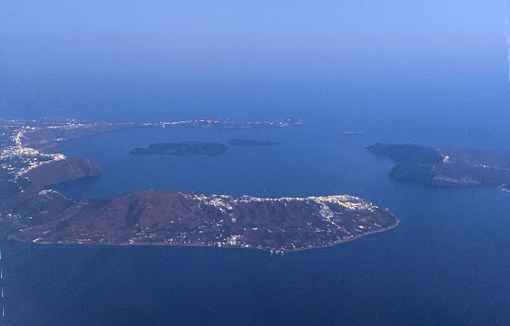
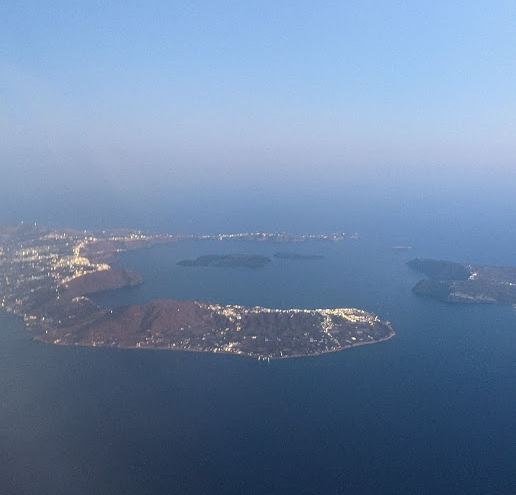
It surely would have been a hell of a natural spectacle to contemplate.
The shape of the caldera is crystal clear in Google Maps’ satellite view, too:
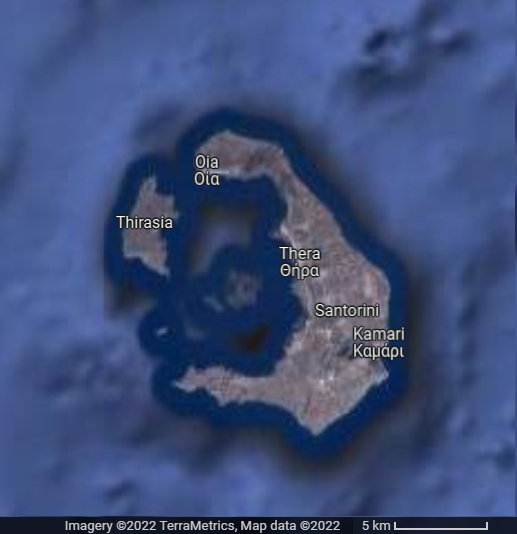
The current landscape of Santorini was modeled over thousands of earthquakes and eruptions among which was one of the largest volcanic events on Earth in human history: the Minoan eruption
Summarizing from Wikipedia (and I leave some links for you to deepen further):
The Minoan eruption took place around 1600 BCE. It destroyed the Minoan settlement at Akrotiri (a Cycladic Bronze Age settlement on the volcanic Greek island of Santorini, also known as Thera) and the communities and agricultural areas on nearby islands with subsequent earthquakes and tsunamis.
The event didn’t just blow a massive hole into the heart of Santorini. It rather set the entire ancient Mediterranean onto a new course that led to its current constitution. Without the Minoan eruption, the geography (and history) in this part of the planet would be quite different.
If you thought that this eruption was of “biblical proportions”, there’s some chance you were actually literally right
In recent times, the scientific community has been studying the chapter of the bible known as Exodus deeply. And they suspect that its storyline is primarily based on seismic events, volcanic activity, and the like.
In the Bible, the Exodus describes the escape of the Jews from Egypt. Allegedly, Moses divided the Red Sea to allow the Jews to traverse to Sinai while the Egyptians drowned in the waters as they refilled the sea. Scientists have found that the caldera of the massive volcano was not open to the sea during the main phase of the eruption, but was flooded once the eruption finished. They estimated that the inflow of water and associated landslide cut a deep submarine channel of over 2 cubic kilometers, filling the caldera with water in just 1 or 2 days.
While the Red Sea opening remains mythical, the parallel is quite amazing if you consider that in order to fill the caldera, water must have come from somewhere else. Anyway, the two seas were not connected, so there’s nothing else to speculate about here! (Today they are connected through the man-made Suez Canal).
Anyway, involved in the Exodus or not, the effects of the Minoan eruption could have explained many of the plagues described in the old testament, including weeks of darkness, strong winds, earthquakes, and tsunamis, shifting populations of bugs that altered ecological equilibria, river pollution, strong deviations in temperature, etc.
Some even say that the loss of the Minoan settlements caused by the eruption might have inspired Plato’s description of the lost city of Atlantis, distorted and exaggerated by the thousand years that separated the eruption from the Greek philosopher.
One way or the other, if you ever visit Santorini don’t miss a tour with a good guide. And as a non-promoted note, I recommend Kamari Tours and that you ask to have a girl called Vaso as your guide. She was amazing, and you could feel how touched by her land and history she is, even if she repeats her speech day after day. Thanks, Vaso for the best-guided tour I ever followed.
Thanks for reading
I hope you’ve enjoyed this reading, and if you did then consider checking my photo stories on Crete and Santorini (links below together with references to external articles) and also this other cool story about the Mediterranean:
For further reads and photography about the Santorini region and Minoan eruption
Interesting scientific peer-reviewed paper, not too hard to follow and with nice infography:
My two recent photostories in Santorini:
Three interesting external articles:
Two more photo stories with the Mediterranean as the protagonist:
www.lucianoabriata.com I write and photoshoot about everything that lies in my broad sphere of interests: nature, science, technology, programming, etc. Become a Medium member to access all its stories (affiliate links of the platform for which I get small revenues without cost to you) and subscribe to get my new stories by email. To consult about small jobs check my services page here. You can contact me here.


