avatarDavid Glidden

Free AI web copilot to create summaries, insights and extended knowledge, download it at here

3179

Abstract

s, roughly equivalent to <b>4th place</b> in a 20-person friends and family bracket pool.</li></ul><p id="c942">In this post, I’ve applied the same mathematical methodology to this year’s 2023 March Madness Optimal Bracket — <a href="https://docs.google.com/spreadsheets/d/1hnsLePCwLj6t8VMs3WQFM30rnNYeyzOO4WaYFSDM4rQ/copy">download your own copy</a> to use it verbatim or simply use it as a foundation to fill out your bracket.</p><h1 id="3b77">The 2023 Optimal Bracket</h1><figure id="0bbe"><img src="https://cdn-images-1.readmedium.com/v2/resize:fit:800/1*AsZ0dpKipSns3VzD-0irDg.png"><figcaption>Click to enlarge or view in detail <a href="https://docs.google.com/spreadsheets/d/1hnsLePCwLj6t8VMs3WQFM30rnNYeyzOO4WaYFSDM4rQ/edit#gid=694804241">here</a>.</figcaption></figure><p id="dd18">The bottom line? Pick #1 Houston to win it all against #1 Alabama, with #1 Purdue and #3 Gonzaga rounding out the Final Four, and #2 Texas, #4 UConn, #6 Creighton, and #2 Marquette filling out the Elite Eight. The math this year produces a much less chalky bracket than in years past, which should make things interesting. That said, it still has two #1 seeds getting to the final, but <b>picking Houston and Gonzaga</b> <b>over <a href="https://fantasy.espn.com/tournament-challenge-bracket/2023/en/whopickedwhom">crowd favorites</a> Alabama and Kansas should create sufficient variation to win out your pool if things go your way</b>. Consider this: The crowd is favoring Alabama (65%) in a hypothetical matchup against Houston (35%) when <a href="https://projects.fivethirtyeight.com/2023-march-madness-predictions/">FiveThirtyEight</a> has Houston actually winning that hypothetical game 63% of the time.</p><p id="780d">If you have the option to submit multiple brackets in a single pool, simply change your overall winner to one of the other teams that proceeds the furthest in the optimal bracket above. For example, for your second bracket, have Alabama beating Houston in the title game. For your third bracket, have Alabama beating Texas in the title game. For your fourth bracket, have Texas beating Alabama, for your fifth game, Houston beating Purdue, and so on and so forth.</p><p id="7bae">As pool sizes increase, you may need to consider getting increasingly risky to differentiate yourself from the field. Change nothing from the bracket except the final winner. My own very unscientific rule of thumb is the following:</p><ul><li>Up to 50 brackets: Houston</li><li>51–250 brackets: Texas</li><li>251–1,000 brackets: Gonzaga</li></ul><p id="5f97">For even larger pools, have some fun to distinguish yourself from the competition even further, considering #4 UConn in the West, #6 Creighton in the South, #4 Tennessee in the East, or #4 Indiana in the Midwest. Consider potential Cinderella teams like #10 Utah State in the South or #11 Providence in the East to make a deep run.</p><p id="8f2f">Here’s a <a href="https://docs.google.com/spreadsheets/d/1hnsLePCwLj6t8VMs3WQFM30rnNYeyzOO4WaYFSDM4rQ/copy">direct link to make your own copy of my comprehensive spreadsheet</a>, updated for 2023 that includes the Optimal Bracket above, plus:</p><ul><li>A blank bracket for yo

Options

u to copy and fill in that dynamically 1) predicts the number of points your bracket will earn, 2) calculates how similar your bracket is to the crowd, 3) gauges your bracket’s risk/reward level, and 4) compares your bracket to optimal strategy (“Your Bracket” sheet)</li><li>Complete rankings for each team based on win probability, crowd distribution, value differential, and optimal strategy (“Rankings” sheet)</li><li>4 pre-filled brackets representing optimal strategy: FiveThirtyEight’s picks based on win probability, ESPN’s People’s Bracket, and chalk</li><li>All the nitty gritty formulas and data behind my bracket</li><li>Settings allowing you to adapt all of the above to your pool’s point structure (“Point Structure” sheet)</li></ul><p id="0f80">Don’t forget to re-read the original guide: <a href="https://medium.com/s/story/the-ultimate-guide-to-filling-out-your-bracket-for-march-madness-9e7d76f16449">The Ultimate Guide to Filling Out Your Bracket for March Madness</a>. It implements optimal strategy as defined in <a href="https://readmedium.com/optimizing-your-2016-march-madness-bracket-bfac775b1e38">Optimizing Your 2016 March Madness Bracket</a> by <a href="https://readmedium.com/ec4ef9b42e42?source=post_page-----e22982f585cb--------------------------------">Robby Greer</a>:</p><figure id="bddc"><img src="https://cdn-images-1.readmedium.com/v2/resize:fit:800/0*hCe2jVHy8VQtGRx7.png"><figcaption>Visualizing optimal strategy, from <a href="https://readmedium.com/optimizing-your-2016-march-madness-bracket-bfac775b1e38">Optimizing Your 2016 March Madness Bracket</a> by <a href="https://readmedium.com/ec4ef9b42e42?source=post_page-----e22982f585cb--------------------------------">Robby Greer</a></figcaption></figure><h1 id="1af2">Before You Go</h1><p id="8220">If you liked this post, you may also like <a href="https://medium.com/@dglid">my other posts</a> about sports and data:</p><ul><li><a href="https://dglid.medium.com/how-to-fill-out-your-2022-march-madness-bracket-e22982f585cb">How to Fill Out Your 2022 March Madness Bracket</a></li><li><a href="https://dglid.medium.com/how-to-fill-out-your-2021-march-madness-bracket-afddb7d82576">How to Fill Out Your 2021 March Madness Bracket</a></li><li><a href="https://towardsdatascience.com/what-could-have-been-the-2020-ncaa-mens-basketball-tournament-9dfecce66cd1">Simulating the 2020 NCAA Men’s Basketball Tournament</a></li><li><a href="https://readmedium.com/how-to-fill-out-your-2019-march-madness-bracket-9b854c567249">How to Fill Out Your 2019 March Madnesss Bracket</a></li><li><a href="https://readmedium.com/how-i-correctly-picked-villanova-to-win-the-2018-ncaa-mens-basketball-tournament-3764e9442ee2">How I Correctly Picked Villanova to Win the 2018 NCAA Men’s Basketball Tournament</a></li><li><a href="https://medium.com/s/story/the-ultimate-guide-to-filling-out-your-bracket-for-march-madness-9e7d76f16449">The Ultimate Guide to Filling Out Your Bracket for March Madness</a></li></ul><p id="d760">Give me a follow and subscribe to email notifications to be notified when I post more or get in touch <a href="https://twitter.com/dglid">on Twitter</a> to chat!</p></article></body>

Use This Mathematical Strategy to Fill Out Your 2023 March Madness Bracket

It has helped me (and my friends) win money in bracket pools four years running.
Photo by Terren Hurst on Unsplash

I expect 2024’s bracket to be available no later than Tuesday, March 19th —subscribe to my free Substack to be alerted when this year’s bracket drops!

In 2018 I shared the in-depth method I used to fill out my NCAA basketball tournament bracket using optimal mathematical strategy to win or at least place highly in a March Madness pool. The results:

  • 2018: I correctly picked Villanova as the tournament winner and ranked in the 94th percentile among the 17.3 million brackets in ESPN’s Tournament Challenge pool, roughly equivalent to 2nd place in a typical 20-person friends and family bracket pool.
  • 2019: The same method correctly picked Virginia to win the tournament, placing in the 97th percentile among 17.2 million ESPN brackets, roughly equivalent to 1st place in a 20-person friends and family bracket pool.
  • 2020: The tournament was canceled 😭 (I simulated it anyways).
  • 2021: Although I didn’t pick the winner that year, my 2021 bracket still fared quite well, placing in the 87th percentile of all EPSN brackets, roughly equivalent to 3rd place in a 20-person friends and family bracket pool. I personally placed first in 3-entry, $300 prize-winning pool using one of the alternate brackets I had recommended (Baylor winning it all over Gonzaga).
  • 2022: Another year where an alternate bracket won me money; I used my recommended bracket but switched out Gonzaga for Kansas in a pool that was heavily weighted toward Gonzaga fans, and it paid off when Kansas cut down the nets. My Gonzaga bracket still did well though, placing in the 85th percentile of all EPSN brackets, roughly equivalent to 4th place in a 20-person friends and family bracket pool.

In this post, I’ve applied the same mathematical methodology to this year’s 2023 March Madness Optimal Bracket — download your own copy to use it verbatim or simply use it as a foundation to fill out your bracket.

The 2023 Optimal Bracket
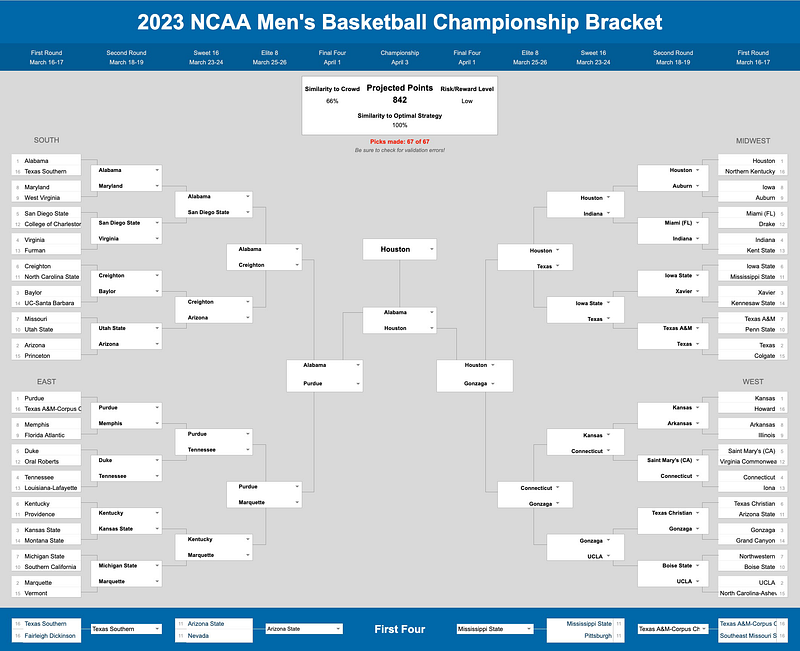
Click to enlarge or view in detail here.

The bottom line? Pick #1 Houston to win it all against #1 Alabama, with #1 Purdue and #3 Gonzaga rounding out the Final Four, and #2 Texas, #4 UConn, #6 Creighton, and #2 Marquette filling out the Elite Eight. The math this year produces a much less chalky bracket than in years past, which should make things interesting. That said, it still has two #1 seeds getting to the final, but picking Houston and Gonzaga over crowd favorites Alabama and Kansas should create sufficient variation to win out your pool if things go your way. Consider this: The crowd is favoring Alabama (65%) in a hypothetical matchup against Houston (35%) when FiveThirtyEight has Houston actually winning that hypothetical game 63% of the time.

If you have the option to submit multiple brackets in a single pool, simply change your overall winner to one of the other teams that proceeds the furthest in the optimal bracket above. For example, for your second bracket, have Alabama beating Houston in the title game. For your third bracket, have Alabama beating Texas in the title game. For your fourth bracket, have Texas beating Alabama, for your fifth game, Houston beating Purdue, and so on and so forth.

As pool sizes increase, you may need to consider getting increasingly risky to differentiate yourself from the field. Change nothing from the bracket except the final winner. My own very unscientific rule of thumb is the following:

  • Up to 50 brackets: Houston
  • 51–250 brackets: Texas
  • 251–1,000 brackets: Gonzaga

For even larger pools, have some fun to distinguish yourself from the competition even further, considering #4 UConn in the West, #6 Creighton in the South, #4 Tennessee in the East, or #4 Indiana in the Midwest. Consider potential Cinderella teams like #10 Utah State in the South or #11 Providence in the East to make a deep run.

Here’s a direct link to make your own copy of my comprehensive spreadsheet, updated for 2023 that includes the Optimal Bracket above, plus:

  • A blank bracket for you to copy and fill in that dynamically 1) predicts the number of points your bracket will earn, 2) calculates how similar your bracket is to the crowd, 3) gauges your bracket’s risk/reward level, and 4) compares your bracket to optimal strategy (“Your Bracket” sheet)
  • Complete rankings for each team based on win probability, crowd distribution, value differential, and optimal strategy (“Rankings” sheet)
  • 4 pre-filled brackets representing optimal strategy: FiveThirtyEight’s picks based on win probability, ESPN’s People’s Bracket, and chalk
  • All the nitty gritty formulas and data behind my bracket
  • Settings allowing you to adapt all of the above to your pool’s point structure (“Point Structure” sheet)

Don’t forget to re-read the original guide: The Ultimate Guide to Filling Out Your Bracket for March Madness. It implements optimal strategy as defined in Optimizing Your 2016 March Madness Bracket by Robby Greer:
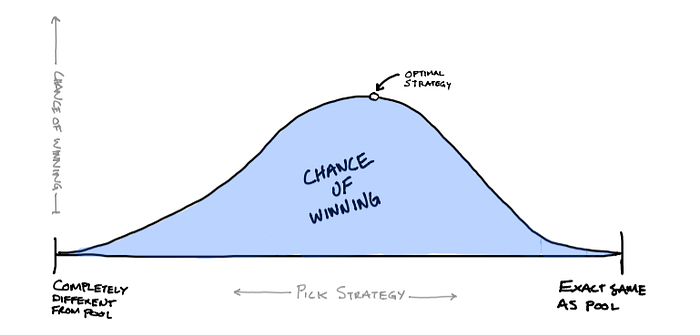
Visualizing optimal strategy, from Optimizing Your 2016 March Madness Bracket by Robby Greer

Before You Go

If you liked this post, you may also like my other posts about sports and data:

Give me a follow and subscribe to email notifications to be notified when I post more or get in touch on Twitter to chat!

Basketball
March Madness
NCAA Basketball
Sports
Sports Betting
Recommended from ReadMedium