
How to Fill Out Your 2019 March Madness Bracket
The 2020 tournament was canceled, but check out what might have been using my simulation. Follow me and subscribe to get my bracket delivered directly to your inbox each year once ready.
Author’s note: The tournament has ended! For the second year in a row, my model picked the winner correctly, even if it did require a bit of late-game heroics by UVA throughout the tournament to be crowned champions. My more adventurous suggestions of Michigan State over Duke and dark horses Auburn and Oregon weren’t too bad either.
Last year I shared the in-depth method I used to fill out my NCAA basketball tournament bracket using the optimal mathematical strategy. It worked out well for me — I correctly picked the tournament winner and ranked in the 94th percentile among the 17.3 million brackets in ESPN’s Tournament Challenge pool. More importantly, I bested most of my friends and family for a year of bragging rights 🙂. In this post, I’ve applied the same mathematical methodology to this year’s 2019 March Madness bracket — feel free to copy it verbatim or simply use it as a foundation as you fill out your bracket.
The Mathematically Optimal 2019 Bracket
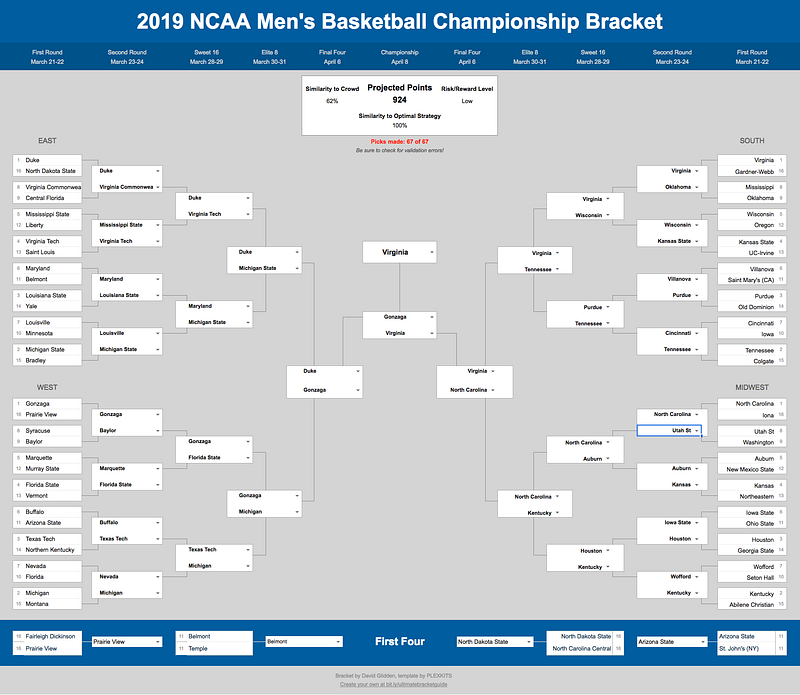
The bottom line? Pick Virginia to win it all against Gonzaga, with Duke and UNC rounding out the Final Four, and Michigan State, Michigan, Tennessee, and Kentucky filling out the Elite Eight. The math this year produces an even chalkier bracket than last year, with all teams in the Elite Eight seeded 1 or 2. However, picking Virginia and Gonzaga over crowd favorites UNC and Duke should create sufficient variation to win out your pool if things go your way. Consider this: The crowd is favoring UNC (63%) in a game against Virginia (37%) when FiveThirtyEight gives that hypothetical game to Virginia at a rate of 57% to UNC’s 43%. Similarly, the crowd is overvaluing Duke (81%) over Gonzaga (19%) when FiveThirtyEight gives Duke only a 55% chance in to Gonzaga’s 45% chance in that hypothetical matchup.
Elsewhere in the bracket, if you’re in a larger pool, consider picking #2 Michigan State over #1 Duke or #2 Kentucky over #1 UNC. Consider dark horses like #5 Auburn, #6 Iowa State, #6 Villanova, or #6 Maryland, and potential Cinderella teams #12 Oregon or #10 Florida.
Here’s a direct link to my comprehensive spreadsheet, updated for 2019, that includes the optimal bracket above, plus:
- A blank bracket for you to copy and fill in that dynamically 1) predicts the number of points your bracket will earn, 2) calculates how similar your bracket is to the crowd, 3) gauges your bracket’s risk/reward level, and 4) compares your bracket to optimal strategy (“Your Bracket” sheet)
- Complete rankings for each team based on win probability, crowd distribution, value differential, and optimal strategy (“Rankings” sheet)
- 4 pre-filled brackets representing optimal strategy, FiveThirtyEight’s picks based on win probability, ESPN’s People’s Bracket, and chalk.
- All the nitty gritty formulas and data behind my bracket
- Settings allowing you to adapt all of the above to your pool’s point structure (“Point Structure” sheet)
Don’t forget to get a refresher on the entire methodology by re-reading last year’s comprehensive post: The Ultimate Guide to Filling Out Your Bracket for March Madness.
Drop a comment and let me know how you do!
Before You Go
If you liked this post, you may also like my other posts about sports and data:


