
Professional Writing
Use Occam’s Razor Principle to Attract More Readers to Your Writing
I learned that professionals are paid well as they are good at hiding complexity and presenting the outcomes in simplicity.

Simplicity is ironic, paradoxical, and sometimes misunderstood, or its power is undermined. However, while dealing with the massive data and information labyrinth in my life to uncover the truth, I use a unique principle that encourages simplicity over complexity. This principle reminds me that, among competing explanations, the simplest is often the most accurate and effective solution.
Using Occam’s razor principle helps me find my truth away from unnecessary complexities. I recognize that while the world is intricate, the most straightforward path leads to the most profound understanding. Like many professionals, this principle is my trusted compass in pursuing clarity, finding knowledge, and gaining skills.
For example, when I encounter a perplexing health claim with elaborate theories and convoluted reasoning, instead of getting lost in its complexity, I pause to apply Occam’s Razor. I ask myself: Is there a simpler, more straightforward explanation for this phenomenon? Most of the time, the answer is yes.
Learning about Occam’s Razor profoundly affected my professional life. For example, I used it to simplify complex enterprise architecture for large corporate clients who wanted simple solutions and paid good money for them. One of my tools is Design Thinking, which helps me serve my clients with agility. I help them to lower their cognitive load.
I documented my perspectives in a story titled How to Create Simplicity for Technology Excellence. Also, in my book, I highlighted the importance of simplicity for practitioners in modernizing enterprises with pragmatic architecture, powerful technologies, innovative agility, and fusion.
Ironically, from my professional experience, one needs to deal with a lot of complexity to create simplicity and excellence for the clients. Simplicity requires us to diminish complication and sophistication in this challenging process.
Therefore, professionals are paid well as they are good at hiding complexity and presenting the outcomes in simplicity. I believe writers who can hide complexity and present simple solutions to their readers in the right context can increase their chances of earning more.
What is Occam’s razor principle, and why does it matter?
As documented in this paper, “Occam’s razor is the principle that all else being equal, simpler explanations should be preferred over more complex ones. This principle is thought to play a role in human perception and decision-making, but our presumed preference for simplicity is not understood.”
Occam’s Razor is evident in scientific writing when researchers choose the simplest model that explains observed phenomena without unnecessary complexities. Effective communicators like journalists or educators often use Occam’s Razor to convey information straightforwardly.
One of my mentors when undertaking my academic studies in Europe, Dr Edward de Bono, who said goodbye to us in June 2021, signed his book at a conference, which taught me the significance of simplicity in problem-solving, decision-making, and timely action.
In that conference, Dr De Bono argued that the world was overly complex, leading to inefficiency and confusion. He emphasized the need for clear thinking and clear communication, suggesting that simplicity is a virtue that should be cultivated by thought leaders.
He offered practical techniques for achieving simplicity in various aspects of life, including creativity, intuition, communication, decision-making, and problem-solving.
His approach encourages us to cut through complexity, reduce unnecessary details, and focus on what truly matters, ultimately leading to more effective and streamlined thinking, decision-making, and action.
Occam’s Razor metaphorically emphasizes the economy of explanation, also known as the principle of parsimony. It suggests that all else being equal, simpler or more straightforward explanations are generally better.
Occam’s Razor principles encourage us to choose the simplest explanation in verbal or written communication that fits the evidence. In writing, this principle means avoiding unnecessary complexity and choosing straightforward, clear explanations in the text.
I believe the opposite of Occam’s Razor principle is Murphy’s Law. It is because while Occam’s Razor suggests that the simplest explanation is the best, Murphy’s Law is a popular adage that implies that if something can go wrong, it will go wrong, often in the most complex or convoluted way that we cannot explain.
Why can complexity be a problem in writing?
Complexity in writing can be a significant disadvantage as it can hinder effective communication and engagement.
Overly intricate and convoluted language can alienate readers, making comprehension challenging and discouraging their interest.
Complex writing may also lead to misinterpretation, causing confusion and misunderstandings.
Complex writing can appear pretentious and may convey an impression of the author showing off their knowledge rather than focusing on the reader’s needs. It turns off the readers.
In essence, complexity in writing might erect barriers between the author’s message and the reader, undermining the core purpose of effective communication and desired comprehension.
What are the benefits of the simplicity principle for writers?
1 — Simplicity in writing offers advantages, like enhancing communication and reader engagement.
2 — Clear, concise, and straightforward writing ensures the message is easily understood, making it accessible to a broader audience.
3 — Simplicity promotes reader retention, as it can reduce the cognitive load, enabling the audience to grasp and remember the content more effectively.
4 — Simple writing also encourages trust and connection with readers, as it appears more genuine and relatable.
5 — Applying Occam’s Razor improves clarity in writing by avoiding convoluted or overly intricate explanations.
6 — Writing concisely and clearly respects readers’ time, making your content more accessible and efficient.
As most readers prefer straightforward content, adhering to Occam’s Razor can enhance reader engagement. Therefore, simplifying our writing can increase the audience's likelihood of understanding and resonating with our messages.
Ultimately, simplicity in writing eliminates unnecessary barriers between the author’s ideas and the audience, facilitating effective communication and a positive reading experience.
One day, one of my writing mentors said my writing was too complicated, and my readers would struggle to understand it. I asked how he determined it. He introduced a free tool called Hemingway Editor.
When I entered my short article into the app, it showed my content at the postgraduate level, finding 34 out of 38 sentences very hard to read, as shown in the screen capture. The tool asked me to aim for level 14, which is still high for the public.
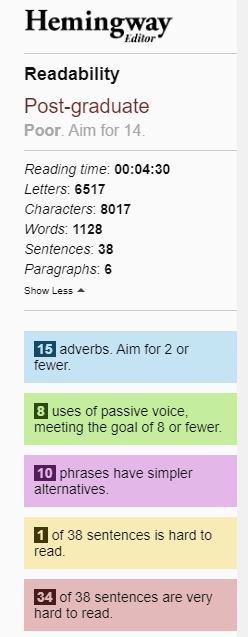
Level 14 was acceptable in an academic environment as it was my goal as the simplest for my scholarly audience. But when I started writing for the public, I had to lower my writing level to grade 6 to 7 to make sense of my content to most of my readers.
Interestingly, when I analyzed over 100 viral stories published in my publication in 2021, most of the viral content was around grade 7, which did not surprise me for public acceptance. So, such tools can be helpful to maintain simplicity in writing and to reach out to a broader audience.
Conclusions
While sometimes valuable in specific contexts, complexity in writing can present various disadvantages. Complex writing often leads to confusion and misinterpretation, as it overwhelms readers with intricate sentence structures, jargon, or excessive details.
This can alienate a broader audience, hindering effective communication. Additionally, complex writing tends to burden readers with a high cognitive load, making it challenging for them to grasp and retain the content.
It may also create detachment between the author and the audience, as it appears less relatable and genuine.
Nevertheless, simplicity in writing offers multiple advantages. It can enhance communication and reader engagement by providing clear, concise, and straightforward content.
Simplicity makes the message easily understandable to a broader audience, increasing accessibility. Simple writing can reduce the cognitive load, enabling the audience to comprehend and remember the content more effectively.
Simplicity in writing can create trust and connection with readers, as it comes across as genuine and relatable. Ultimately, simplicity eliminates unnecessary barriers between the author’s ideas and the audience, facilitating effective communication and a positive reading experience.
For aspiring writers, Occam’s Razor is a tool for creating more effective, memorable, relatable, and engaging content. By prioritizing simplicity and clarity, writers can attract and retain readers more effectively.
Takeaways
1 — Use clear and simple language by chosing common words and phrases in short sentences and paragrapsh to convey your ideas without unnecessary jargon.
2 — Remove redundant phrases or explanations that don’t add essential value to your writing by self-editing multiple times.
3 — Occam’s Razor encourages simplicity in writing, making it more accessible to a broader audience so keep this principle in mind while writing and editing.
4 — Prioritize the most critical and necessary information, avoiding unnecessary details that might confuse or overwhelm readers.
In essence, Occam’s Razor emphasizes simplicity in explanations to make our lives easier, while Murphy’s Law suggests that complexity and complications are more likely to occur in real-world situations, so we need to focus on simplicity.
Simplicity and simple lifestyles like minimalism are also important for physical and mental health. Clearing mental clutter significantly increased my cognitive function and mental performance. Therefore I choose single tassking instead of multitasking for my creativity and productivity.
As a content strategist for five decades, focusing on simplicity to overcome complexity, I documented my experience and perspectives in numerous stories that might guide aspiring writers and bloggers.
Thank you for reading my perspectives. I wish you a healthy and happy life.
To inform my new readers, I wrote numerous articles that might inform and inspire you. Some topics I cover are brain and cognitive function, significant health conditions, valuable nutrients, ketogenic lifestyle, self-healing, weight management, writing/reading, and humor.
I publish my health and wellness stories on EUPHORIA. My posts do not include professional or health advice. I only document my reviews, observations, experiences, and perspectives to provide information and create awareness.
To get my post in your inbox, you may subscribe to my content. If you are a writer, you are welcome to join my publications by sending a request via this link. I support 24K+ writers who contribute to my publications on this platform.


