avatarAvi Kotzer

Free AI web copilot to create summaries, insights and extended knowledge, download it at here

3085

Abstract

in that sport.</p><p id="0504">Speaking of inflammation, Schortsanitis does look swole here.</p><figure id="e08a"><img src="https://cdn-images-1.readmedium.com/v2/resize:fit:800/0*Oi3mh7x_VenWR7CK.jpg"><figcaption>Screenshotted by Iva Reztok</figcaption></figure><p id="8bf3">Okay, back to skin rashes. Although dermatitis is also characterized by itchiness, redness, and the presence of a rash, in long-term cases the skin may thicken. In other words, long-term skin damage does occur. Dermatitis can more likely cover the entire body, too. The most famous type of dermatitis is the one that Head & Shoulders has been fighting for decades.</p><p id="3bad">Dandruff. Which is the mild form of seborrheic dermatitis and — because of its mildness — actually responds to H&S and other dandruff shampoos of similar composition. Those who suffer from <b>seborrhea</b> know that even if they shampooed their hair hourly, none of the TV-ad shampoos would do any good.</p><p id="48a5">Seborrhea is not limited to the scalp; it can appear anywhere on the skin where there are oil-producing glands. One of the areas commonly affected is the face itself:</p><figure id="bf8b"><img src="https://cdn-images-1.readmedium.com/v2/resize:fit:800/0*e1-OrVsOH0k87XgG.jpg"><figcaption>Photo by Roymishali</figcaption></figure><p id="f2e8">Treatment for this persistent skin disease falsely attributed to poor hygiene is more complicated than what television commercials would have you believe.</p><p id="6c0e">If what you suffer from is hives and not the above condition, you can feel blessed.</p><h2 id="2792">The writing on the wall… of skin</h2><p id="05e7">The most common general causes of <i>urticaria</i> are infections and allergic reactions. More specifically, allergies to any of the following:</p><p id="a228"><b>Medication: </b>some of the drugs that can cause allergic reactions are codeine, aspirin, ibuprofen (Advil), penicillin and a few other antibiotics, vaccines, and even anti-diabetic drugs.</p><p id="6121"><b>Food:</b> nuts, shellfish, eggs, wheat, soy… these are all causes of serious allergic reactions with hives as a symptom.</p><p id="04a4"><b>Environment:</b> the sun, exercise, and even water can cause <i>urticaria</i>. Boy, am I making a case here for not stepping outside your home…</p><p id="9676"><b>Stress: </b>when you hear people saying they are “breaking out” from all the craziness in their lives, they are not kidding.</p><p id="fd3f"><b>Cold or pressure:</b> yep, these, too. Although mostly as part of a non-fatal reaction.</p><p id="9a49"><b>Writing:</b> no, not by writing on Medium, for example. So relax and keep churning out those “How I made soooooo much money in sooooo little time” articles. Or read <a href="https://readmedium.com/how-i-made-four-figures-my-first-week-writing-on-medium-6f2dbbfc12f5">mine</a>, for laughs.</p><p id="23ff">The “writing hives” I’m talking about is called <b>Dermatographic urticaria</b>, and it’s one of the most common types of <i>urticaria</i>, affecting around one out of 25 to 50 people. According

Options

to Wikipedia (and other research I’ve performed):</p><blockquote id="05a8"><p>“The condition manifests as an allergic-like reaction, causing a warm red wheal to appear on the skin. As it is often the result of scratches, involving contact with other materials, it can be confused with an allergic reaction, when in fact it is the act of being scratched that causes a wheal to appear. These wheals are a subset of urticaria (hives), and appear within minutes, in some cases accompanied by itching. The first outbreak of urticaria can lead to other reactions on body parts not directly stimulated, scraped, or scratched. In a normal case, the swelling will decrease without treatment within 15–30 minutes, but, in extreme cases, itchy red welts may last anywhere from a few hours to days.”</p></blockquote><p id="3bf7">It sounds terrible, but it can also lead to cool things like this:</p><figure id="4a94"><img src="https://cdn-images-1.readmedium.com/v2/resize:fit:800/0*-VKCGqO6kb_B5oJm.jpg"><figcaption>Photo by Mysid — Own hand, own photo</figcaption></figure><p id="7334">Before anyone files suit, I will add the disclaimer that I am not endorsing this behavior. I mean, c’mon, you can write on your skin and you choose to inscribe “L503”?</p><p id="921e">Be brave! Scratch a Shakespeare sonnet on your chest and woo your sweetheart by ripping off your shirt.</p><p id="738c">In any case, if you’re allergic, you can tell people that you break out in hives. Just don’t say <i>urticaria</i>, because that word is forbidden by the editors of the Spelling Bee game who declared that <i>urticaria</i> is<i> </i>a <a href="https://www.merriam-webster.com/words-at-play/dord-a-ghost-word"><b>dord</b></a><b>.</b></p><p id="f4f6">You can check out my previous entry on another <b>dord </b>here:</p><div id="9d10" class="link-block"> <a href="https://readmedium.com/ocicat-1ff8416c1ac5"> <div> <div> <h2>Ocicat</h2> <div><h3>I’m counting on this cute cat to increase my readership</h3></div> <div><p>medium.com</p></div> </div> <div> <div style="background-image: url(https://miro.readmedium.com/v2/resize:fit:320/0*JJZk34WdIemWA349.jpg)"></div> </div> </div> </a> </div><p id="90cc">*What the heck is a <b>dord, </b>you ask? Here’s the answer:</p><div id="8dc5" class="link-block"> <a href="https://www.merriam-webster.com/words-at-play/dord-a-ghost-word"> <div> <div> <h2>'Dord': A Ghost Word</h2> <div><h3>One of the questions people like to ask lexicographers is this: Can you sneak something into the dictionary? Can you…</h3></div> <div><p>www.merriam-webster.com</p></div> </div> <div> <div style="background-image: url(https://miro.readmedium.com/v2/resize:fit:320/0*aJIPUyEQaPh30vF_)"></div> </div> </div> </a> </div></article></body>

Urticaria

I’m itching to tell you more about this word
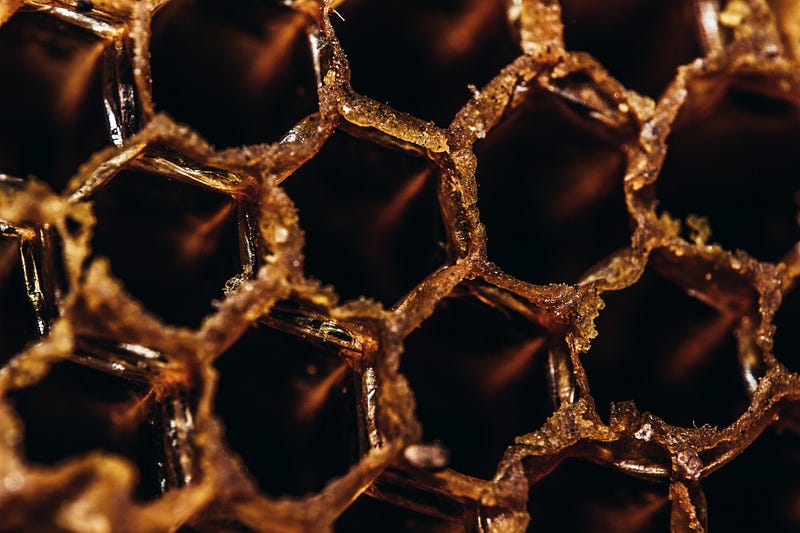
Photo by Vivek Doshi on Unsplash

Today’s New York Times Spelling Bee letters:

Art: Iva Reztok

A, C, H, I, R, U, and center T (all words must include T)

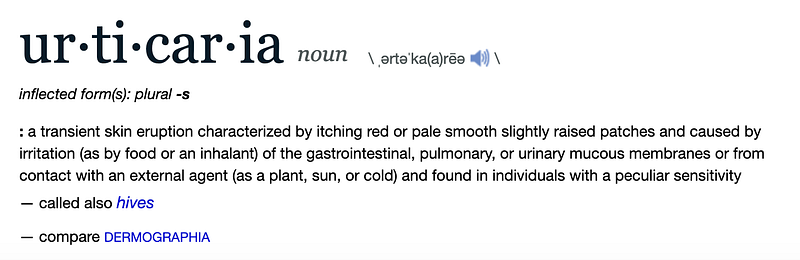
Merriam-Webster says…
Credit: merriam-webster.com

Silly little dictionary! Don’t you know that urticaria can’t possibly be a word if the New York Times says it ain’t?

For further fascinating facts, check out the Spelling Bee Master.

What’s your favorite dord* from today’s puzzle?

My Two Cents

The photo at the top of today’s article does not show urticaria, although it does show hives. Or part of a hive, to be more precise. It’s just that hives — as in the skin condition — is not very photogenic.

And, as far as I know, most people don’t mind looking at a picture of a beehive. It’s also very appropriate, considering we are talking about a word rejected by the Spelling Bee.

Merriam-Webster says the term hives as a synonym for urticaria is of unknown origin, and dictionary.com adds only that it may have been Scottish in origin, from around the late 15th century.

Transient itch

One of urticaria’s main characteristics is its temporary and relatively benign appearance. Although the skin rash can present with red, raised bumps that itch or burn, the rash itself usually lasts a few days and does not leave scars or have long-lasting effects on the skin.

Urticaria is often confused with dermatitis (or eczema), which is inflammation of the skin. As a rule of thumb, whenever a doctor mentions something that ends in -itis, they are talking about a condition or disease that is inflammatory.

So, appendicitis is “inflammation of the appendix”, laryngitis is “inflammation of the larynx (voice box)”, and schortsanitis is an “inflammation of a schort guy”, which makes sense since Sofoklis Schortsanitis was a 6-foot-10-inch Greek basketball player… and it always helps to be tall in that sport.

Speaking of inflammation, Schortsanitis does look swole here.

Screenshotted by Iva Reztok

Okay, back to skin rashes. Although dermatitis is also characterized by itchiness, redness, and the presence of a rash, in long-term cases the skin may thicken. In other words, long-term skin damage does occur. Dermatitis can more likely cover the entire body, too. The most famous type of dermatitis is the one that Head & Shoulders has been fighting for decades.

Dandruff. Which is the mild form of seborrheic dermatitis and — because of its mildness — actually responds to H&S and other dandruff shampoos of similar composition. Those who suffer from seborrhea know that even if they shampooed their hair hourly, none of the TV-ad shampoos would do any good.

Seborrhea is not limited to the scalp; it can appear anywhere on the skin where there are oil-producing glands. One of the areas commonly affected is the face itself:
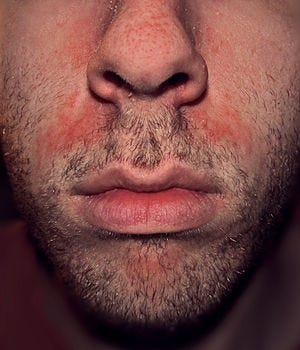
Photo by Roymishali

Treatment for this persistent skin disease falsely attributed to poor hygiene is more complicated than what television commercials would have you believe.

If what you suffer from is hives and not the above condition, you can feel blessed.

The writing on the wall… of skin

The most common general causes of urticaria are infections and allergic reactions. More specifically, allergies to any of the following:

Medication: some of the drugs that can cause allergic reactions are codeine, aspirin, ibuprofen (Advil), penicillin and a few other antibiotics, vaccines, and even anti-diabetic drugs.

Food: nuts, shellfish, eggs, wheat, soy… these are all causes of serious allergic reactions with hives as a symptom.

Environment: the sun, exercise, and even water can cause urticaria. Boy, am I making a case here for not stepping outside your home…

Stress: when you hear people saying they are “breaking out” from all the craziness in their lives, they are not kidding.

Cold or pressure: yep, these, too. Although mostly as part of a non-fatal reaction.

Writing: no, not by writing on Medium, for example. So relax and keep churning out those “How I made soooooo much money in sooooo little time” articles. Or read mine, for laughs.

The “writing hives” I’m talking about is called Dermatographic urticaria, and it’s one of the most common types of urticaria, affecting around one out of 25 to 50 people. According to Wikipedia (and other research I’ve performed):

“The condition manifests as an allergic-like reaction, causing a warm red wheal to appear on the skin. As it is often the result of scratches, involving contact with other materials, it can be confused with an allergic reaction, when in fact it is the act of being scratched that causes a wheal to appear. These wheals are a subset of urticaria (hives), and appear within minutes, in some cases accompanied by itching. The first outbreak of urticaria can lead to other reactions on body parts not directly stimulated, scraped, or scratched. In a normal case, the swelling will decrease without treatment within 15–30 minutes, but, in extreme cases, itchy red welts may last anywhere from a few hours to days.”

It sounds terrible, but it can also lead to cool things like this:
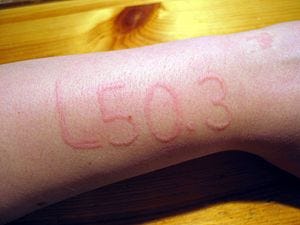
Photo by Mysid — Own hand, own photo

Before anyone files suit, I will add the disclaimer that I am not endorsing this behavior. I mean, c’mon, you can write on your skin and you choose to inscribe “L503”?

Be brave! Scratch a Shakespeare sonnet on your chest and woo your sweetheart by ripping off your shirt.

In any case, if you’re allergic, you can tell people that you break out in hives. Just don’t say urticaria, because that word is forbidden by the editors of the Spelling Bee game who declared that urticaria is a dord.*

You can check out my previous entry on another dord* here:

*What the heck is a dord, you ask? Here’s the answer:

Language
Medicine
Science
Spelling Bee
Culture
Recommended from ReadMedium