
Five Principal Patterns For New Nature Writers
‘science describes accurately from outside, poetry describes accurately from inside’ — Ursula K. Le Guin
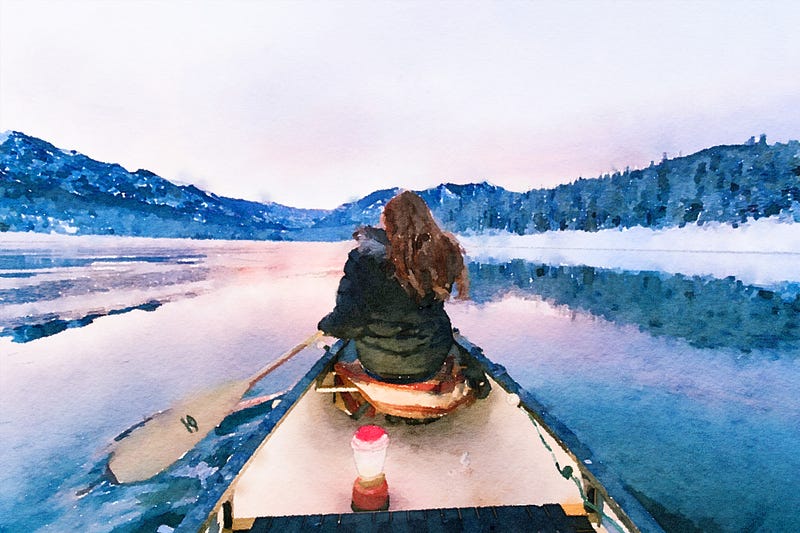
‘Contact! Contact!’
When we select the words we put to our experience of the world, what role does metaphor play in helping us make sense of this world? In writing about the natural world, for example, do metaphors enhance our insights into the nonhuman world, or do they distort it?
Paradoxically, many consider language to be an intermediary between us and nature, a capacity that both enables us to connect to the natural world yet at the same time separates us from nature.
In his fascinating book about the new science of fungi, Entangled Life, the scientist Merlin Sheldrake asks an interesting question:
“Our descriptions warp and deform the phenomena we describe, but sometimes this is the only way to talk about features of the world: to say what they are like but are not. Might this also be the case when we talk about other organisms?”
In this case, he is talking about how we might understand what it’s like to be a fungi. This might seem like a weird question to ask, but for scientists who spend their lives becoming familiar with the phenomenal lived experience a particular organism, this question –what is like to be a mycelial network (or a wolf, or an eagle, or a salmon) — is a constant conundrum echoing in the background.
Sheldrake wonders, for example, when a truffle-hunter uses the metaphor of ‘marriage’ describes the interdependent partnership between a tree and a mushroom, is this taking a step too far? Or somewhat differently, when a chemist says that Cis-3-hexanol smells like cut grass, or that Oxane smells like sweaty mango, is this a distortion of reality? Or does this language of comparison offer us a key portal through which humans can, and perhaps must, walk through if we ever want to understand the radical otherness of nonhuman nature?
There’s a common idea that using metaphors rooted in human experience of the world – metaphors based on human social relationships or human sensory experiences of sight and smell — are projections we cast on animals are anthropomorphic distortions.
But in our effort to counteract this worry of anthropomorphizing nature, do we flip too easily to its polar opposite? Opting for a cold rationality that tends to construe an organism’s experience as trapped in a small world of robot-like stimulus-response?
Many poets and writers have grappled with this paradoxical question about the role of human language in mediating human experience of nature: whether language brings us closer to nature, or just as easily severs us from the wild reality of the natural world around us.
Hunched over in front of our computers, or enraptured by the ‘spell’ of our own written words, for some, human language can seem like a vanity mirror that ensconces ever deeper in a human-made world.
And when us languaging two-leggers step outside, there’s a feeling that despite the world-making powers that language has given us, there’s a nagging sense we’ve lost touch.
I think about Thoreau moving “to the woods because I wished to live deliberately, to front only the essential facts of life.” The essential facts of life, for Thoreau, could only be made contact with once the veneer of society was cast off. One day, hiking up Mount Katahdn in Maine, Thoreau asks,
“Think of our life in nature, — daily to be shown matter, to come into contact with it, — rocks, trees, wind on our cheeks! the solid earth! the actual world! the common sense! Contact! Contact! Who are we? where are we?”
Or what about the poet Rainer Marie Rilke, when he suggests a similar idea of lost connection with nature, but this time from the perspective of the wild world language now separates us from:
“And the animals, instinctively, have already noticed that we aren’t really at home in our talked-about world.”
— Rainer Marie Rilke, “The First Elegy,” Duino Elegies
Science explicates, poetry implicates
We know that other organisms, from spiders to sea turtles, sense and interpret the world around them in complex ways. But for some reason, we still seem to have hang-ups about wielding our ‘talked-about world’ in the service of deepening our scientific understanding of this more-than-human world.
Can we deliberately and precisely use metaphoric and poetic language to bring us closer to the lived experience of nonhuman nature in a way that remains rooted in the best available science? The ‘new nature writer’ Robert Macfarlane seems to think so, calling this poetic space at the horizons of scientific understandings of the natural world, imaginative naturalism.
In my own trial-and-error attempts at exploring this space, one writer I often look to for insights into this poetic genre of naturalist description is Ursula K. Le Guin (1929–2018). Her strategy for exploring the poetic horizon of human understanding and connection with the more-than-human world draws on the metaphor of time in science fiction. Or as she put it, “the future in science fiction is just a metaphor for now.”
In another book she is more explicit on the relationship between poetry and science in her work: “Science describes accurately from outside, poetry describes accurately from inside. Science explicates, poetry implicates. Both celebrate what they describe.”
Practical as ever, Le Guin outlines “five principal elements” of this approach to nature writing, principles which must “work in one insoluble unitary movement.” Here they are:
- The patterns of the language — the sounds of words.
- The patterns of syntax and grammar; the way the words and sentences connect themselves together; the ways their connections interconnect to form the larger units (paragraphs, sections, chapters); hence the movement of the work, its tempo, pace, gait, and shape in time.
- The patterns of the images: what the words make us or let us see with the mind’s eye or sense imaginatively.
- The patterns of the ideas: what the words and the narration of events make us understand, or use our understanding upon.
- The patterns of the feelings: what the words and the narration, by using all the above means, make us experience emotionally or spiritually, in areas of our being not directly accessible to or expressible in words.
Conclusion: ‘Hard times are coming’
I’m not sure how to end this piece, so I’ll just leave you with this call from Le Guin for a new movement of writers who can help us reimagine our interdependence and interconnection with a more-than-human world:
“Hard times are coming, when we’ll be wanting the voices of writers who can see alternatives to how we live now, can see through our fear-stricken society and its obsessive technologies to other ways of being, and even imagine real grounds for hope. We’ll need writers who can remember freedom — poets, visionaries — realists of a larger reality.
– Ursula K. Le Guin, in Words Are My Matter