
A Mycologist On What It’s Like To Be A Fungus
Four rhizomatic ideas that will change the way you see the natural world from Merlin Sheldrake’s new book ‘Entangled Life’
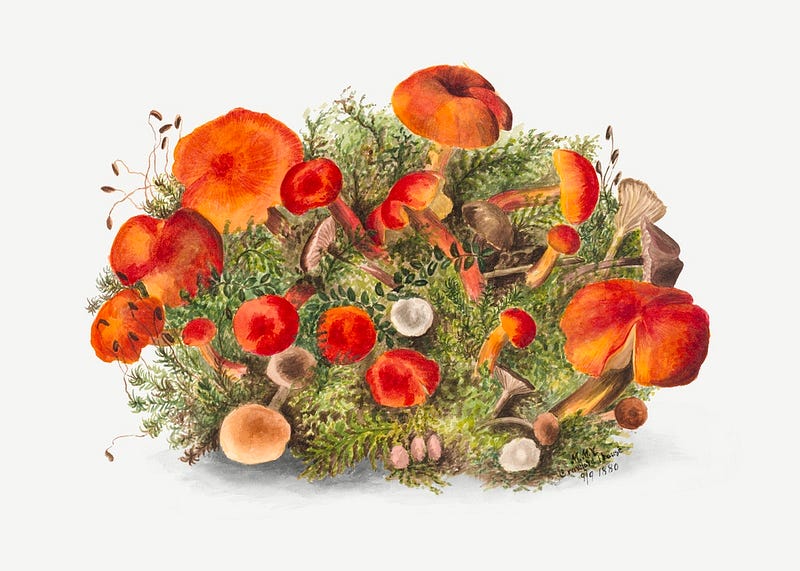
“A mycelial network is a map of a fungus’s recent history and is a helpful reminder that all life-forms are in fact processes not things. The “you” of five years ago was made from different stuff than the “you” of today. Nature is an event that never stops. As William Bateson, who coined the word genetics, observed, “We commonly think of animals and plants as matter, but they are really systems through which matter is continually passing.”
— Merlin Sheldrake
From the first paragraph of Entangled Life: How Fungi Make Our Worlds, Change Our Minds & Shape Our Futures, Merlin Sheldrake channels the reader’s senses into the dirt, and just about everywhere else too. “The more we learn about fungi,” he writes, “the less makes sense without them.”
From there fungal connections explode.
We first learn where fungi are found: everywhere. Living in our gut, creating new medicines, surviving in space, communicating through the wood wide web, shaping animal behavior, composing the atmospheric air we breathe, and more.
Merlin writes about his life-long fungal obsession in a magical way. To get a sense of his intriguing writing style, I recommend watching the video below of Merlin growing mushrooms from a copy of his book, and then eating those mushrooms. It captures his wild scientific-artistic talent well:
Here are four ideas from Merlin Sheldrake’s Entangled Life that struck a chord with me…
#1 The Drunken Monkey Hypothesis
“‘Drunkenness,’ the French theorist Gilles Deleuze writes, is ‘a triumphant eruption of the plant in us.’ It is no less the triumphant eruption of the fungus in us. Can intoxication help us rediscover parts of ourselves in the fungal world”
– Merlin Sheldrake, in Entangled Life
Yeast. About 10 million years ago, a mutation occurred in the enzyme ADH4. For our ancestors, this mutation transformed alcohol from a poison to a source of energy. “Long before our ancestors became human,” writes Sheldrake, “and long before we evolved stories to make cultural and spiritual sense of alcohol and the cultures of yeast that produce it, we evolved the enzyme to make metabolic sense of them.”
Biologist Robert Dudley proposed the “drunken monkey hypothesis” to explain why human beings are so drawn to alcohol. The ancient ancestor humans shared with gorillas, chimps, and bonobos all those millennia ago were attracted to alcohol because it indicated (very) ripe fruit. The hypothesis stems from a simple question: why would the ability to metabolize alcohol in human ancestors emerge long before modern humans developed fermentation technologies?
“Drunkenness may be the eruption of the fungus in us; this would be the eruption of a fungal story. How often stories change our perceptions, and how often we don’t notice.” – Merlin Sheldrake
#2 Ancient Fungal Firestarters
Ötzi, more famously known as the Iceman, was a Neolithic man who lived about 5,000 years ago. His mummified corpse was found in 1991 in the Austrian alps, with an arrowhead embedded in his left shoulder. Scientists speculate he was murdered. But that’s not what interests Merlin. The Iceman was found with a pouch containing Fomes fomentarius or tinder fungus, as part of his firefighting kit. Pieces of medicinal Fomitopsis betulina (birch mushroom) were also in the pouch.
Fast forward a few thousand years, Robigus, the god of mildew, was worshipped in ancient Rome to prevent grain fields from being destroyed by the disease. Fungal diseases would nonetheless lead to widespread crop failures, contributing to the famines that precipitated the fall of the Roman Empire. Today, these ancient prayers coming from understandable anxiety of crop failure have been technologized into super-anti fungal, industrial-scale agriculture. But these high-tech agricultural practices, Merlin argues, are destroying the symbiotic relationships between plants and fungi that enable them to flourish.
And as Merlin points out, recent research shows we need regenerative, pro-fungi forms of agriculture, that recognize that “Without Bacteria and Fungi, the Earth Would Look Like Mars.”
#3 Fungi trick us out of our perceptions
Merlin tells the story about his good friend, the perception ecologist David Abram, about his days long before becoming an academic, making money as a magician. Abram would do coin tricks, making them disappear and reappear. One day, two customers who had just left came back and walked up to David. Merlin tells the story: “When they left the restaurant, they said, the sky had appeared shockingly blue and the clouds large and vivid. Had he put something in their drinks?”
This kept happening over the next several weeks. David’s magic tricks were having a strange, and enduring effect on people’s perception of the world. Merlin recalls how David made sense of these encounters. Our perceptions of the world are heavily influenced by our expectations of the world. The magic tricks seem to loosen the grip of people’s deeply held expectations, making them see the sky and clouds anew, more directly.
“Fungi, too, trick us out of our preconceptions. Their lives and behaviors are startling. The more I’ve studied fungi, the more my expectations have loosened and the more familiar concepts have started to appear unfamiliar. Two fast-growing fields of biological inquiry have helped me both navigate these states of surprise and provide frameworks that have guided my exploration of the fungal world.” — Merlin Sheldrake
# 4 Fungi-centric Metaphors
The wonderful thing about this book is how Sheldrake describes the powerful role metaphor plays in helping us make sense of fungi and the way he transitions from the details of his biological research to more philosophical questions about how we understand nonhuman life.
Sheldrake’s discussions of metaphor as essential scientific tools for making sense of the more-than-human world are fascinating. In particular, he delves into the problems with the common dismissal of anthropomorphism as the layperson’s vice that leads to understanding nature mistakenly: “Anthropomorphism is usually thought of as an illusion that arises like a blister in soft human minds,” he writes.
Merlin notes that the issue of using anthropomorphic metaphors to describe plant behavior erupted into fierce academic debate in 2007 when 36 plant scientists wrote an open letter protesting the emerging field of ‘plant neurobiology.’ The anthropologist Natasha Myers interviewed some of these scientists involved in the debate in a fascinating article, Conversations on Plant Sensing.
From Merlin’s perspective, we need to move beyond debates (and accusations) about anthropomorphism, and instead to develop a ‘grammar of animacy’: a language that doesn’t reduce a nonhuman life to an ‘it.’ Merlin stirs the metaphorical pot, writing:
“If you say that a plant “learns,” “decides,” “communicates,” or “remembers,” are you humanizing the plant or vegetalizing a set of human concepts? The human concept might take on new meanings when applied to a plant, just as plant concepts might take on new meanings when applied to a human: blossom, bloom, robust, root, sappy, radical…”
Conclusion
Entangled Life is a fascinating look into the cutting-edge biology of fungi, revealing how much is still unknown about mycelial networks, fungi-tree communication systems, and how all these organisms work together as ‘holobionts,’ or “an assemblage of different organisms that behaves as a unit. The word holobiont derives from the Greek word holos, which means ‘whole.’
Sheldrake’s writing style is imaginative and unique, and among the many reasons to read this book is to see how he uses metaphor and goes off on imaginative tangents to shift our perception of the natural world.
This is definitely a book to take note of for environmental writers looking to find new ways to communicate environmental science in compelling ways.
Finally, if you’re curious to learn more about Merlin’s fungi research, here’s a great conversation held virtually a couple of months ago between the writer Michael Pollan and Merlin Sheldrake about Merlin’s book Entangled Life and the craft of environmental storytelling.


