
The ‘Carrier Bag’ Theory of Nature Writing
Ursula K. Le Guin’s how-to guide to telling Life Stories over Killer Stories
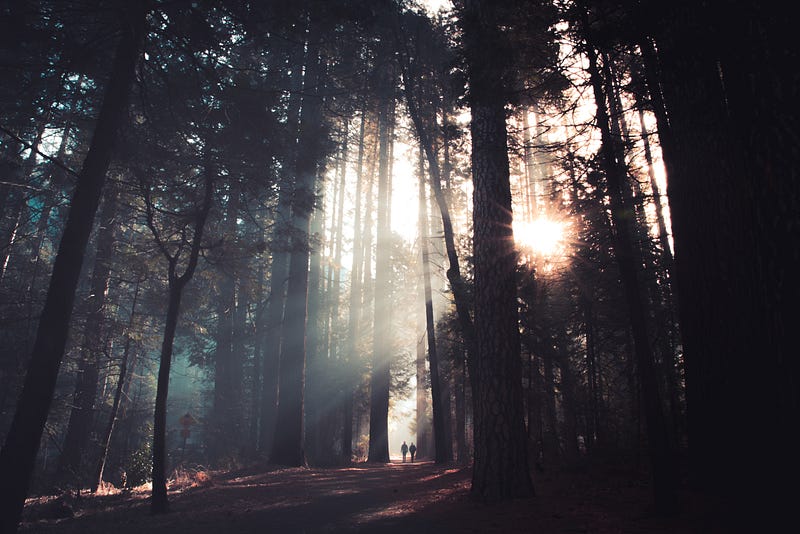
“The trouble is, we’ve all let ourselves become part of the killer story, and so we may get finished along with it.”
–Ursula K. Le Guin
How do you give voice to the nonhuman world?
In most storytelling, nature plays a background stage for human dramas to take place. The natural world appears as an inert backdrop. Plants, animals, and natural places are mostly “props, ground, plot space, or prey. They don’t matter; their job is to be in the way, to be overcome, to be the road, the conduit, but not the traveler, not the begetter” (Donna Haraway).
Now that the climate crisis has forced us to recognize that the nonhuman world isn’t a mere ‘plot space’ for human stories but an active force shaping human lives, many environmental writers are asking, ‘how do you give voice to the nonhuman world’? How do you tell stories that are expansive enough to tell both human and nonhuman stories?
Ursula K. Le Guin’s ‘Carrier Bag Theory‘ of storytelling
In her essay, “The Carrier Bag Theory of Fiction,” Ursula K. Le Guin gives us a characteristically insightful answer to how we can tell stories that give voice to the nonhuman world.
Stories of hunting and killing, Le Guin argues, have long held center stage in our imagination, leading us to believe that the individual hero’s journey is the point of the story.
She takes us back to a scene sometime in the paleolithic: ‘little Ool’ and ‘Oom’ are singing, joke-telling, and picking oat after oat, gathering them in a basket, telling more jokes, watching newts wiggle across the rocks by the creek, and then picking some more oats.
Later that night, around the fire, no matter how gripping a story Ool and Oom might come up with from their joking and singing and picking that day, it will always pale in comparison to Oob and Boob’s story of the wooly mammoth hunt:
“No, it does not compare, it cannot compete with how I thrust my spear deep into the titanic hairy flank while Oob, impaled on one huge sweeping tusk, writhed screaming, and blood spouted everywhere in crimson torrents, and Boob was crushed to jelly when the mammoth fell on him as I shot my unerring arrow straight through eye to brain.”
Unlike Ool and Oom’s story, Oob and Boob’s story has a Hero in it, and the Action of the hunt and kill is gripping!
Le Guin calls the Mammoth Hunt story, the dominant human-centered story of our time, the Killer Story. A Killer Story has 3 main characteristics:
- Narratives should be shaped like a spear or arrow, “starting here and going straight there and THOK! hitting its mark (which drops dead).”
- Any good story must be centrally concerned with conflict: a story is like a battle, with strategic attacks to achieve victory in the finale.
- If a story is to be any good, it needs a central hero in it.
In contrast to the Killer Story that ends with a THOK!, Le Guin proposes that we might instead tell the Life Story.
“It sometimes seems that that story is approaching its end. Lest there be no more telling of stories at all, some of us out here in the wild oats, amid the alien corn, think we’d better start telling another kind, which maybe people can go on with when the old one’s finished. Maybe. The trouble is, we’ve all let ourselves become part of the killer story, and so we may get finished along with it. Hence it is with a certain feeling of urgency that I seek the nature, subject, words of the other story, the untold one, the life story.”
First, life stories are non-linear, they don’t end with a THOK! but a knotty handful of threads that connect you to ever more stories.
Second, while life stories may have conflict in them, conflict is not the main force shaping the narrative, just one element among others in the story’s bag. Instead, as a whole, the narrative is hard to characterize as either harmony or conflict, but only as a process of continual transformation.
Third, heroes don’t get to look so good in Life Stories. Or as Le Guin puts it, they kind of look like little potatoes in bag. There is no pedestal, summit, or wooly mammoth carcass to triumphantly stand on at the end of a Life Story. In Life Stories, heroes are just another character in an ‘overstory’ much larger than themselves.
For those of us searching for ways to tell stories that give voice to the nonhuman world, stories that put Nature in the Active Voice, Le Guin’s notion of Life Story gives us a useful starting point.
In explaining her ‘Carrier Bag Theory’ of storytelling, Le Guin describes the reasoning that compels her to write Life Stories instead of Killer Stories:
If it is a human thing to do to put something you want, because it’s useful, edible, or beautiful, into a bag, or a basket, or a bit of rolled bark or leaf, or a net woven of your own hair, or what have you, and then take it home with you, home being another, larger kind of pouch or bag, a container for people, and then later you take it out and eat it or share it or store it up for winter in a solider container or put it in the medicine bundle or the shrine or the museum, the holy place, the area that contains what is sacred, and then next day you probably do much the same again — if to do that is human, if that’s what it takes, then I am a human being after all. Fully, freely, gladly, for the first time.”
Telling a compelling and thrilling Life Story is obviously much more challenging than providing an audience with the familiar and satisfying THOK! of a Killer Story.
But it’s not impossible, encourages Le Guin, telling compelling Life Stories can be done!
How? Well, I’m still figuring that out.
Fiction like Amitav Ghosh’s Gun Island and N.K. Jemisin’s Broken Earth series give me some ideas for how good Life Stories can be told, compelling stories that are big enough to hold both human and nonhuman voices. And nonfiction like Eduardo Kohn’s How Forests Think or Bathsheba Demuth’s Floating Coast offer other helpful examples.
But I especially like how the environmental anthropologist Anna Tsing suggests we might tell better Life Stories. In describing the writing process behind her fascinating book on the global Matsutake mushroom picking industry, The Mushroom at the End of the World, Tsing writes,
“Ursula K. Le Guin argues stories of hunting and killing have allowed readers to imagine that individual heroism is the point of a story. Instead, she proposes that storytelling might pick up diverse things of meaning and value and gather them together, like a forager rather than a hunter waiting for the big kill. In this kind of storytelling, stories should never end, but rather lead to further stories. In the intellectual woodlands I have been trying to encourage, adventures lead to more adventures, and treasures lead to further treasures.”
Support my writing
If you find my writing helpful in your own life and work and would like to support me as a writer, consider signing up to become a Medium member. It’s $5 a month, giving you access to all my writing and all stories on Medium. If you sign up using my link, I earn a portion of your membership fee. Thank you for your support!😊


