avatarKurt Dillon

Free AI web copilot to create summaries, insights and extended knowledge, download it at here

3863

Abstract

eg"><figcaption>Image of the diagramed parts of a typical DNA Double Helix, Courtesy of the National Human Genome Research Institute — used with permission</figcaption></figure><p id="cda5">For the sake of accuracy, I will again borrow the listed parts of DNA as provided by The National Human Genome Research Institute. I will also include a graph of the structure that appears on their website and which the Institute was gracious enough to allow me to use in this series to promote academic awareness of the subject; so, I sincerely thank <b>Sarah A. Bates, M.S., M.A</b>., Chief of the Institute’s Office of Communications, for permitting me to use it within these essays.</p><p id="0f3f">For those of you who wish to delve even deeper into this part of the fundamental understanding of DNA, its components, and its functionality, I sincerely suggest a deep dive into the base of knowledge provided on the Institute’s website which I have linked for you above. Their site is a virtual treasure trove of information on DNA. That being said, I must caution that if you are even half as fascinated with this subject as I am, you can truly lose hours, even days, absorbing information from their site.</p><p id="1d4e">Now that you’ve been duly warned, I think it’s safe to proceed.</p><p id="5fdf">Lastly, to close out our first part of this series, we will look at how DNA functions, and I will once again lean on the Institute’s expertise in defining and explaining all of the relevant aspects in a way I would never be able to compete with.</p><p id="fd70">To paraphrase the Institute’s explanation, DNA holds the necessary instructions for the development, survival, and reproduction of an organism. To execute these instructions, DNA sequences must undergo the process of being converted into messages that are capable of producing proteins — <i>proteins are the intricate molecules that carry out essential functions in our bodies.</i></p><p id="0914">Each DNA sequence that encodes instructions for protein synthesis (the fancy word for when a protein follows its encoded instructions and does what it is supposed to do) is referred to as a gene. The size of each gene varies widely, ranging from approximately 1,000 bases in some things to over 1 million bases in humans.</p><p id="4855">Despite their diversity, genes constitute only about 1% of our entire DNA sequence. The remaining 99% of our DNA sequences play a role in regulating the timing, manner, and quantity of the body’s protein production.</p><p id="31f3">The process of using DNA sequences to generate proteins involves a two-step mechanism. Initially, enzymes read the information within a DNA molecule and transcribe it into an intermediary molecule known as messenger ribonucleic acid or mRNA. It was research using these messenger RNA strands that led to the earliest vaccinations for COVID-19, some of which are still used today.</p><p id="727e">As the next part of the process, the information contained in mRNA molecules is then translated into the “language” of amino acids. Amino acids are the fundamental building blocks of all proteins.</p><p id="e9aa">This linguistic code guides the protein synthesis machinery within the cell to precisely arrange the amino acids in a specific order which then results in the production of a very specific protein.</p><p id="6ca7">Given that there are 20 types of amino acids, they can be arranged in numerous orders, allowing for the creation of a pretty diverse array of proteins which only adds to the statistical uniqueness of every protein they ultimately create.</p><p id="948d">I hope you enjoyed the first part of this series and that you will actively seek the remaining parts as they drop. In the meantime, if you have any questions that I did not adequately address, please feel free to ask them in the comments below so that others

Options

who read the series can benefit from your attention to detail and my oversights.</p><div id="f630" class="link-block"> <a href="https://kurtdillon.medium.com/subscribe"> <div> <div> <h2>Subscribe to Kurt's email newsletter (twice/mo) and stay informed of his exciting projects and…</h2> <div><h3>Subscribe to Kurt's email newsletter (twice/mo) and stay informed of his exciting projects and true-crime podcasts…</h3></div> <div><p>kurtdillon.medium.com</p></div> </div> <div> <div style="background-image: url(https://miro.readmedium.com/v2/resize:fit:320/0*h0zFiDdXBDCKh_ev)"></div> </div> </div> </a> </div><p id="1e80">Be sure to keep on the lookout for the next parts of this fascinating series. In the meantime, if you have an unquenchable taste for true crime, you should also check out Kurt’s two true crime podcasts — The Veritas 7, and Veritas True Crime which also has a sister publication here on Medium under the same name. The V<b><i>eritas True Crime</i></b> Medium Publication is always looking for new writers to write about true crime. <i>Do you have what it takes?</i></p><p id="71fb"><b>Some other fascinating articles by Kurt Dillon that you might enjoy:</b></p><div id="a171" class="link-block"> <a href="https://readmedium.com/a-true-understanding-of-forensic-psychology-4e95b46dcd28"> <div> <div> <h2>A True Understanding of Forensic Psychology</h2> <div><h3>Unlike many believe, the discipline of forensic psychology is not as glamorous and intriguing as often portrayed on TV…</h3></div> <div><p>medium.com</p></div> </div> <div> <div style="background-image: url(https://miro.readmedium.com/v2/resize:fit:320/1*kC7QtKGrstNcviTF9FcBrQ.png)"></div> </div> </div> </a> </div><div id="2457" class="link-block"> <a href="https://readmedium.com/genealogical-dna-solves-another-33-year-old-cold-case-d78f4fc4da21"> <div> <div> <h2>Genealogical DNA Solves Another 33-Year-Old Cold Case</h2> <div><h3>The constantly evolving, highly controversial science has once again done what conventional investigative techniques…</h3></div> <div><p>medium.com</p></div> </div> <div> <div style="background-image: url(https://miro.readmedium.com/v2/resize:fit:320/0*JscV0IJu_RuDHECC.jpg)"></div> </div> </div> </a> </div><div id="88bf" class="link-block"> <a href="https://readmedium.com/copy-raped-9aeaecca9a54"> <div> <div> <h2>Copy-Raped</h2> <div><h3>A Deep Dive into the Quagmire of Electronic Intellectual Property Crimes</h3></div> <div><p>medium.com</p></div> </div> <div> <div style="background-image: url(https://miro.readmedium.com/v2/resize:fit:320/1*0_4Fp7gNTwbYf0jzhNuJLA.jpeg)"></div> </div> </div> </a> </div><p id="e703"><b><i>Kurt Dillon is a Medium Top Writer in Psychology, Social Media, and True Crime. He is the CEO of WOMEN — Wild Orchid Media & Entertainment Network, Inc., and is also a long-standing editor for the ILLUMINATION family of Medium publications. Kurt and his wife Crystal rescue abandoned animals and currently lavish love upon 5 abandoned and abused dogs and 6 abandoned cats at the time of this writing. Kurt’s social links and personal/professional websites are all available in his Medium bio.</i></b></p></article></body>

The Genealogical DNA Series — Part 1

Understanding Genetics & DNA — The Building Blocks of All Life

Have you ever wondered what genealogical DNA is? Or how can scientists know for sure that DNA left at a decades-old crime scene came from a specific person’s family member?
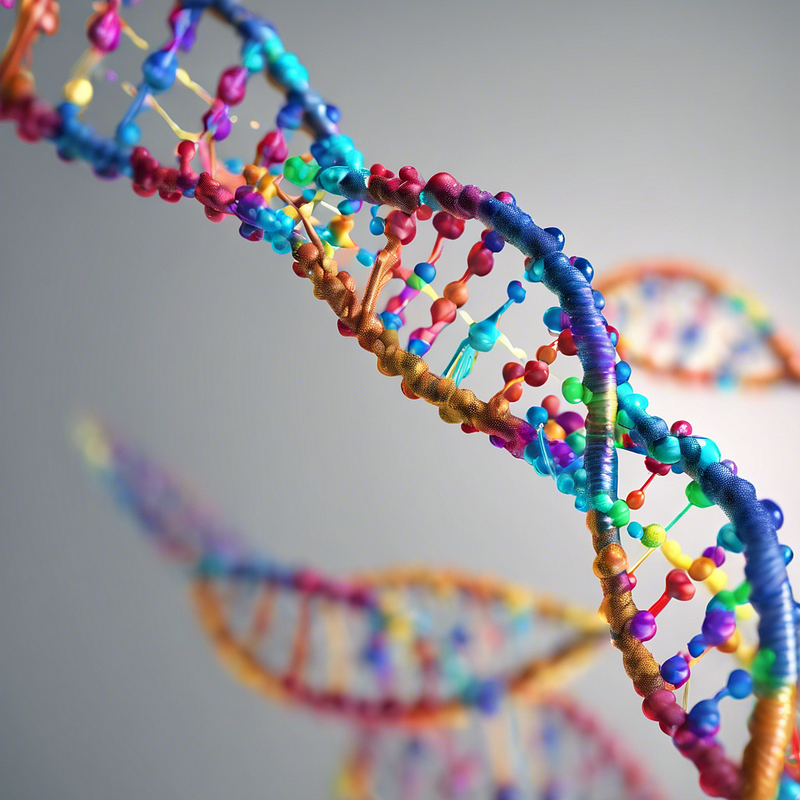
an AI-generated 3D image of a typical DNA Double Helix Created by author Kurt Dillon using Jounce — Copyright 2024 — All Rights Reserved

If you’ve ever wondered exactly how science can distinguish between each of us on a microbial and cellular level, this is a series you won’t want to miss a single part of. In part 1, we begin with a (hopefully) easy-to-understand explanation of what DNA is, its parts, and how it functions.

As the series progresses, we will examine various techniques that today’s scientists use to break down samples of unknown DNA — even very old ones — and either match or eliminate them from groups of known people to determine if there are any common factors or genetic marker links.

Of course, the complete explanations of DNA, its component parts, and how they function, could fill gigabytes of computer memory and quite literally require several years of exhaustive study to establish a solid working knowledge of the science we call genetics.

Be that as it may, as I hope you’ll see in this series, the magnitude and complexity of the complete body of subject matter that is genetics also doesn’t stop anyone interested in the basics of the science from getting a functional understanding of what makes each of us who we are and distinctly unique from one another — even our close relatives.

That’s the goal of part 1 of this series. To help you understand what DNA is, what it’s made up of, and how it works. The next parts will then build upon that basic knowledge until we can finally answer the questions — ‘What is Genealogical DNA?’ And ‘How can today’s scientists tell for sure that DNA left at a crime scene 30 + years ago came from someone’s uncle, cousin, brother, or parent?’

To begin, I’ll answer the first, most basic question — What is DNA? by offering the official definition as supplied by The National Human Genome Research Institute. According to them, Deoxyribonucleic acid — or DNA as it’s commonly called, is:

“… a molecule that contains the biological instructions that make each species unique. DNA, along with the instructions it contains, is passed from adult organisms to their offspring during reproduction.”

Now that we have a basic understanding of what DNA is, let’s start to break down its parts.

We need to do this because the massive number of ordered combinations those parts can be placed in (called pairings), factored together with the virtually limitless number of positions they can be arranged in (called variables), creates a total number of possible sequences that far exceeds the population of the Earth.

That large disparity of possible sequences makes it statistically impossible that any two randomly arranged sequences could be identical — hence the unique genetic characteristics all living things have that differentiate them from any other.
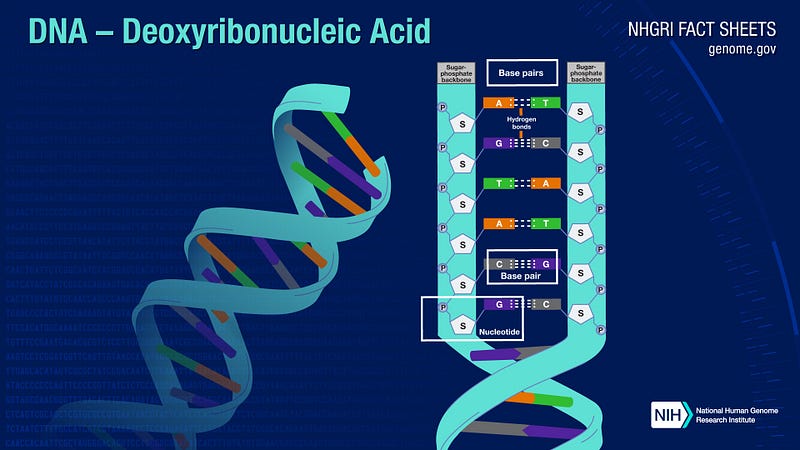
Image of the diagramed parts of a typical DNA Double Helix, Courtesy of the National Human Genome Research Institute — used with permission

For the sake of accuracy, I will again borrow the listed parts of DNA as provided by The National Human Genome Research Institute. I will also include a graph of the structure that appears on their website and which the Institute was gracious enough to allow me to use in this series to promote academic awareness of the subject; so, I sincerely thank Sarah A. Bates, M.S., M.A., Chief of the Institute’s Office of Communications, for permitting me to use it within these essays.

For those of you who wish to delve even deeper into this part of the fundamental understanding of DNA, its components, and its functionality, I sincerely suggest a deep dive into the base of knowledge provided on the Institute’s website which I have linked for you above. Their site is a virtual treasure trove of information on DNA. That being said, I must caution that if you are even half as fascinated with this subject as I am, you can truly lose hours, even days, absorbing information from their site.

Now that you’ve been duly warned, I think it’s safe to proceed.

Lastly, to close out our first part of this series, we will look at how DNA functions, and I will once again lean on the Institute’s expertise in defining and explaining all of the relevant aspects in a way I would never be able to compete with.

To paraphrase the Institute’s explanation, DNA holds the necessary instructions for the development, survival, and reproduction of an organism. To execute these instructions, DNA sequences must undergo the process of being converted into messages that are capable of producing proteins — proteins are the intricate molecules that carry out essential functions in our bodies.

Each DNA sequence that encodes instructions for protein synthesis (the fancy word for when a protein follows its encoded instructions and does what it is supposed to do) is referred to as a gene. The size of each gene varies widely, ranging from approximately 1,000 bases in some things to over 1 million bases in humans.

Despite their diversity, genes constitute only about 1% of our entire DNA sequence. The remaining 99% of our DNA sequences play a role in regulating the timing, manner, and quantity of the body’s protein production.

The process of using DNA sequences to generate proteins involves a two-step mechanism. Initially, enzymes read the information within a DNA molecule and transcribe it into an intermediary molecule known as messenger ribonucleic acid or mRNA. It was research using these messenger RNA strands that led to the earliest vaccinations for COVID-19, some of which are still used today.

As the next part of the process, the information contained in mRNA molecules is then translated into the “language” of amino acids. Amino acids are the fundamental building blocks of all proteins.

This linguistic code guides the protein synthesis machinery within the cell to precisely arrange the amino acids in a specific order which then results in the production of a very specific protein.

Given that there are 20 types of amino acids, they can be arranged in numerous orders, allowing for the creation of a pretty diverse array of proteins which only adds to the statistical uniqueness of every protein they ultimately create.

I hope you enjoyed the first part of this series and that you will actively seek the remaining parts as they drop. In the meantime, if you have any questions that I did not adequately address, please feel free to ask them in the comments below so that others who read the series can benefit from your attention to detail and my oversights.

Be sure to keep on the lookout for the next parts of this fascinating series. In the meantime, if you have an unquenchable taste for true crime, you should also check out Kurt’s two true crime podcasts — The Veritas 7, and Veritas True Crime which also has a sister publication here on Medium under the same name. The Veritas True Crime Medium Publication is always looking for new writers to write about true crime. Do you have what it takes?

Some other fascinating articles by Kurt Dillon that you might enjoy:

Kurt Dillon is a Medium Top Writer in Psychology, Social Media, and True Crime. He is the CEO of WOMEN — Wild Orchid Media & Entertainment Network, Inc., and is also a long-standing editor for the ILLUMINATION family of Medium publications. Kurt and his wife Crystal rescue abandoned animals and currently lavish love upon 5 abandoned and abused dogs and 6 abandoned cats at the time of this writing. Kurt’s social links and personal/professional websites are all available in his Medium bio.

Genetics
Dna Sequencing
Familial Dna
Genealogical Dna
True Crime
Recommended from ReadMedium