
Unbeatable Chess-Playing Robot Fooled the World for 65 years — An Untold History
The 1700s robot mysteriously defeated Napoleon & Ben Franklin.
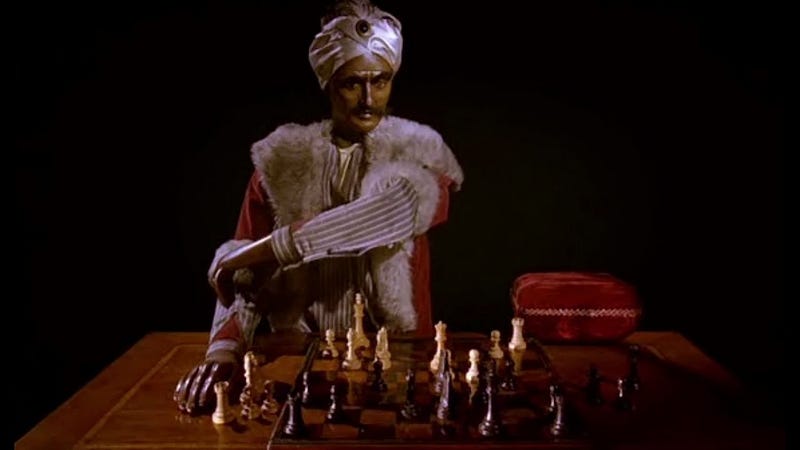
New York welcomed one of the most famous chess masters. Several articles had glorified the winnings of unbeaten robot players. Ready for the next challenge, the robot exhibited its supremacy at Broadway’s National Hotel.
An audience of 200 people, where hundreds of others were turned away from the doors, lauded in awe. In the same game, the robot challenged to win against anyone who dared to play against one. Interestingly, two experienced and professional chess players joined the game and were defeated with extreme ease.
It was a phenomenal response. Chess is not easy — it is an intellectually demanding game. How can a robot, programmed with specific instructions, beat professional players? Such questions flooded the minds of many. Not since the robot arrived in America, but since its creation in the late 18th century.
Where it all started from?
In 1769, Maria Theresa, the Empress of Austria-Hungary, commissioned her royal advisor named Wolfgang von Kempelen, to develop a mind-boggling invention.
Kempelen was already an investor. Thus, he took six months off from his royal duties and delved into a mystery project — creating a chess robot.
Robot’s fancy name & its mechanism
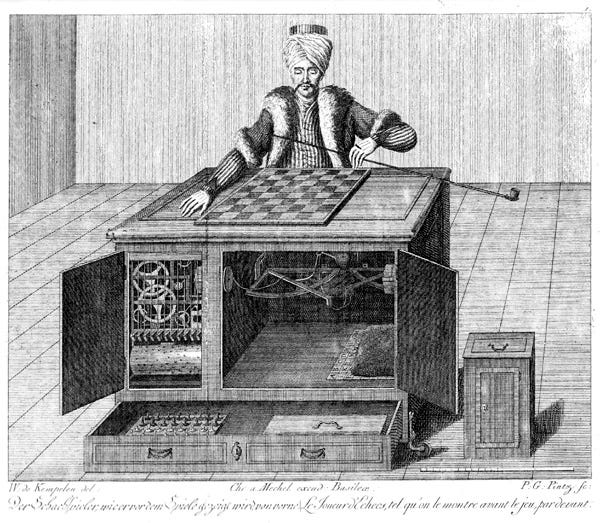
The robot was better known for “Turk.” Any particular reason for being known for Turk? Well, the dummy carried a pipe and wore a turban with a colorful robe. The dressing and costume accounted for the predicated name.
Even though the game and the robot had been passed down to different owners, the one thing remained consistent: a large wooden cabinet for holding chess and a robot seated behind.
Why a cabinet? The interior contained levels, cranks, and gears — all the Turk’s technical assemblies.
Turk’s mind-boggling first appearance
Upon the first appearance in 1770, Turk surpassed all the expectations she had from the project. Kemepelen wheeled his chess automation machine — a four-foot cabinet.
To ease the rising curiosity of the audience and other nobles, Kepelen, for several years, repeated the process of showcasing what the interior of the cabinet held — nothing more than the wirings to control the robot. Kepelen satisfied the prying eyes that nothing hid inside or directed the process by lighting the candle inside.
The game functioned like this: Kempelen would wound up a crank placed over the cabinet, instructing the robot to take an action mode. The dummy further turns the mechanical head around and reaches for the board to make the first move.
By beating any player who challenged, the Turk became a sensation: speculations and just speculations. Many failed to conclude, but random guesses were thrown here and there: a magnetism mechanism might have been deployed, or a dwarf hid inside.
Apart from catching the doubters’ eyes, the game also accumulated marvelous praises from the others across. Several observers regarded it as a technological miracle that needed to be enjoyed rather than questioned.
How Turk toured across countries & defeated legends?
After Maria Theresa died, her the Emperor Joseph II came to the throne and ordered Kempelen to take Turk for a two-year European tour in 1783.
The first stop was Paris. The robot met with players known for unparalleled intellectual but attained success. Beating Benjamin Franklin, who in Paris at that time served as an American ambassador, the robot hit another milestone of popularity.
Turk’s travel continued to Germany, the Netherlands, and England, all the while, its mission to baffle the inquiring minds didn’t halt. The men of science couldn’t explain who the Turk works.
Robots could not die, but Kempelen indeed did in 1804. Johann Maelzel, a German showman and inventor, purchased the Turk, touring with it for the rest of his life.
Maelzel poured a bit of creativity into the mystery project by installing a robotic voice box, enabling the mechanical sound of “check” at the instances when it endangered a move.
The guy turned heavy on advertisements as well, deploying a decent time and into it. In Vienna in 1809, Maelzel encountered a most significant coup — a competition between the Turk and Napoleon Bonaparte, Emperor of the French. Interestingly, it is reported, the French emperor did make some illegal moves but still lost.
Let’s close the loop where the story started from: a Turk’s visit to the United States in 1826. After conquering the heart of New Yorkers, Maelzel took the Turk to Boston and Philadelphia.
Maelzel extended the tour to the South and in Richmond, Virginia, met with an inquiring audience. One of the guys in the crowd named Edgar Allan Poe wrote an essay about the Turk and its mystery.
The young witness of the game argued that the machine had a hidden human operator. He was too confident that moves could not be programmed and its human mind fooling the large audiences for decades.
Well, even before Poe, several people had labeled Turk to be a fraud. Pamphlets, articles, and what not had been linked to debunk the mystery, but all lacked proof.
A claim could not be turned into a fact until proved, something British writers and Poe missed. They justified how a chess master fooled the world by hiding inside the cabinet and controlling everything through wriggling into the robot’s body.
65 years of mystery unknotted
Isn’t it incredible that the Turk held the secret for 65 years? The mystery began unraveling with the death of Maelzel in an ocean voyage while he sailed from Cuba to America.
Creditors took the chess automation and further sold it to John Kearsley Mitchell, a doctor interested in ascertaining the secret. But interestingly, he exhibited the automation in Philadelphia and then donated it to the Chinese Museum.
People seemed to forget the Turk who fooled queens and kings when housed in the Chinese Museum. On July 5, 1854, the secret was let out but through a tragic incident — a fire inside the museum.
Upon knowing about the fire, Silas, Dr. Mitchell’s son, ran to the sit but he was too late. For what? For rescuing an 85-year-old chess player who hid in the cabinet of the game.
Silas, through a news article, exposes the Trunk’s secret when the marvel no more existed. The automation burned, and with it died the mechanical voice of “check!”
Silar explained how the critics were right of Turk being operated by a human mind. The critics were right, but their explanations were incomplete and incomprehensible.
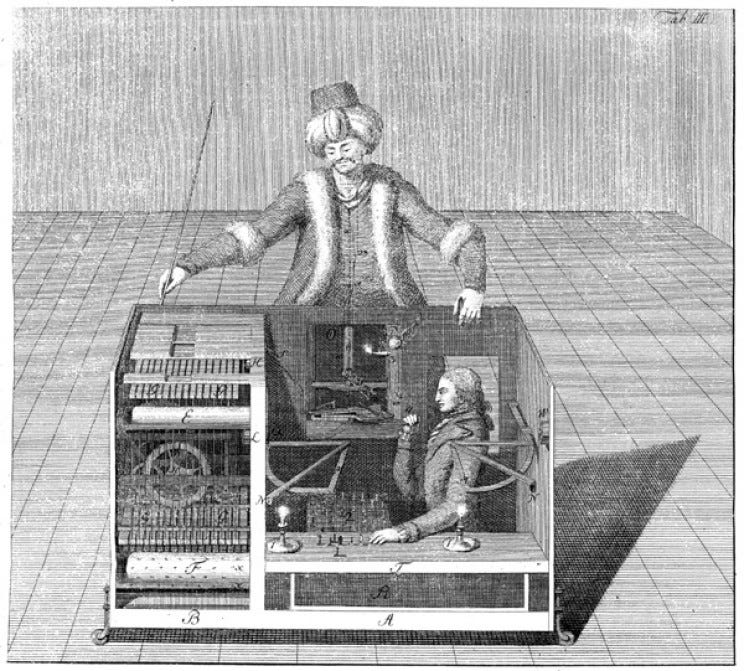
Interestingly, all the cranks within the machine never functioned. They filled only a part of the cabinet to fool the onlooker, and the rest of the space was left for a human chess master to fit and operate the game.
How were Kempelen and Mealzel able to open the cabinet door to show the interiors where no one could be seen? Through the use of mechanical sliding seats, the human chess master could drop out of sight. Moving out of the view, the chess master could place himself in the main compartment from where.
The movement of metal discs attracted to the magnets attached to the base of chess pieces would direct the game’s progress to the master human. For making the Turk move, the operator with few levers would open and close its fingers. Interestingly, all this while, the human mastermind took the aid of candles for lighting the interiors!
What was challenging to pull this whole automation game — finding a skilled person capable of beating the competitor. Both Kemepelen and Maelzel needed an expert chess player.
They enlisted many during their tours. Interestingly enough, during Maelzel’s American visit, the guy acting as his secretary was a chess master who used to conceal himself within the cabinet at showtime!
Two Cents?
There is an interesting conclusion that can be drawn. Kempelen's real genius was not inventing the chess-playing machine but noticing the world’s pattern — there is more exceptional talent available in the world than you can perceive.
Kempelen identified that masters would work for cheap and hide for weeks. Sadly, in this world, we underrate mastery and overrate the masters.
More from the author:


