
Ultra-Processed Foods: A Brain-Fart Label We Need To Let Go Off
Non-medium members can read the full text here.
Here is a little illustration of how confused we consumers are:
- 60% recognize raw eggs as unprocessed food, BUT 40% don’t
- 60% recognize energy drinks as ultra-processed, BUT 40% don’t
That means a large proportion of people think that what happens inside a hen is food processing, but what happens inside a cola factory isn’t.
No wonder there are still so many flat-earthers around.
Sarcasm aside, the numbers I quoted are from a report that the European Institute of Innovation and Technology (EIT) has just released. What it says on 72 pages could be summarized in 21 words:
Most everybody fears UPFs, hardly anybody knows what they are, and even if they did, almost nobody would stop eating them.
In the following sections, you will learn (1) that with their ignorance, those ordinary EU citizens are in really good company (scientists), (2) that equating UPFs with ill health is (mostly) unsubstantiated by research, and (3) what I, as a public health scientist, do to eradicate the term UPF from my daily menu.
So, we’ll start by settling two questions
- What are UPFs
- How unhealthy are they really
Spoiler alert: the surprising answer to both is “nobody really knows.”.
What are UPFs
In 2009, the world was in dire need of a new food labeling system. The existing Health Star Rating, Multiple Traffic Lights, Nutri-Score, Reference Intakes, and Warning Label systems didn’t confuse consumers enough.
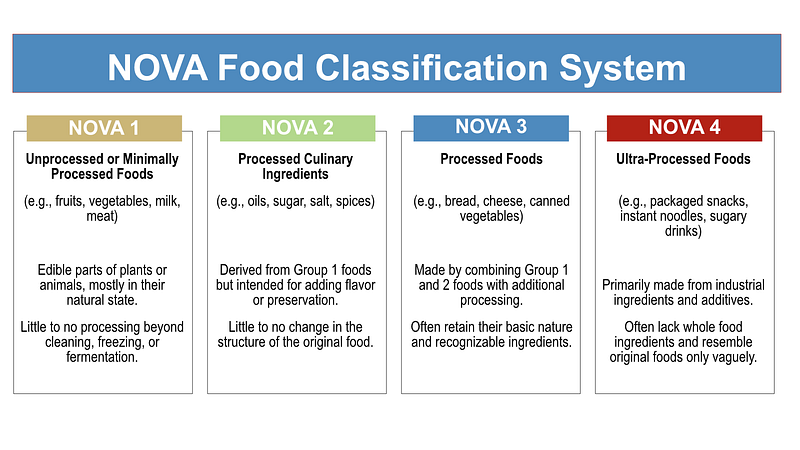
So, a Brazilian scientist, Carlos Augusto Monteiro, rose to the challenge and introduced the NOVA system. NOVA categorized foods into three groups: unprocessed, processed, and ultra-processed.
Today, the NOVA system (Figure 1) contains 4 groups, the three that I mentioned plus one for “culinary ingredients” [1].
Figure 1
When you introduce a rating system, it should be possible for independent raters to assign the same rates to the same product. That’s particularly important when epidemiologists all over the world investigate how the consumption of ultra-processed foods might affect your health. Since NOVA has become the rating system of choice for policy makers the world over, a group of French researchers wanted to know:
“ whether a large number of food and nutrition specialists arrived at consistent food assignments when applying the system’s criteria”. [2]
So, they gathered 159 evaluators to classify 120 different marketed foods (foods with a nutrient label) and 177 evaluators to classify 111 generic foods (foods without a nutrient label). Then the researchers looked at the 19,080 and 19,647 assignments of marketed and generic foods, respectively.
Just so you don’t think the researchers plucked the evaluators haphazardly from the street, they selected them from among researchers and medical doctors, all with expertise in nutrition, health, and nutritional guidance.
How confused are the experts?
Only three of the 120 marketed foods and only one of the 111 generic foods were assigned to the same NOVA group by all the evaluators, and most of the foods in both lists were placed in two, three, or even four NOVA groups.
Figure 2 (m.foods = marketed foods; g.foods = generic foods)
How to read this chart: 33% of the marketed foods were assigned to all 4 NOVA classes.
The researchers also looked at disparities between NOVA and the EU’s favorite Nutri-Score (I have written about that score’s inconsistencies in another post).
Nutri-Score class 1 is home to the presumably healthiest foods. However 26% (one in four) of ultra-processed marketed foods (as per NOVA) reside in the Nutri-Score’s saintliest class.
Figure 3 illustrates these disparities for the generic foods.
If the ratings of close to 200 experts neither agree with each other nor with another nutrient score, how, for crying out loud, can we blame the lay consumers for blithely putting things on their plates that may harm them?
Which brings us to the next question.
Is ultra-processed food as unhealthy as everybody seems to think?
That’s the question that a German team of researchers answered barely 2 weeks ago [3]. They conducted an umbrella review:
“ to systematically summarize and evaluate the current evidence on ultra-processed food consumption and any health-related outcomes”
For the uninitiated, an umbrella review is a review of reviews. Reviews collate the results of many trials that independent research groups conducted to answer the same or similar questions.
The idea is to get a more solid understanding of the balance between the benefits and harms of interventions. After all, individual trials often lead to conflicting results and conclusions. That’s what makes summary reviews so attractive.
So, my first step was to check the quality of the reviews that made it under the umbrella. As for almost anything in medicine, there exist guidelines on how to conduct such a review [4] and how to judge the quality of their component reviews [5].
The latter guideline’s AMSTAR 16-item quality scoring grades reviews as having a “high,” “moderate,” “low,” or “critically low” value. Of the 16 reviews that made it under the umbrella review, 10 (63%) had the lowest grade (critically low), and the remaining six scored “low”. None of the reviews were of moderate or high grade.
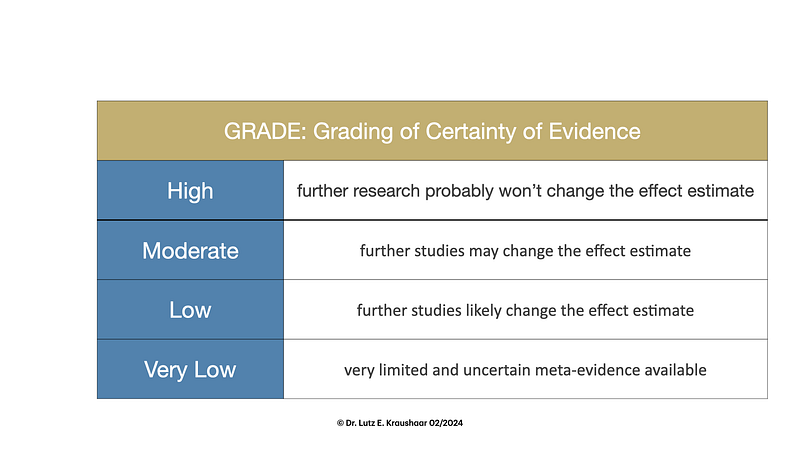
Aside from the quality of the reviews, there is the question of the certainty of the evidence (CoE). In other words, how much belief can we place in the results that the studies or reviews present us? As you probably have guessed, there are also guidelines for grading the evidence [6]. Appropriately named the GRADE system, the researchers applied it to the selected reviews.
The following figure illustrates the grading system:
Here are the results:
Of the 30 health conditions and diseases that the researchers looked at, only the following showed some significant correlation with UPF intake:
- Colon cancer: low CoE
- Low HDL: low CoE
- Hypertriglyceridemia: low CoE
- Overweight/obesity: very low CoE
- Crohns disease: low CoE
- Depression: low CoE
- Anxiety: very low CoE
- All-cause and CVD mortality: moderate CoE (with 2% risk increase)
- type 2 diabetes: moderate CoE
In Summary
So, what use is this UPF label good for? Certainly not to inform consumers. They are confused enough already by all the health gurus and studies that shout their contradictory recommendations through the media.
Here is what I do.
I unreservedly acknowledge that highly processed food is everywhere around us. No matter how you slice it, a Mars bar, a Big Mac, or a brownie, are not exactly health food.
But they don’t make you sick either — if you don’t let them.
Because they are only one half of the equation for health. The other half is exercise (and whatever other aspects of your lifestyle affect your health).
I have elaborated in another post (actually a series of three) on whether and how we can out-exercise a poor diet. My wife and I certainly do that.
There is one more thing that we do: we watch what we eat from Mondays through Fridays, and only on weekends do we “let our hair down”, so to speak.
I’m sure that on those two days we have some UPFs on our menu, probably some during the weekdays too.
But I wouldn’t forego my Bavarian beer, pretzel, and pork knuckle lunch this Saturday, even if all the experts recognized it as a UPF.
The French team of researchers agrees with me [2]:
“While the concept of ultra-processed foods has certainly entered the consumer consciousness, our results indicate that NOVA criteria do not currently allow foods to be unequivocally defined as ultra-processed.”
Bon Appetit!
Cited References
[1] Monteiro CA, Cannon G, Levy RB, Moubarac JC, Louzada MLC, Rauber F, et al. Ultra-processed foods: What they are and how to identify them. Public Health Nutr 2019;22:936–41. doi:10.1017/S1368980018003762.
[2] Braesco V, Souchon I, Sauvant P, Haurogné T, Maillot M, Féart C, et al. Ultra-processed foods: how functional is the NOVA system? Eur J Clin Nutr 2022;76:1245–53. doi:10.1038/s41430–022–01099–1.
[3] Barbaresko J, Bröder J, Conrad J, Szczerba E, Lang A, Schlesinger S. Ultra-processed food consumption and human health: an umbrella review of systematic reviews with meta-analyses. Crit Rev Food Sci Nutr 2024:1–9. doi:10.1080/10408398.2024.2317877.
[4] Møller MH, Ioannidis JPA, Darmon M. Are systematic reviews and meta-analyses still useful research? We are not sure. Intensive Care Med 2018;44:518–20. doi:10.1007/s00134–017–5039-y.
[5] Shea BJ, Reeves BC, Wells G, Thuku M, Hamel C, Moran J, et al. AMSTAR 2: A critical appraisal tool for systematic reviews that include randomised or non-randomised studies of healthcare interventions, or both. BMJ 2017;358:1–9. doi:10.1136/bmj.j4008.
[6] Schünemann HJ, Cuello C, Akl EA, Mustafa RA, Meerpohl JJ, Thayer K, et al. GRADE guidelines: 18. How ROBINS-I and other tools to assess risk of bias in nonrandomized studies should be used to rate the certainty of a body of evidence. J Clin Epidemiol 2019;111:105–14. doi:10.1016/j.jclinepi.2018.01.012.


