
The Amazing Benefits of Whole Milk
But Why Do Food Guidelines Demonize It?
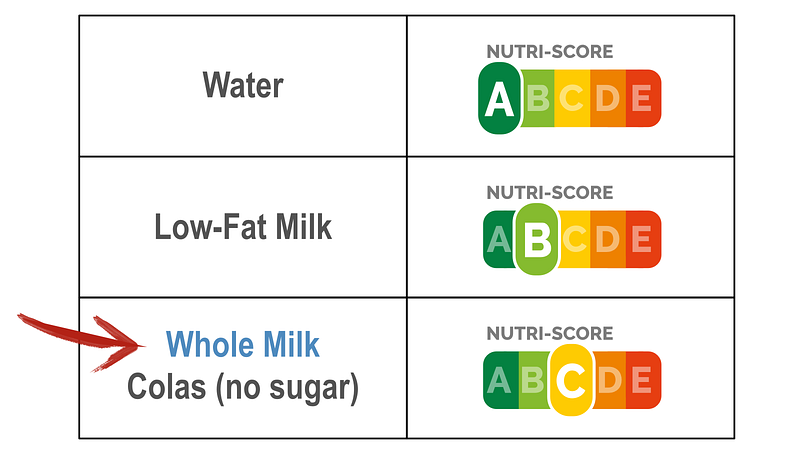
If you trust front-of-pack nutrition labeling (FOPNL), you’ll find that low-fat, or skim, milk outranks whole milk. The A-B-C-D-E Nutri-Score, for example, grades low-fat milk grade B, but whole milk a less healthy C. The difference in fat content is what makes the score’s traffic-lights index jump from green to yellow (btw, water is the only drink, making the dark-green grade “A”).
The Nutri-Score Absurdity
The Nutri-Score label is a graphic scale composed of 5 classes (expressed by a color and a letter) from dark green “A” (higher nutritional quality) to dark orange “E” (lower nutritional quality). It drumbeats its chest: “Nutri-Score: Europe’s best chance for a consumer-friendly front-of-pack nutritional label”.
Absurdly, consumer friendliness means grading white wheat flour, which is devoid of nutrients, as class A and downgrading nutrient-loaded whole milk from class B to class C (effective this year).
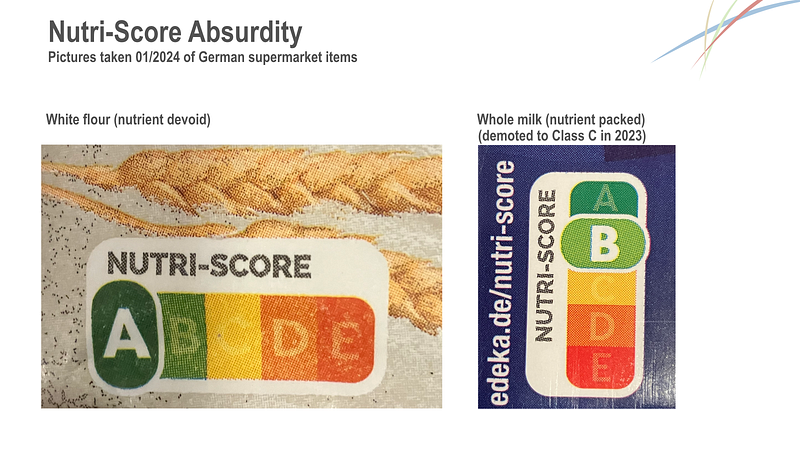
Not knowing any better, you are forgiven for choosing the low-fat variant. However, with respect to health, we have firm evidence that the tunnel vision on fat in milk may actually harm your health.
Looking back: How fat became bad
The fat-is-bad mantra entered the world of nutrition guidelines in the late 1970s. It was rooted in the reductionist way of investigating individual nutrients in foods.
What scientists learned about the biological responses to those nutrients drove their judgments on the whole foods that contain them. Saturated fat intake correlated so well with heart disease that full-fat milk was deemed guilty by association.
The 1970s were still early days for nutrition scientists. They would have wholeheartedly endorsed Nutri-Score’s 2022 demotion of whole milk compared to low-fat milk.
Now, I want you to know that science has discovered a meteor that is about to smash into the world of diet dinosaurs (hopefully eradicating their ideas). It is called the (food) matrix, and you are totally forgiven if you haven’t heard of it.
The Food Matrix
Every natural food is a complex mixture of nutrients that sit in a microstructure called the food matrix. Whether it's peanuts, pumpkin, or pork, their microstructure has a large influence on the bio-accessibility of nutrients (the fraction released during digestion) and their bioavailability (the fraction being absorbed) [1].
Moreover, nutrients interact with each other, their food matrix, and other food components. That makes for a very complex system of interactions. Research on the health effects of individual nutrients disregards this complexity.
So, “the whole being more than the sum of its parts” is much more than a cute colloquialism. It’s an essential discovery in the science of complex systems. And it is entirely lost on the creators of FOPNL, who tell you that whole milk is worse than its fat-depleted variant.
Here is what this matrix looks like in milk:
As you have probably noticed, fat and water don’t mix very well. Yet milk, which is more than 80% water, is a liquid that keeps its fats evenly “dissolved” as an oil-in-water emulsion.
Figure 1
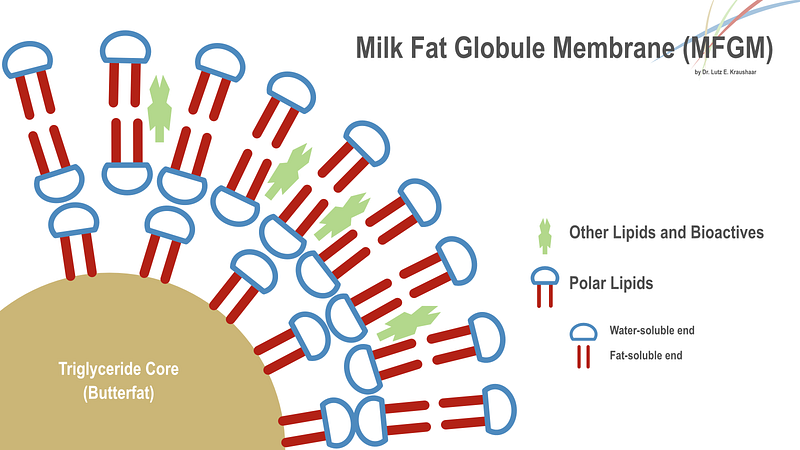
To achieve that, milk fats are enveloped in tiny droplets called globules. These globules have a surrounding membrane that makes them water-soluble on the outside and fat-soluble on the inside.
Within its membrane of polar lipids (water-soluble on one end and fat-soluble on the other), the MFGMN holds the milk’s fats and all its other constituents, from proteins to carbs to vitamins and all other bioactive micronutrients. That’s why the food matrix of milk is called the Milk Fat Globule Membrane (MFGM).
Research over the past few years has uncovered distinct health benefits of MFGM.
The consumption of MFGM vs. control [2] [3]:
- inhibits fat absorption from the gut (which is good for your waistline)
- reduces risk for cardiovascular disease
- improves muscle strength and size in frail old adults
- improves infant growth and cognitive development
While there is still a lot of research work to be done, scientists are convinced that MFGM holds promise as a valuable nutraceutical [4]:
“ the dairy matrix has specific beneficial effects on health because the metabolic effects of whole dairy on body weight, cardiometabolic disease risk, and bone health differ from those of single dairy constituents”
In fact, if you replace milk fats with non-milk unsaturated fats (as nutrition guidelines implore you to do), you’ll very likely reduce your intake of key nutrients as well [5].
But how about cholesterol?
After all, fat-loaded diets carry the stigma of pushing your blood cholesterol levels up.
An interesting study answered this question [6]. For 8 weeks, 57 overweight men and women consumed 40 grams of milk fat daily. Half the participants received their milk fat from whipping cream, the others from butter.
The difference between the two is that whipping cream is loaded with MFGM, whereas butter is essentially MFGM-free. I’ll get to the reason for this in a moment.
As expected, butter consumption significantly increased blood cholesterol. But whipping cream did not.
And compared to butter, whipping cream favorably affected the expression of 19 genes.
What this experiment shows is that the same fats can have opposite health effects depending on their delivery vehicle.
“The same fats can have opposite health effects depending on their delivery vehicle.”
That’s where front-of-package nutrient labels, like the Nutri-Score, fail you miserably.
I promised to explain why whipping cream and butter are so different in their MFGM content.
Whipping cream is the creamy layer of intact fat globules that forms on the surface of raw milk when it is left to stand. Butter, on the other hand, is the product of churning milk to separate the globules’ fatty content from their membranes.
That’s why MFGM is concentrated in whipping cream but absent in butter. On the other hand, the byproduct of butter—buttermilk — is loaded with it.
What food-based dietary guidelines also hide from you is that the commercial processing of milk into low-fat and fat-free dairy foods removes most of the MFGM.
That’s a pity because…
milk contains roughly 400 different fatty acids, making it the most complex of all dietary fats [8].
So, let’s have a look at what you’ll be missing out on when you follow the low-fat evangelists.
The branched-chain fatty acids (BCFAs)—saintly sisters of saturated fats
Fatty acids are chains of carbon atoms, with hydrogen and oxygen atoms in specific configurations and locations arranged around these chains. Depending on those configurations, the chains are either straight (in saturated fatty acids) or kinked (in unsaturated fatty acids). These make up 99% of the fats in your diet.
Then there are the branched-chain fatty acids, which you will mostly encounter in, you guessed it, milk. But also in beef and mutton because it’s the bacteria in these ruminants’ digestive tracts that produce BCFA [9].
Research about the health effects of BFCAs in humans is still in its infancy. What we do know is that in humans, BCFAs improve insulin sensitivity and reduce systemic inflammation, a precursor condition for cardiovascular disease [10].
Another special kind of fatty acid: the milk polar lipids (MPLs)
Polar lipids are fat molecules (much like the fatty acids I described earlier) that are water-soluble on one end and fat-soluble on the other (see Figure 1). That’s what makes them essential components of all biological membranes.
In overweight, post-menopausal women, a 4-week dietary intervention using full-fat cream cheese that was enriched with milk polar lipids significantly improved the women’s blood lipid profiles, thereby reducing their risk for cardiovascular disease [11].
That’s why a systematic review of the subject found:
“…superior functional benefits of milk polar lipids in several areas as compared to non-milk polar lipid sources” [12]
Summary and Conclusions
The milk food matrix is an essential nutrient with large health benefits. Taking it out of whole milk to lower its fat content reduces milk’s enormous nutritional value. Yet, current food-based dietary guidelines (FBDG) and FOPNLs coax consumers to forego whole milk in favor of its nutrient-depleted fat-reduced alternatives.
A global review of 100 food-based dietary guidelines concluded:
“…most of dairy’s contributions to healthy and sustainable dietary patterns are not captured in current FBDGs….” [13].
Another review recommends we
“look beyond the Nutrition Facts label and be inclusive of the current science demonstrating the powerful connection among nutrients, the food matrix, and health” [14].
Both messages have fallen on deaf ears of the creators of Nutri-Score and of any other FOPNL.
So, the next time a front-of-pack-nutrition label discourages you from choosing the full-fat version of your dairy, keep in mind that
“… milk consumption does more good than harm for human health” [15].
I know that this message is anathema to the evangelists of “sustainable diets”. And I hope that their considerations will never worm themselves into scores and labels that are supposed to help consumers prioritize their health.
The labels’ credibility will only be tarnished further if their creators’ tardiness to incorporate scientific discoveries is compounded by climate or animal welfare indoctrination.
To illustrate the ineffectiveness of the low-fat diet movement, compare the rise in obesity prevalence with the rise in low-fat milk consumption from the 1960s to today.
The 9-fold increase in proportional consumption of low-fat milk from 1960 to 2010( see figure below) runs parallel to a tripling of obese adults (BMIs north of 30) in the US from 13% then to more than 42% today.
I am not suggesting that the increased consumption of low-fat milk has caused the rise in obesity. But it certainly didn’t prevent it.
Did it at least slow down the rise in obesity?
I don’t think so. With over 40% of US adults being obese [16], how much fatter can a nation get?
On a personal note: Do I do as I preach?
I consume more than 300 liters of whole milk per year. That has been the case for the past ten years. My “good” cholesterol (HDL) is higher than my “bad” cholesterol (LDL).
My blood triglycerides are in very healthy double-digit territory. I take no medications at all.
At age 67, that’s definitely not only due to drinking so much milk. But it certainly hasn’t done any harm.
Thank you for reading my story.
References
[1] Aguilera JM. The food matrix: implications in processing, nutrition, and health. Crit Rev Food Sci Nutr 2019;59:3612–29. doi:10.1080/10408398.2018.1502743.
[2] Raza GS, Herzig KH, Leppäluoto J. Invited review: Milk fat globule membrane — A possible panacea for neurodevelopment, infections, cardiometabolic diseases, and frailty. J Dairy Sci 2021;104:7345–63. doi:10.3168/jds.2020–19649.
[3] Torres-Gonzalez M, Rice Bradley BH. Whole-Milk Dairy Foods: Biological Mechanisms Underlying Beneficial Effects on Risk Markers for Cardiometabolic Health. Adv Nutr 2023;14:1523–37. doi:10.1016/j.advnut.2023.09.001.
[4] Thorning T K, Bertram HC, Bonjour JP, De Groot L, Dupont D, Feeney E, et al. Whole dairy matrix or single nutrients in assessment of health effects: Current evidence and knowledge gaps. Am J Clin Nutr 2017;105:1033–45. doi:10.3945/ajcn.116.151548.
[5] Rehm CD, Drewnowski A. Replacing Dairy Fat With Polyunsaturated and Monounsaturated Fatty Acids: A Food-Level Modeling Study of Dietary Nutrient Density and Diet Quality Using the 2013–16 National Health and Nutrition Examination Survey. Front Nutr 2019;6. doi:10.3389/fnut.2019.00113.
[6] Rosqvist F, Smedman A, Lindmark-Mansson H, Paulsson M, Petrus P, Straniero S, et al. Potential role of milk fat globule membrane in modulating plasma lipoproteins, gene expression, and cholesterol metabolism in humans: A randomized study. Am J Clin Nutr 2015;102:20–30. doi:10.3945/ajcn.115.107045.
[7] Weaver CM. Dairy matrix: Is the whole greater than the sum of the parts? Nutr Rev 2021;79:4–15. doi:10.1093/nutrit/nuab081.
[8] Lindmark Månsson H. Fatty acids in bovine milk fat. Food Nutr Res 2008;52:1–3. doi:10.3402/fnr.v52i0.1821.
[9] Starr DA. Branched Chain Fatty Acid (BCFA) Content of Foods and Estimated Intake in the United States. Physiol Behav 2011;176:139–48. doi:10.1017/S0007114514001081.Branched.
[10] Yehia NA, Lai KZH, Semnani-Azad Z, Blanco Mejia S, Bazinet RP, Beaudry JL, et al. Association of branched-chain fatty acids with cardiometabolic disorders in humans: A systematic review. Nutr Rev 2023;81:180–90. doi:10.1093/nutrit/nuac051.
[11] Vors C, Joumard-Cubizolles L, Lecomte M, Combe E, Ouchchane L, Drai J, et al. Milk polar lipids reduce lipid cardiovascular risk factors in overweight postmenopausal women: Towards a gut sphingomyelin-cholesterol interplay. Gut 2020;69:487–501. doi:10.1136/gutjnl-2018–318155.
[12] Venkat M, Chia LW, Lambers TT. Milk polar lipids composition and functionality: a systematic review. Crit Rev Food Sci Nutr 2024;64:31–75. doi:10.1080/10408398.2022.2104211.
[13] Comerford KB, Miller GD, Boileau AC, Masiello Schuette SN, Giddens JC, Brown KA. Global Review of Dairy Recommendations in Food-Based Dietary Guidelines. Front Nutr 2021;8. doi:10.3389/fnut.2021.671999.
[14] Unger AL, Astrup A, Feeney EL, Holscher HD, Gerstein DE, Torres-Gonzalez M, et al. Harnessing the Magic of the Dairy Matrix for Next-Level Health Solutions: A Summary of a Symposium Presented at Nutrition 2022. Curr Dev Nutr 2023;7:100105. doi:10.1016/j.cdnut.2023.100105.
[15] Zhang X, Chen X, Xu Y, Yang J, Du L, Li K, et al. Milk consumption and multiple health outcomes: umbrella review of systematic reviews and meta-analyses in humans. Nutr Metab 2021;18:7. doi:10.1186/s12986–020–00527-y.
[16] Ogden CL, Fryar CD, Martin CB, Freedman DS, Carroll MD, Gu Q, et al. Trends in obesity prevalence by race and hispanic origin — 1999–2000 to 2017–2018. JAMA — J Am Med Assoc 2020;324:1208–10. doi:10.1001/jama.2020.14590


